

2 piastres – Lebanon
Add to wishlist
Lebanon
Context
Year: 1924
Issuer: Lebanon
Period:
(1920—1926)
Currency:
(1920—1939)
Demonetized: Yes
Total mintage: 1,800,000
Material
Diameter: 18.2 mm
Weight: 2 g
Thickness: 1.12 mm
Shape: Round
Composition: Aluminium bronze
Magnetic: No
Technique: Milled
Alignment: Coin alignment
flip
References
KM: #
Numista: #5826
Obverse
Description:
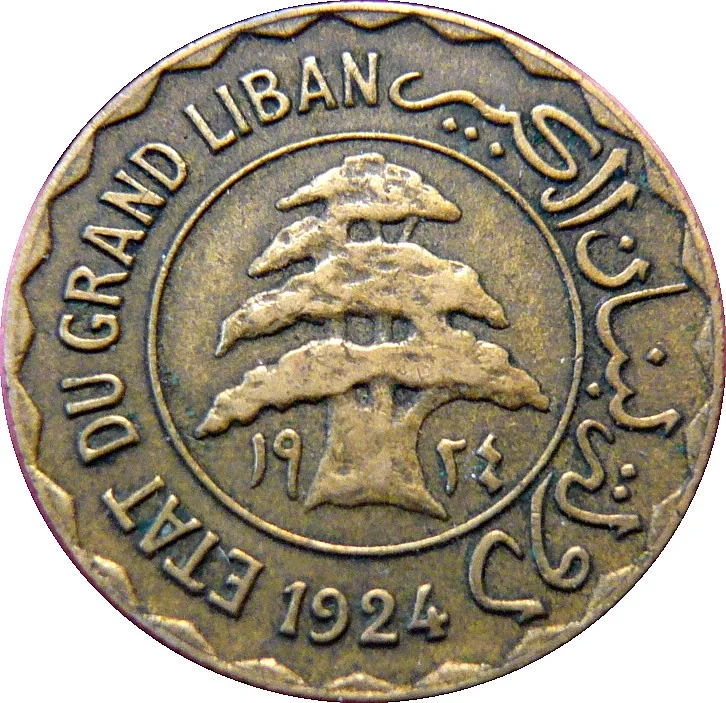
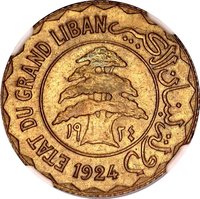
A cedar tree, Lebanon's symbol, encircled above the date.
Inscription:
ETAT DU GRAND LIBAN دولة لبنان الكبير
٢٤ ١٩
1924
٢٤ ١٩
1924
Translation:
State of Greater Lebanon
24 19
1924
24 19
1924
Engraver: Henri-Auguste Patey
Reverse
Description:
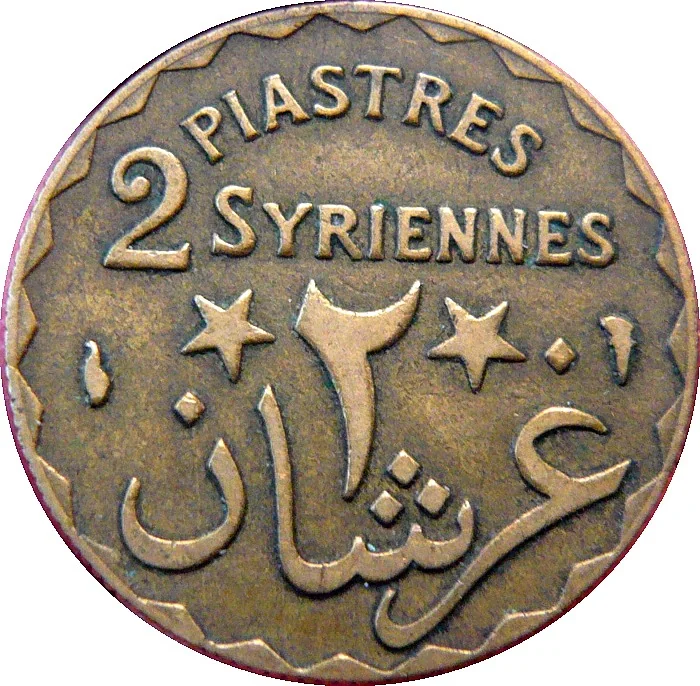
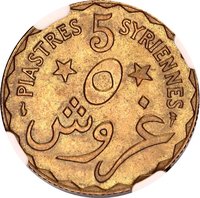
*Star-flanked value.*
Inscription:
2 PIASTRES
SYRIENNES
٢
غرشان
SYRIENNES
٢
غرشان
Translation:
2 Piastres
Syrian
2
Qirsh
Syrian
2
Qirsh
Engraver: Henri-Auguste Patey
Edge
Milled
Mints
| Name | Mark |
|---|---|
| Monnaie de Paris | — |
Mintings
| Year | Mint Mark | Mintage | Quality | Collection |
|---|---|---|---|---|
| 1924 | — | 1,800,000 |
Historical background
In 1924, Lebanon's currency situation was defined by its position within the French Mandate for Syria and Lebanon, established by the League of Nations after World War I. The Ottoman lira, the former currency, had been replaced. The official legal tender was the Syrian pound (also known as the livre syrienne), issued by the French-controlled Banque de Syrie, which held a monopoly on note issuance. This currency was effectively pegged to the French franc at a fixed rate, firmly anchoring Lebanon's monetary system to that of France and integrating it into the Franc Zone.
This arrangement provided a degree of monetary stability and facilitated trade with France, but it was fundamentally an instrument of colonial economic policy. The currency board system meant that note issuance was directly backed by French franc reserves, limiting local economic autonomy. While it ended the hyperinflation of the later Ottoman period, the system primarily served French commercial and strategic interests, ensuring that Lebanon's financial flows were oriented toward Paris.
Consequently, the monetary landscape of 1924 was one of imposed order rather than national sovereignty. The Syrian pound circulated in both Syria and Lebanon, with the territories not yet possessing distinct national currencies. This framework laid the technical and administrative groundwork for the future Lebanese pound, but at the time, it reflected Lebanon's status as a mandated territory under tight French fiscal and monetary control, with its economy deliberately linked to the metropolis.
This arrangement provided a degree of monetary stability and facilitated trade with France, but it was fundamentally an instrument of colonial economic policy. The currency board system meant that note issuance was directly backed by French franc reserves, limiting local economic autonomy. While it ended the hyperinflation of the later Ottoman period, the system primarily served French commercial and strategic interests, ensuring that Lebanon's financial flows were oriented toward Paris.
Consequently, the monetary landscape of 1924 was one of imposed order rather than national sovereignty. The Syrian pound circulated in both Syria and Lebanon, with the territories not yet possessing distinct national currencies. This framework laid the technical and administrative groundwork for the future Lebanese pound, but at the time, it reflected Lebanon's status as a mandated territory under tight French fiscal and monetary control, with its economy deliberately linked to the metropolis.
🌱 Common