

20 Drachmai – Greece
Greece

Obverse
Description:
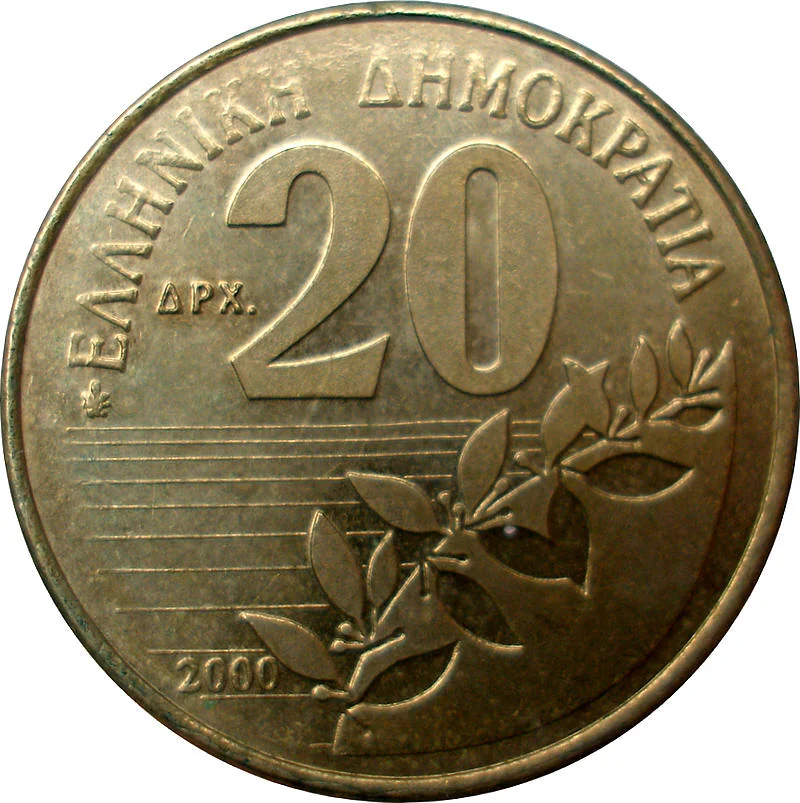
Value with olive branch, date, and country.
Inscription:
ΕΛΛΗΝΙΚΗ ΔΗΜΟΚΡΑΤΙΑ
ΔΡΧ. 20
2000
ΔΡΧ. 20
2000
Translation:
HELLENIC REPUBLIC
DRCH. 20
2000
DRCH. 20
2000
Script: Greek
Language: Greek
Designer: Konstantinos Kazakos
Reverse
Description:
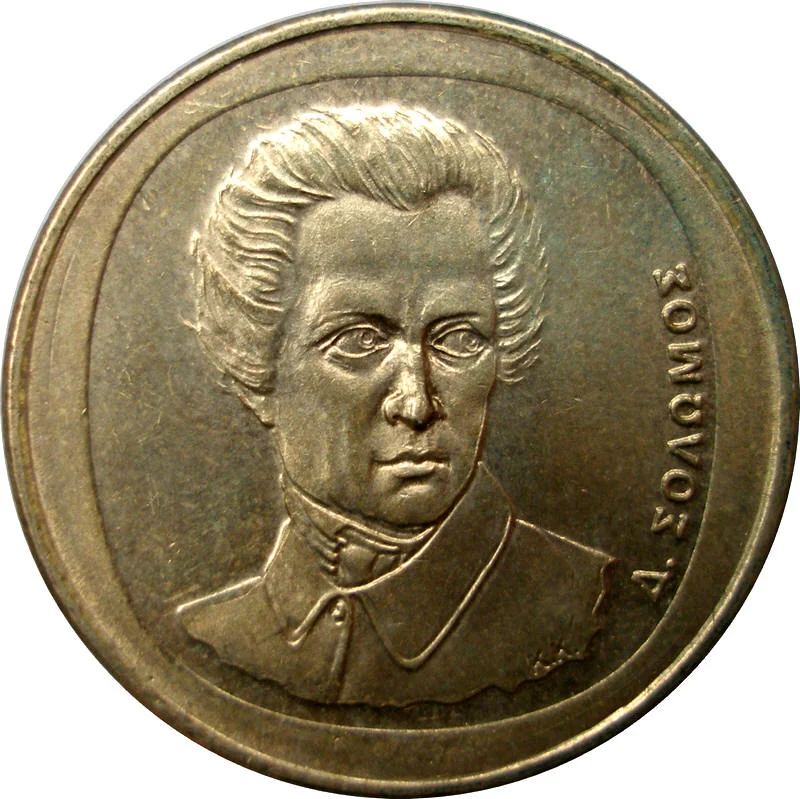
Bust of Dionysios Solomos facing forward, engraver's initials at base.
Inscription:
Δ. ΣΟΛΩΜΟΣ
Κ.Κ.
Κ.Κ.
Translation:
D. Solomon
K.K.
K.K.
Script: Greek
Language: Greek
Designer: Konstantinos Kazakos
Edge
Reeded
Mints
| Name | Mark |
|---|---|
| National Mint of the Bank of Greece | — |
Mintings
| Year | Mint Mark | Mintage | Quality | Collection |
|---|---|---|---|---|
| 1990 | — | — | ||
| 1992 | — | 18,645,000 | ||
| 1993 | — | — | In sets | |
| 1993 | — | — | Proof | |
| 1994 | — | 27,640,000 | ||
| 1998 | — | 26,419,000 | ||
| 2000 | — | 17,048,000 |
Historical background
In 1990, Greece's currency situation was defined by its participation in the European Monetary System (EMS) and the ongoing struggle to control high inflation and fiscal deficits. The national currency, the drachma, was part of the EMS Exchange Rate Mechanism (ERM), but under a special "wide band" of fluctuation (±15% instead of the narrower ±2.25%). This reflected the drachma's relative weakness and the country's economic instability compared to core European nations like Germany. The primary goal of the Bank of Greece was to maintain drachma stability within this band, using high interest rates and periodic devaluations to manage persistent inflationary pressures and a large current account deficit.
The underlying economic conditions were challenging. Greece was grappling with double-digit inflation, which averaged around 20% in the late 1980s and remained stubbornly high, eroding the drachma's purchasing power. Public finances were strained by large budget deficits and rising public debt, fueled by expansive government spending and weak tax collection. These domestic weaknesses made the drachma vulnerable to speculative pressures, as markets doubted Greece's ability to align with the stricter convergence criteria being discussed for the planned European Economic and Monetary Union (EMU).
Consequently, the currency policy of 1990 was a tightrope walk between European ambition and domestic reality. The government, led by Prime Minister Constantine Mitsotakis, embarked on a stabilization program promising fiscal austerity and structural reforms to curb inflation and prepare for eventual EMU membership. However, this path was politically and socially difficult. The drachma's managed stability within the EMS was thus not a sign of robust economic health, but a disciplined yet fragile commitment to European integration, setting the stage for the severe economic trials and drachma crises that would intensify later in the decade.
The underlying economic conditions were challenging. Greece was grappling with double-digit inflation, which averaged around 20% in the late 1980s and remained stubbornly high, eroding the drachma's purchasing power. Public finances were strained by large budget deficits and rising public debt, fueled by expansive government spending and weak tax collection. These domestic weaknesses made the drachma vulnerable to speculative pressures, as markets doubted Greece's ability to align with the stricter convergence criteria being discussed for the planned European Economic and Monetary Union (EMU).
Consequently, the currency policy of 1990 was a tightrope walk between European ambition and domestic reality. The government, led by Prime Minister Constantine Mitsotakis, embarked on a stabilization program promising fiscal austerity and structural reforms to curb inflation and prepare for eventual EMU membership. However, this path was politically and socially difficult. The drachma's managed stability within the EMS was thus not a sign of robust economic health, but a disciplined yet fragile commitment to European integration, setting the stage for the severe economic trials and drachma crises that would intensify later in the decade.
🌱 Very Common