

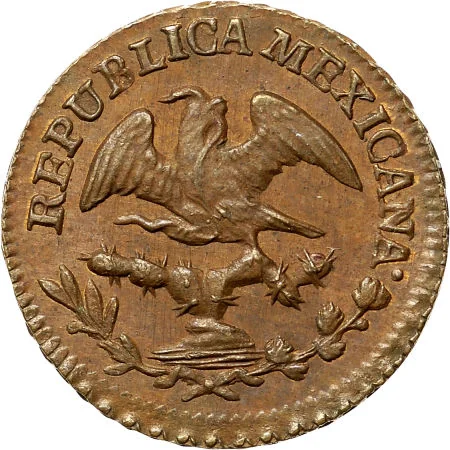
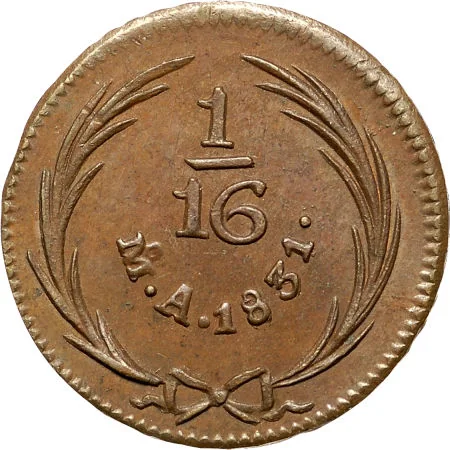
1⁄16 real – Mexico
Add to wishlist
Mexico
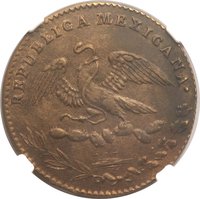
Obverse
Reverse
Description:
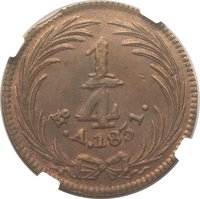
Denomination, date, and mint mark encircled by a palm wreath.
Inscription:
1/16
Mo•A•1831•
Mo•A•1831•
Script: Latin
Edge
Incuse Rectangles
Mintings
| Year | Mint Mark | Mintage | Quality | Collection |
|---|---|---|---|---|
| 1831 | Mo | — | ||
| 1832 | Mo | — | ||
| 1833 | Mo | — |
Historical background
In 1831, Mexico's currency situation was characterized by profound instability and scarcity, a direct legacy of the destructive War of Independence (1810-1821) and the subsequent political turmoil. The fledgling republic inherited a bankrupt treasury and a monetary system in disarray, where the official Spanish colonial coinage—primarily silver reales and gold escudos—remained the standard but were in critically short supply due to the collapse of mining production. To fill the void, a chaotic mix of tokens, copper coins from different regions, and foreign currencies (especially Spanish and British) circulated, leading to widespread confusion and regional variations in value.
The federal government, under President Anastasio Bustamante, struggled to assert monetary control. While the 1823 minting of the first republican coins, the copper centavo and silver peso, had been a symbolic step, production was insufficient. The most significant and problematic development was the proliferation of paper money issued not by a central bank (which did not exist), but by state governments and even private companies to pay debts and stimulate local commerce. These bills, often poorly backed and subject to counterfeiting, rapidly depreciated, eroding public trust in any form of fiduciary currency.
Consequently, the economy operated on a precarious dual system: a preference for hard silver coinage for major transactions and savings, which held intrinsic value, and a devalued paper and copper system for everyday use. This monetary fragmentation severely hampered national trade, credit, and economic development, reflecting the broader challenges of constructing a unified state. The currency chaos of 1831 was thus both a symptom and a cause of Mexico's early post-independence struggles, setting the stage for future attempts at reform that would remain elusive for decades.
The federal government, under President Anastasio Bustamante, struggled to assert monetary control. While the 1823 minting of the first republican coins, the copper centavo and silver peso, had been a symbolic step, production was insufficient. The most significant and problematic development was the proliferation of paper money issued not by a central bank (which did not exist), but by state governments and even private companies to pay debts and stimulate local commerce. These bills, often poorly backed and subject to counterfeiting, rapidly depreciated, eroding public trust in any form of fiduciary currency.
Consequently, the economy operated on a precarious dual system: a preference for hard silver coinage for major transactions and savings, which held intrinsic value, and a devalued paper and copper system for everyday use. This monetary fragmentation severely hampered national trade, credit, and economic development, reflecting the broader challenges of constructing a unified state. The currency chaos of 1831 was thus both a symptom and a cause of Mexico's early post-independence struggles, setting the stage for future attempts at reform that would remain elusive for decades.
💎 Extremely Rare