

1 Abbasi – Karabakh Khanate
Context
Years: 1806–1813
Country: Caucasia
Issuer: Karabakh Khanate
Ruler: Mahdi Quli Khan
Currency:
Demonetized: Yes
Material
Weight: 2.31 g
Silver weight: 2.31 g
Shape: Irregular round
Composition: Silver
Magnetic: No
Technique: Hammered
Alignment: Coin alignment
flip
References
KM: #Click to copy to clipboard7
Numista: #57575
Value
Bullion value: $6.57
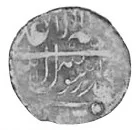
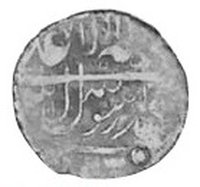
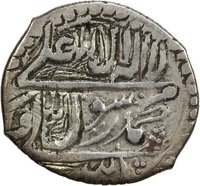
Obverse
Description:
Shiite declaration of faith
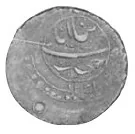
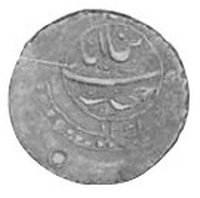
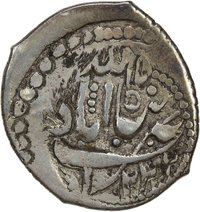
Reverse
Description:
Mint name, formula.
Edge
Mints
| Name | Mark |
|---|---|
| Panahabad | — |
Mintings
| Year | Mint Mark | Mintage | Quality | Collection |
|---|---|---|---|---|
| 1806 | — | — | ||
| 1807 | — | — | ||
| 1809 | — | — | ||
| 1811 | — | — | ||
| 1812 | — | — | ||
| 1813 | — | — |
Historical background
In 1806, the currency situation within the Karabakh Khanate was a complex reflection of its precarious political status, caught between the declining Persian and expanding Russian empires. The khanate did not mint its own coins; instead, its economy operated on a multi-currency system dominated by Persian silver abbasis and qirans, alongside a limited circulation of Russian copper dengas and silver rubles introduced through trade and military presence. The most common and trusted medium for larger transactions remained Persian silver, a legacy of Karabakh's historical ties to the Iranian sphere, while Russian currency began to gain ground, particularly in areas with stronger Russian military contacts.
This monetary duality was directly tied to the ongoing Russo-Persian War (1804-1813), during which the Khanate became a contested battleground. The Russian Empire, having established a protectorate over the region and stationed troops there following the 1805 Treaty of Kurekchay, was actively working to sever Karabakh's economic and political links to Persia. Consequently, Russian authorities encouraged the use of their currency to facilitate supply payments to local allies and to integrate the local economy into the imperial system. However, the war's instability meant that Persian coinage retained its practical and symbolic importance for much of the population.
Ultimately, the currency circulation in 1806 was in a state of flux and uncertainty, mirroring the khanate's own unresolved sovereignty. The simultaneous use of Persian and Russian money created practical challenges for trade, including exchange rate fluctuations and questions of authenticity. This unstable monetary environment underscored the transitional nature of the period, as the old Persian economic order was being actively, but not yet completely, displaced by the incoming Russian imperial administration, a process that would only be solidified after the war's conclusion in 1813 with the Treaty of Gulistan.
This monetary duality was directly tied to the ongoing Russo-Persian War (1804-1813), during which the Khanate became a contested battleground. The Russian Empire, having established a protectorate over the region and stationed troops there following the 1805 Treaty of Kurekchay, was actively working to sever Karabakh's economic and political links to Persia. Consequently, Russian authorities encouraged the use of their currency to facilitate supply payments to local allies and to integrate the local economy into the imperial system. However, the war's instability meant that Persian coinage retained its practical and symbolic importance for much of the population.
Ultimately, the currency circulation in 1806 was in a state of flux and uncertainty, mirroring the khanate's own unresolved sovereignty. The simultaneous use of Persian and Russian money created practical challenges for trade, including exchange rate fluctuations and questions of authenticity. This unstable monetary environment underscored the transitional nature of the period, as the old Persian economic order was being actively, but not yet completely, displaced by the incoming Russian imperial administration, a process that would only be solidified after the war's conclusion in 1813 with the Treaty of Gulistan.
✨ Legendary