

10 Euro – Spain
Non-circulating coins
Commemoration: European Union Council Spanish Presidency
Spain
Context

Material

References
KM: #Click to copy to clipboard1171
Numista: #57548
Value
Exchange value: 10 EUR = $11.81
Bullion value: $71.00
Inflation-adjusted value: 13.54 EUR
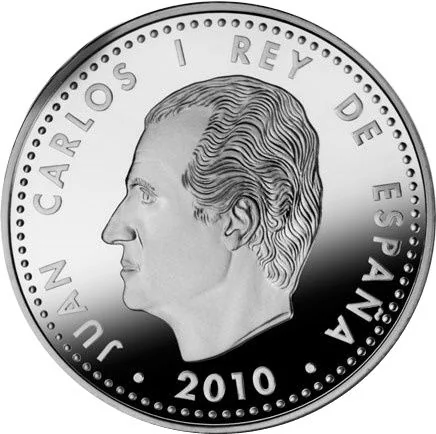
Obverse
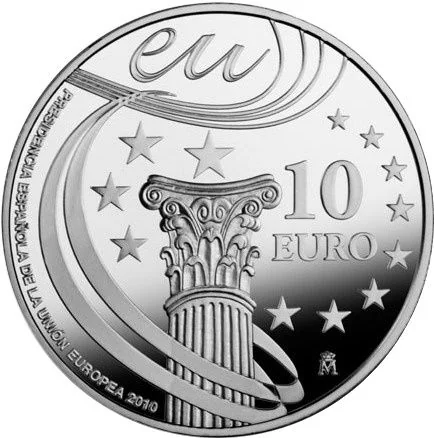
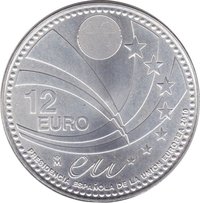
Reverse
Description:
A column with crossed lines symbolizes a flag union. Above, the lowercase "eu" logo represents the Spanish, Belgian, and Hungarian team of the Presidency.
Inscription:
eu
PRESIDENCIA ESPAÑOLA DE LA UNIÓN EUROPEA 2010
10 EURO
M
PRESIDENCIA ESPAÑOLA DE LA UNIÓN EUROPEA 2010
10 EURO
M
Translation:
Spanish Presidency of the European Union 2010
10 Euro
10 Euro
Script: Latin
Language: Spanish
Edge
Reeded
Mints
| Name | Mark |
|---|---|
| Royal Mint of Madrid | (M) |
Mintings
| Year | Mint Mark | Mintage | Quality | Collection |
|---|---|---|---|---|
| 2010 | M | 10,000 | Proof |
Historical background
In 2010, Spain was in the grip of a severe economic crisis, but its currency situation was paradoxically stable because it was a member of the Eurozone. Having adopted the euro in 1999, Spain no longer controlled its own monetary policy or currency valuation; these were managed by the European Central Bank (ECB) in Frankfurt. This meant Spain could not devalue its currency to regain competitiveness, a traditional tool for countries facing massive trade deficits and high debt. Instead, it was locked into a shared currency with stronger economies like Germany, which exacerbated its internal economic imbalances.
The core of Spain's crisis was not currency fluctuation but a burst property bubble and a resulting banking crisis, which led to a dramatic surge in public debt and unemployment. As investor confidence evaporated, the risk premium Spain paid to borrow money (measured by the spread between Spanish and German 10-year bond yields) began to climb alarmingly. This sovereign debt crisis raised fears that Spain might require an international bailout, similar to Greece and Ireland, and sparked speculative pressures within the Eurozone framework. The stability of the euro itself was called into question, as markets worried about the potential for a euro breakup or a Spanish default.
Consequently, the currency situation was defined by Spain's struggle within the euro's constraints. The government implemented harsh austerity measures and labor reforms in an attempt to reassure markets and EU partners, aiming to reduce its deficit without the tool of devaluation—a process known as "internal devaluation." The period culminated in 2012 with Spain formally requesting a European bailout, not for the sovereign state directly, but for its crippled banking sector, underscoring how the single currency had transformed a national financial crisis into a pivotal test for the entire Eurozone's architecture.
The core of Spain's crisis was not currency fluctuation but a burst property bubble and a resulting banking crisis, which led to a dramatic surge in public debt and unemployment. As investor confidence evaporated, the risk premium Spain paid to borrow money (measured by the spread between Spanish and German 10-year bond yields) began to climb alarmingly. This sovereign debt crisis raised fears that Spain might require an international bailout, similar to Greece and Ireland, and sparked speculative pressures within the Eurozone framework. The stability of the euro itself was called into question, as markets worried about the potential for a euro breakup or a Spanish default.
Consequently, the currency situation was defined by Spain's struggle within the euro's constraints. The government implemented harsh austerity measures and labor reforms in an attempt to reassure markets and EU partners, aiming to reduce its deficit without the tool of devaluation—a process known as "internal devaluation." The period culminated in 2012 with Spain formally requesting a European bailout, not for the sovereign state directly, but for its crippled banking sector, underscoring how the single currency had transformed a national financial crisis into a pivotal test for the entire Eurozone's architecture.
✨ Legendary