Logo Title
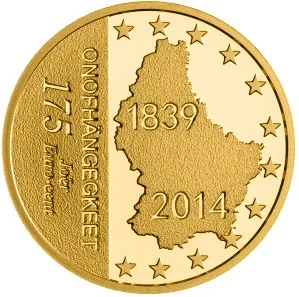
obverse
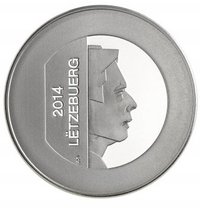
reverse
Banque centrale du Luxembourg

175 Euro Cents (Luxembourg's independence) – Grand Duchy of Luxembourg

Non-circulating coins
Commemoration: 175 Years of Independence of Luxembourg
Luxembourg
Context
Year: 2014
Country: Luxembourg Country flag
Ruler: Henry
Currency:
(since 2002)
Total mintage: 2,500
Material
Diameter: 20 mm
Weight: 6.22 g
Gold weight: 6.21 g
Thickness: 1.4 mm
Shape: Round
Composition: 99.9% Gold
Magnetic: No
Technique: Milled
References
KM: #Click to copy to clipboard132
Numista: #110774
Value
Exchange value: 1.75 EUR = $2.07
Bullion value: $1034.37
Inflation-adjusted value: 2.23 EUR

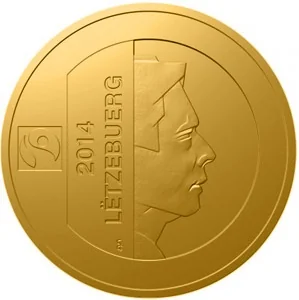
Obverse

Description:
1839–2014: 175 years of independence
Inscription:
LËTZEBUERG

2014

CG
Translation:
Luxembourg

2014
Script: Latin
Languages: French, Luxembourgish

Reverse

Description:
Luxembourg map encircled by stars.
Inscription:
1839

2014

ONOFHÄNGEGKEET

175 Joër

Euro-cent
Translation:
1839

2014

INDEPENDENCE

175 Years

Euro-cent
Script: Latin

Edge
Categories

Map

Mintings

YearMint MarkMintageQualityCollection
20142,500Proof

Historical background

In 2014, the Grand Duchy of Luxembourg was a fully integrated member of the Eurozone, having adopted the euro as its official currency upon its launch in 1999 (with banknotes and coins entering circulation in 2002). As such, the country's monetary policy was entirely determined by the European Central Bank (ECB), with Luxembourg's central bank, the Banque Centrale du Luxembourg (BCL), participating in the Eurosystem. The domestic currency situation was therefore stable and characterized by the same euro banknotes and coins used across the monetary union, with no national deviations or independent monetary levers.

The broader context, however, was shaped by the aftermath of the European sovereign debt crisis. While Luxembourg itself maintained a AAA credit rating and prudent public finances, the stability of the euro as a whole was a paramount concern. Key themes in 2014 included the ECB's moves toward unconventional monetary policy to combat low inflation and stimulate the Eurozone economy, culminating in the announcement of a large-scale quantitative easing program in early 2015. Luxembourg, as a major international financial centre, was particularly attentive to these developments and their implications for banking liquidity and cross-border capital flows.

Domestically, Luxembourg's financial sector, a cornerstone of its economy, continued to operate seamlessly within the single currency framework. The use of the euro facilitated its role as a hub for investment funds, private banking, and financial services. There were no discussions or movements toward altering the currency regime; instead, national economic policy focused on leveraging the advantages of Eurozone membership while maintaining fiscal discipline and overseeing a large, internationally exposed banking sector within the evolving European regulatory landscape post-crisis.
Legendary