

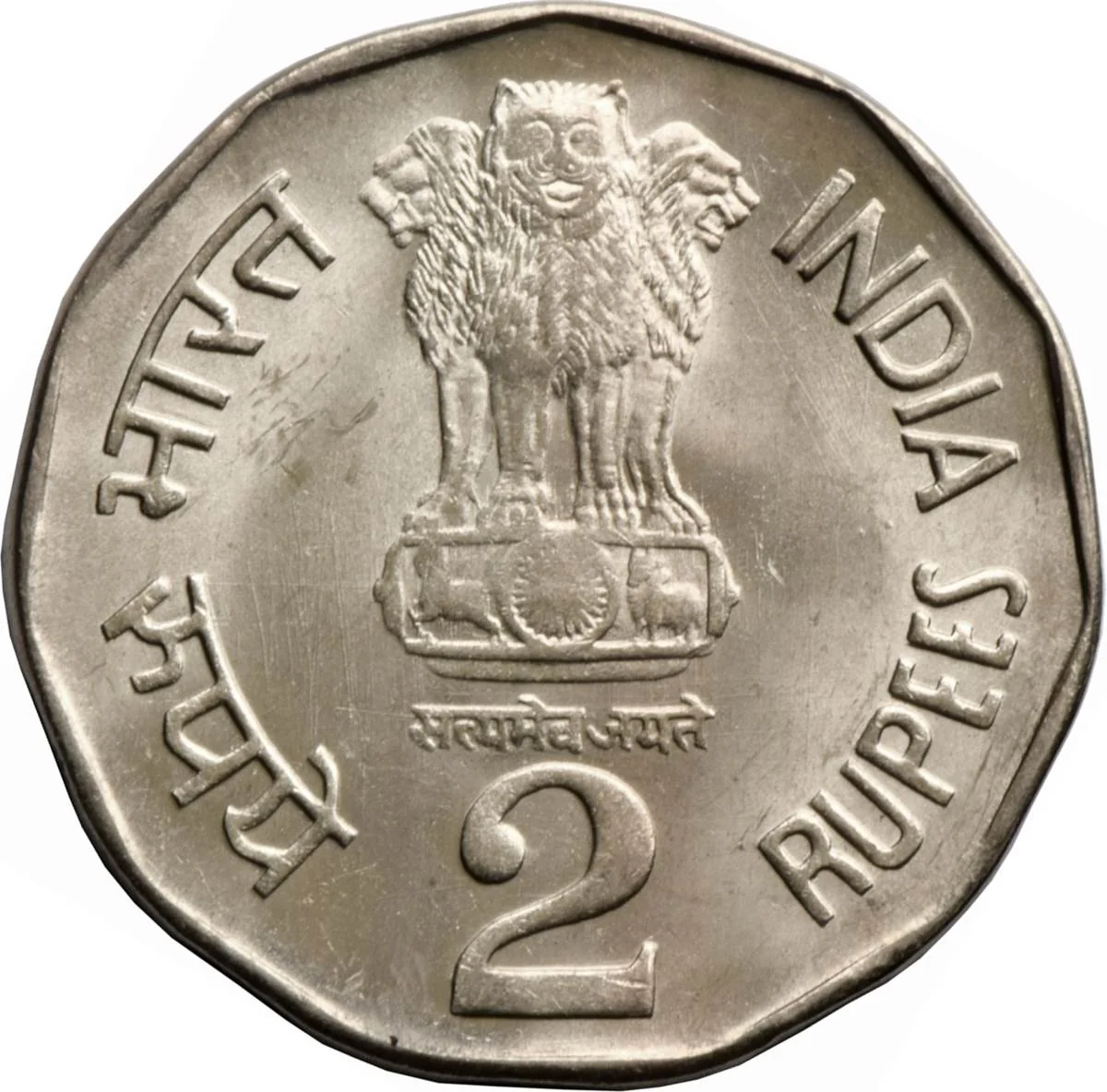
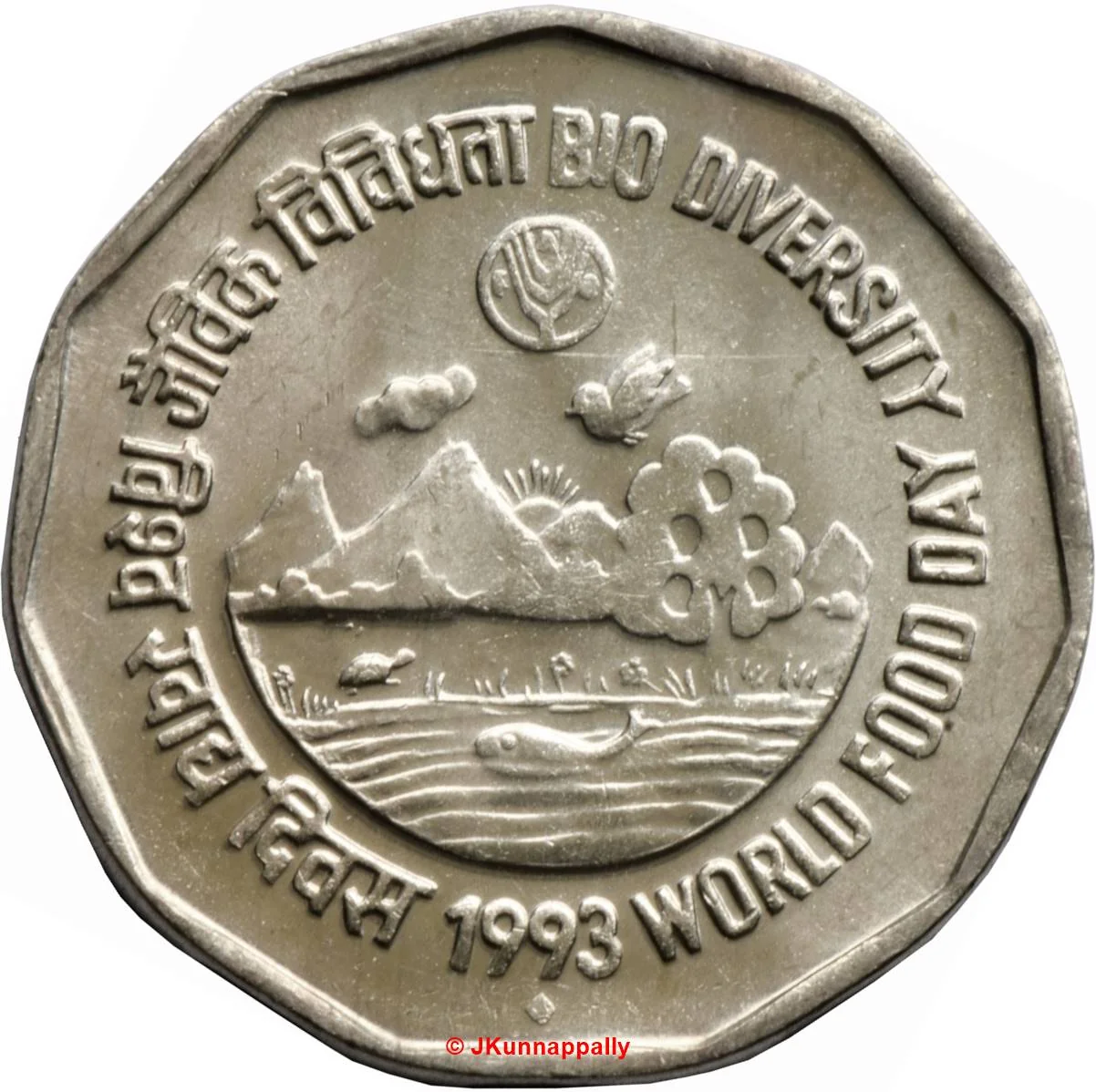
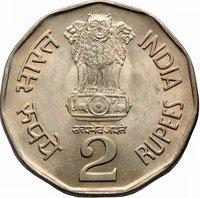
2 rupees – India
Add to wishlist
Circulating commemorative coins
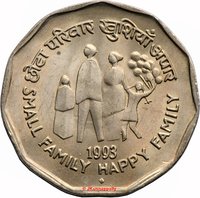
Commemoration: FAO - World Food Day - Bio Diversity
India
Material
Diameter: 26.5 mm
Weight: 6 g
Thickness: 1.6 mm
Shape: Hendecagonal
Composition: Copper-nickel
Technique: Milled
Alignment: Medal alignment
flip
References
KM: #
Numista: #5699
Value
Exchange value: 2 INR
Inflation-adjusted value: 16.30 INR
Obverse
Reverse
Edge
Plain
Categories
| Organization> FAO |
Mintings
| Year | Mint Mark | Mintage | Quality | Collection |
|---|---|---|---|---|
| 1993 | * | — | ||
| 1993 | ♦ | — |
Historical background
In 1993, India was navigating the turbulent aftermath of a profound economic crisis and a landmark policy shift. Just two years prior, in 1991, the country had faced a severe balance of payments crisis, with foreign exchange reserves plummeting to a level barely sufficient for two weeks of imports. This forced the government, under Finance Minister Dr. Manmohan Singh, to initiate sweeping reforms, including a dramatic devaluation of the rupee and a move towards a market-determined exchange rate. By 1993, the crucial transition from a fixed, government-controlled exchange rate to a unified, market-driven system was being consolidated, marking a definitive break from the past.
The key development of 1993 was the full implementation of the Liberalised Exchange Rate Management System (LERMS) and its evolution into a unified market-determined exchange rate. Introduced in March 1992, LERMS initially created a dual exchange rate: 40% of foreign exchange earnings were to be converted at an official RBI rate, while 60% could be converted at a market-determined rate. By March 1993, this dual system was abolished, and the rupee was set fully afloat for all trade transactions, with its value determined by supply and demand in the interbank market. This unification was a cornerstone of India's integration into the global economy, boosting exporter confidence and attracting foreign investment by reducing currency uncertainty.
The results of this shift were becoming evident by the end of 1993. The rupee, which had been devalued by around 20% in 1991, found a new equilibrium, trading at approximately ₹31.50 to the US dollar by December 1993, compared to about ₹26 in 1991. Crucially, India's foreign exchange reserves, which had been nearly depleted, showed a strong recovery, rising to over $15 billion, providing a vital cushion for the economy. Thus, 1993 stands as the year India firmly embraced a market-based currency regime, laying the essential monetary foundation for the era of economic liberalization that would transform the nation in the decades to follow.
The key development of 1993 was the full implementation of the Liberalised Exchange Rate Management System (LERMS) and its evolution into a unified market-determined exchange rate. Introduced in March 1992, LERMS initially created a dual exchange rate: 40% of foreign exchange earnings were to be converted at an official RBI rate, while 60% could be converted at a market-determined rate. By March 1993, this dual system was abolished, and the rupee was set fully afloat for all trade transactions, with its value determined by supply and demand in the interbank market. This unification was a cornerstone of India's integration into the global economy, boosting exporter confidence and attracting foreign investment by reducing currency uncertainty.
The results of this shift were becoming evident by the end of 1993. The rupee, which had been devalued by around 20% in 1991, found a new equilibrium, trading at approximately ₹31.50 to the US dollar by December 1993, compared to about ₹26 in 1991. Crucially, India's foreign exchange reserves, which had been nearly depleted, showed a strong recovery, rising to over $15 billion, providing a vital cushion for the economy. Thus, 1993 stands as the year India firmly embraced a market-based currency regime, laying the essential monetary foundation for the era of economic liberalization that would transform the nation in the decades to follow.
🌱 Very Common