

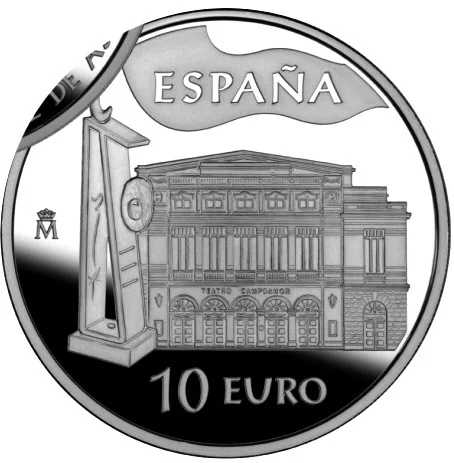
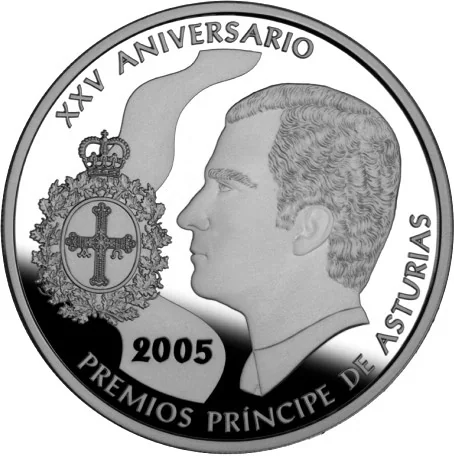
10 Euro (Prince of Asturias Awards) – Spain
Non-circulating coins
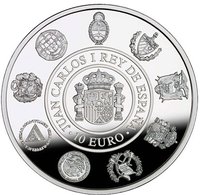
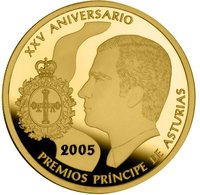
Commemoration: 25th anniversary of Prince of Asturias Awards
Spain
Context

Material
References
KM: #Click to copy to clipboard1110
Numista: #56911
Value
Exchange value: 10 EUR = $11.81
Bullion value: $70.98
Inflation-adjusted value: 15.46 EUR
Obverse
Reverse
Edge
Reeded
Mints
| Name | Mark |
|---|---|
| Royal Mint of Madrid | (M) |
Mintings
| Year | Mint Mark | Mintage | Quality | Collection |
|---|---|---|---|---|
| 2005 | M | 20,000 | Proof |
Historical background
In 2005, Spain was in its fourth year of using the euro, having fully adopted the single currency in 2002 and said farewell to the peseta. The transition was widely considered a success, with the public and businesses largely adapted to the new monetary reality. The European Central Bank (ECB) now set interest rates for the Eurozone, a significant shift from the autonomy of the Banco de España. This period was characterized by a sense of stability and integration, with the euro facilitating trade, travel, and investment within the European single market, reinforcing Spain's position as a core member of the European project.
Beneath this surface stability, however, economic imbalances were building. The low interest rates set by the ECB, appropriate for the sluggish core economies like Germany and France, were excessively stimulative for a rapidly growing Spain. This fueled a massive credit boom and a historic property bubble, driving inflation in Spain consistently above the Eurozone average. While the euro eliminated currency risk for foreign investors, it also masked the growing loss of competitiveness within the Spanish economy, as rising costs and wages were not reflected in a depreciating national currency.
Consequently, 2005 represented the calm before the storm. The currency situation was not a point of acute crisis but rather the institutional framework within which a dangerous domestic economic imbalance was accelerating. Policymakers and citizens enjoyed the benefits of a strong, stable currency while largely overlooking the vulnerabilities it helped to create—specifically, an overheated economy entirely dependent on a booming construction sector and cheap euro-denominated credit, the reversal of which would lead to severe consequences just a few years later during the global financial crisis.
Beneath this surface stability, however, economic imbalances were building. The low interest rates set by the ECB, appropriate for the sluggish core economies like Germany and France, were excessively stimulative for a rapidly growing Spain. This fueled a massive credit boom and a historic property bubble, driving inflation in Spain consistently above the Eurozone average. While the euro eliminated currency risk for foreign investors, it also masked the growing loss of competitiveness within the Spanish economy, as rising costs and wages were not reflected in a depreciating national currency.
Consequently, 2005 represented the calm before the storm. The currency situation was not a point of acute crisis but rather the institutional framework within which a dangerous domestic economic imbalance was accelerating. Policymakers and citizens enjoyed the benefits of a strong, stable currency while largely overlooking the vulnerabilities it helped to create—specifically, an overheated economy entirely dependent on a booming construction sector and cheap euro-denominated credit, the reversal of which would lead to severe consequences just a few years later during the global financial crisis.
✨ Legendary