


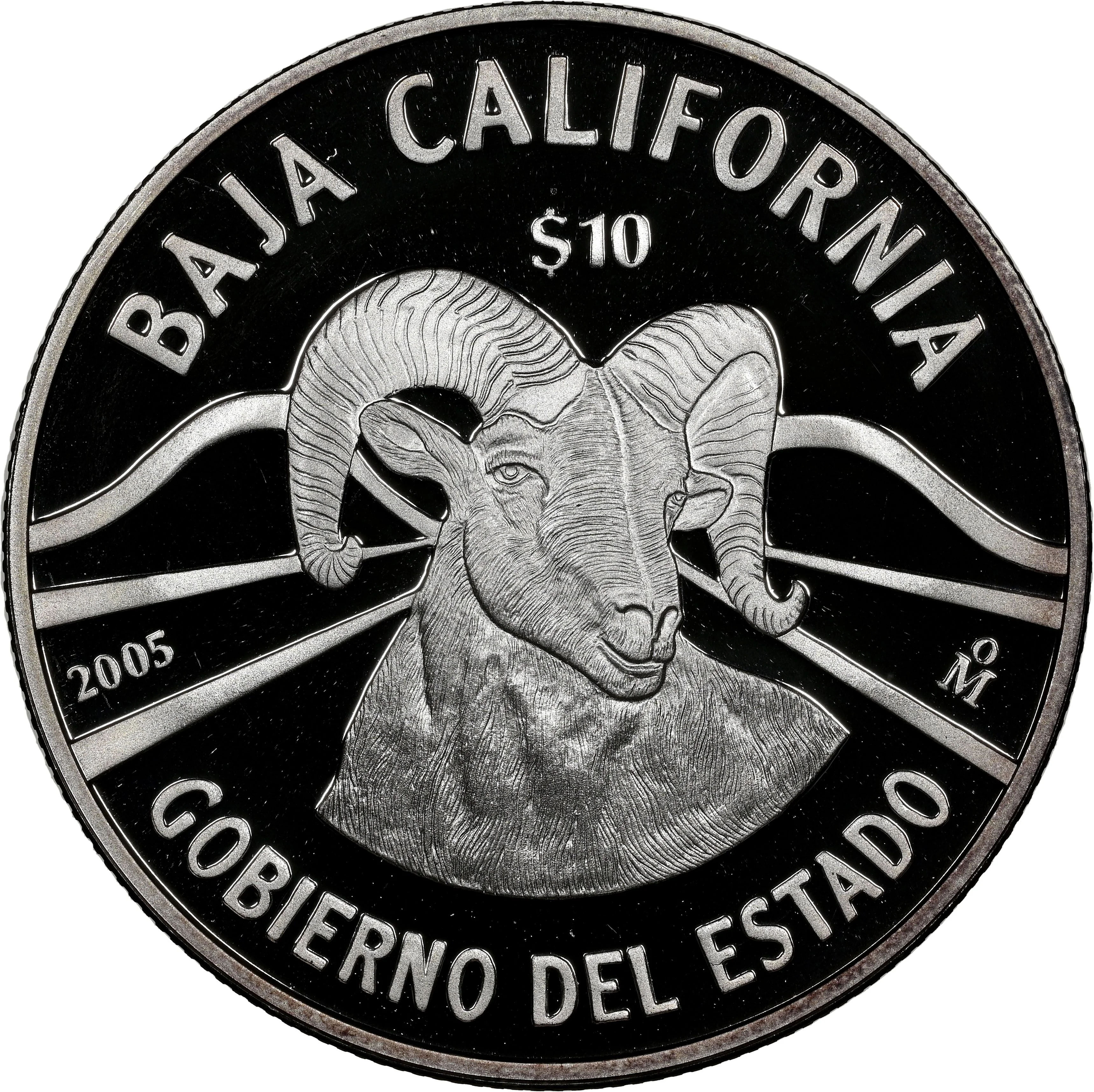
10 Pesos (Baja California) – Mexico
Non-circulating coins
Commemoration: 180th Anniversary of Federation - Baja California (2nd edition)
Mexico
Context

Material
Diameter: 40 mm
Weight: 31.1 g
Silver weight: 31.07 g
Thickness: 3 mm
Shape: Round
Composition: 99.9% Silver
Standard: Silver ounce
Magnetic: No
Technique: Milled
Alignment: Coin alignment

flip
References
KM: #Click to copy to clipboard757
Numista: #56577
Value
Exchange value: 10 MXN = $0.58
Bullion value: $88.32
Inflation-adjusted value: 23.70 MXN
Obverse
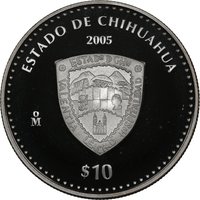
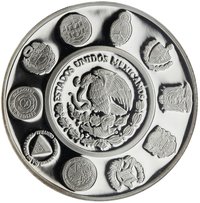
Reverse
Edge
Reeded
Mints
| Name | Mark |
|---|---|
| Mexican Mint | (Mo) |
Mintings
| Year | Mint Mark | Mintage | Quality | Collection |
|---|---|---|---|---|
| 2005 | Mo | 6,000 | Proof |
Historical background
In 2005, Mexico's currency situation was characterized by a period of remarkable stability and strength for the Mexican peso (MXN), a significant shift from its volatile past. This stability was largely attributed to a disciplined monetary policy framework implemented by the Bank of Mexico, which had formally adopted an inflation-targeting regime in 2001. The central bank's credible commitment to controlling inflation, supported by high interest rates and a floating exchange rate, bolstered investor confidence. Furthermore, strong inflows of foreign direct investment and steady remittances from abroad provided underlying support for the currency.
A key external factor contributing to this stability was the sustained high price of oil, a major Mexican export. With crude oil prices averaging over $50 per barrel for much of the year, the nation's current account was bolstered, reducing pressure on the peso. Additionally, the broader global economic context was favorable, with robust growth in the United States—Mexico's largest trading partner under NAFTA—driving demand for Mexican exports. This combination of sound domestic policy and favorable external conditions allowed the peso to trade within a relatively narrow band, appreciating to approximately 10.6 pesos per US dollar by the end of the year, its strongest level since the late 1990s.
However, this apparent calm masked underlying vulnerabilities and growing concerns. Economists and policymakers were increasingly attentive to Mexico's heavy dependence on the US economy and oil revenues, which posed risks for the future. There was also domestic political uncertainty ahead of the pivotal 2006 presidential election, which had the potential to unsettle markets. While 2005 itself was a year of currency strength and macroeconomic stability, it represented a calm before the storms that would later emerge from the global financial crisis of 2008-2009 and the subsequent domestic challenges, highlighting the fragile nature of stability built on cyclical commodity prices and external demand.
A key external factor contributing to this stability was the sustained high price of oil, a major Mexican export. With crude oil prices averaging over $50 per barrel for much of the year, the nation's current account was bolstered, reducing pressure on the peso. Additionally, the broader global economic context was favorable, with robust growth in the United States—Mexico's largest trading partner under NAFTA—driving demand for Mexican exports. This combination of sound domestic policy and favorable external conditions allowed the peso to trade within a relatively narrow band, appreciating to approximately 10.6 pesos per US dollar by the end of the year, its strongest level since the late 1990s.
However, this apparent calm masked underlying vulnerabilities and growing concerns. Economists and policymakers were increasingly attentive to Mexico's heavy dependence on the US economy and oil revenues, which posed risks for the future. There was also domestic political uncertainty ahead of the pivotal 2006 presidential election, which had the potential to unsettle markets. While 2005 itself was a year of currency strength and macroeconomic stability, it represented a calm before the storms that would later emerge from the global financial crisis of 2008-2009 and the subsequent domestic challenges, highlighting the fragile nature of stability built on cyclical commodity prices and external demand.

✨ Legendary