

50 litų (Great Seimas of Vilnius) – Lithuania
Add to wishlist
Non-circulating coins
Commemoration: 100th Anniversary of the Great Seimas of Vilnius
Lithuania
Context
Material
References
KM: #
Numista: #56444
Value
Exchange value: 50 LTL
Bullion value: $65.66
Inflation-adjusted value: 109.81 LTL
Obverse
Description:
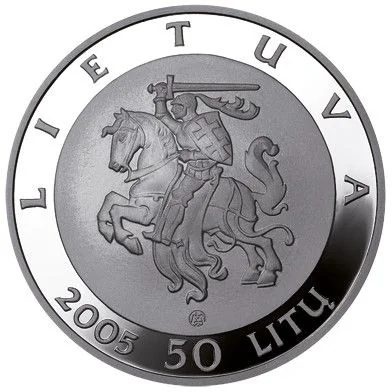
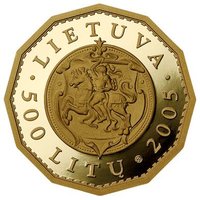
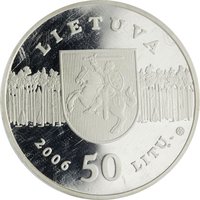
The obverse features Lithuania's stylized Vytis coat of arms, surrounded by the inscriptions LIETUVA, 2005, and 50 LITŲ.
Inscription:
LIETUVA
LMK
2005 50 LITŲ
LMK
2005 50 LITŲ
Translation:
Republic of Lithuania
LMK
2005 50 Litas
LMK
2005 50 Litas
Script: Latin
Language: Lithuanian
Designers: Albertas Gurskas, Rytas Jonas Belevičius
Reverse
Description:
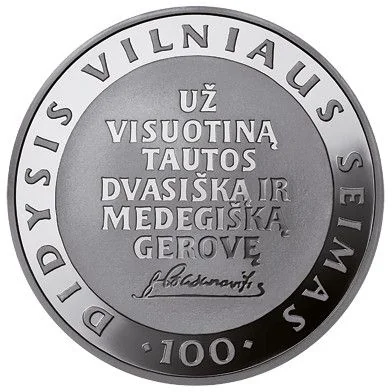
The reverse features an excerpt from Jonas Basanavičius's speech at the Great Seimas of Vilnius: "UŽ VISUOTINĄ TAUTOS DVASIŠKĄ IR MEDEGIŠKĄ GEROVĘ," encircled by the inscriptions DIDYSIS VILNIAUS SEIMAS and 100, along with his facsimile signature.
Inscription:
DIDYSIS LIETUVOS SEIMAS
· 100 ·
UŽ
VISUOTINĄ
TAUTOS
DVASIŠKĄ IR
MEDEGIŠKĄ
GEROVĘ
· 100 ·
UŽ
VISUOTINĄ
TAUTOS
DVASIŠKĄ IR
MEDEGIŠKĄ
GEROVĘ
Translation:
THE GREAT SEIMAS OF LITHUANIA
· 100 ·
FOR
THE COMPREHENSIVE
NATIONAL
SPIRITUAL AND
MATERIAL
WELFARE
· 100 ·
FOR
THE COMPREHENSIVE
NATIONAL
SPIRITUAL AND
MATERIAL
WELFARE
Script: Latin
Language: Lithuanian
Designers: Albertas Gurskas, Rytas Jonas Belevičius
Edge
The edge of the coin features the Pillars of Gediminas
Categories
| Animal> Horse |
| Object> Cold weapons |
Mints
| Name | Mark |
|---|---|
| Lithuanian Mint | (LMK) |
Mintings
| Year | Mint Mark | Mintage | Quality | Collection |
|---|---|---|---|---|
| 2005 | LMK | 1,500 | Proof |
Historical background
In 2005, Lithuania was in a pivotal period of monetary transition, operating under a currency board arrangement that had been a cornerstone of its economic stability since 1994. The national currency, the litas (LTL), was irrevocably fixed to the euro at a rate of 3.4528, a peg that had previously been to the U.S. dollar until 2002. This strict regime successfully tamed the hyperinflation of the early 1990s and provided a stable foundation for growth, but it also meant Lithuania had relinquished control over its independent monetary policy, with interest rates effectively set by the European Central Bank.
The dominant economic narrative of that year was Lithuania's determined push to join the European Exchange Rate Mechanism II (ERM II), the mandatory "waiting room" for adopting the euro. Having joined the European Union in 2004, the government viewed euro adoption as a strategic priority for deeper integration and to eliminate exchange rate risk for trade and investment. However, the path was blocked by persistently high inflation, which exceeded the Maastricht criterion. This inflation was largely driven by rapid convergence growth, rising wages, and soaring energy prices, making it difficult to meet the strict stability benchmarks required for ERM II entry.
Consequently, 2005 was a year of preparation and slight frustration. The currency board functioned smoothly, ensuring no volatility in the exchange rate, but the focus was on fiscal discipline and structural reforms to cool the overheating economy. The government officially submitted its application for ERM II membership in March 2005, but the European Central Bank and European Commission indicated that inflation must be lowered first. This delay set the timeline back, meaning that Lithuania's ambitious goal of adopting the euro by 2007 would be postponed, with the eventual entry into ERM II not occurring until 2004.
The dominant economic narrative of that year was Lithuania's determined push to join the European Exchange Rate Mechanism II (ERM II), the mandatory "waiting room" for adopting the euro. Having joined the European Union in 2004, the government viewed euro adoption as a strategic priority for deeper integration and to eliminate exchange rate risk for trade and investment. However, the path was blocked by persistently high inflation, which exceeded the Maastricht criterion. This inflation was largely driven by rapid convergence growth, rising wages, and soaring energy prices, making it difficult to meet the strict stability benchmarks required for ERM II entry.
Consequently, 2005 was a year of preparation and slight frustration. The currency board functioned smoothly, ensuring no volatility in the exchange rate, but the focus was on fiscal discipline and structural reforms to cool the overheating economy. The government officially submitted its application for ERM II membership in March 2005, but the European Central Bank and European Commission indicated that inflation must be lowered first. This delay set the timeline back, meaning that Lithuania's ambitious goal of adopting the euro by 2007 would be postponed, with the eventual entry into ERM II not occurring until 2004.
💎 Extremely Rare