

100 Krooni (Republic of Estonia) – Estonia
Non-circulating coins
Commemoration: 90th Anniversary of Republic of Estonia
Estonia
Context

Material
Diameter: 18 mm
Weight: 7.78 g
Platinum weight: 7.77 g
Shape: Round
Composition: 99.9% Platinum
Standard: Silver quarter ounce
Technique: Milled
References
KM: #Click to copy to clipboard47
Numista: #100685
Value
Exchange value: 100 EEK
Bullion value: $0.00
Inflation-adjusted value: 198.23 EEK
Obverse
Description:
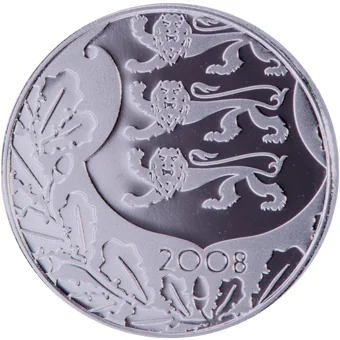
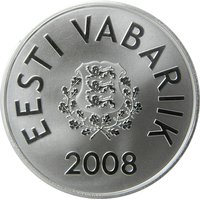
National coat of arms on a shield with an oak branch to the left.
Inscription:
2008
Script: Latin
Engraver: Tiit Jürna
Reverse
Description:
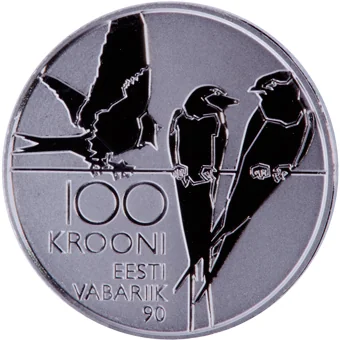
Three barn swallows perched on a wire.
Inscription:
100
KROONI
EESTI
VABARIIK
90
KROONI
EESTI
VABARIIK
90
Translation:
CROWN
ESTONIAN
REPUBLIC
90
ESTONIAN
REPUBLIC
90
Script: Latin
Language: Estonian
Engraver: Tiit Jürna
Edge
Smooth with engraving of the alloy
Legend:
Pt 999
Categories
| Animal> Bird |
| Symbols> Coat of Arms |
Mints
| Name | Mark |
|---|---|
| Mint of Finland | — |
Mintings
| Year | Mint Mark | Mintage | Quality | Collection |
|---|---|---|---|---|
| 2008 | — | 3,000 | BU |
Historical background
In 2008, Estonia's currency situation was defined by its unwavering commitment to the Estonian kroon (EEK) and its fixed exchange rate peg to the euro. This policy, established in 1992, tied the kroon at a rate of 15.6466 EEK to 1 EUR, serving as a cornerstone of the country's economic stability and a strategic path toward Eurozone membership. The currency board arrangement mandated that every kroon in circulation be fully backed by foreign reserves, primarily euros, which strictly limited the central bank's ability to conduct independent monetary policy. This discipline was a key factor in Estonia's rapid economic convergence with the EU following its 2004 accession.
The global financial crisis of 2008 struck Estonia with severe force, testing the rigidity of its currency peg. The economy contracted sharply by over 14% in 2009, following a credit-fueled boom. Despite the dramatic downturn, the government, under Prime Minister Andrus Ansip, adamantly refused to devalue the kroon, viewing such a move as a catastrophic blow to credibility and future euro adoption. Instead, Estonia pursued a policy of "internal devaluation," implementing drastic fiscal austerity, cutting public sector wages and pensions, and maintaining the peg to preserve confidence and meet the Maastricht criteria for euro adoption.
This steadfast approach proved successful in its ultimate goal. By enduring the short-term pain of austerity without currency devaluation, Estonia maintained macroeconomic stability and convincingly met all convergence criteria. Consequently, in January 2011, Estonia became the first post-Soviet state to adopt the euro, seamlessly transitioning from the kroon at its long-held fixed rate. The 2008 crisis period, therefore, was the final and most difficult test of a monetary policy that had guided the country for nearly two decades, culminating in the secure anchoring of its economy to the European single currency.
The global financial crisis of 2008 struck Estonia with severe force, testing the rigidity of its currency peg. The economy contracted sharply by over 14% in 2009, following a credit-fueled boom. Despite the dramatic downturn, the government, under Prime Minister Andrus Ansip, adamantly refused to devalue the kroon, viewing such a move as a catastrophic blow to credibility and future euro adoption. Instead, Estonia pursued a policy of "internal devaluation," implementing drastic fiscal austerity, cutting public sector wages and pensions, and maintaining the peg to preserve confidence and meet the Maastricht criteria for euro adoption.
This steadfast approach proved successful in its ultimate goal. By enduring the short-term pain of austerity without currency devaluation, Estonia maintained macroeconomic stability and convincingly met all convergence criteria. Consequently, in January 2011, Estonia became the first post-Soviet state to adopt the euro, seamlessly transitioning from the kroon at its long-held fixed rate. The 2008 crisis period, therefore, was the final and most difficult test of a monetary policy that had guided the country for nearly two decades, culminating in the secure anchoring of its economy to the European single currency.

✨ Legendary