

5000 colones – Costa Rica
Add to wishlist
Non-circulating coins
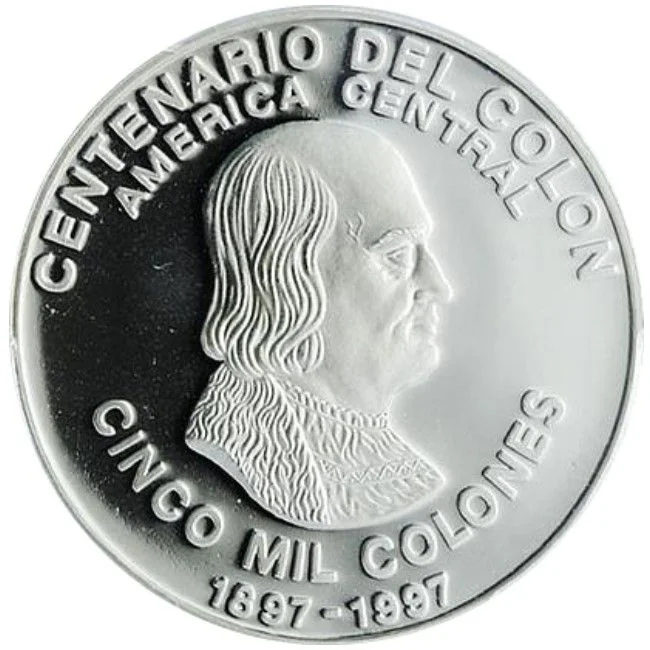
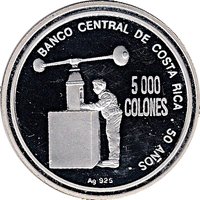
Commemoration: Centennial of the Colon
Costa Rica
Context
Year: 1997
Issuer: Costa Rica
Issuing organization: Central Bank of Costa Rica
Period:
(since 1948)
Currency:
(since 1896)
Total mintage: 10,000
Material
References
KM: #
Numista: #56160
Value
Exchange value: 5000 CRC
Bullion value: $57.13
Obverse
Description:
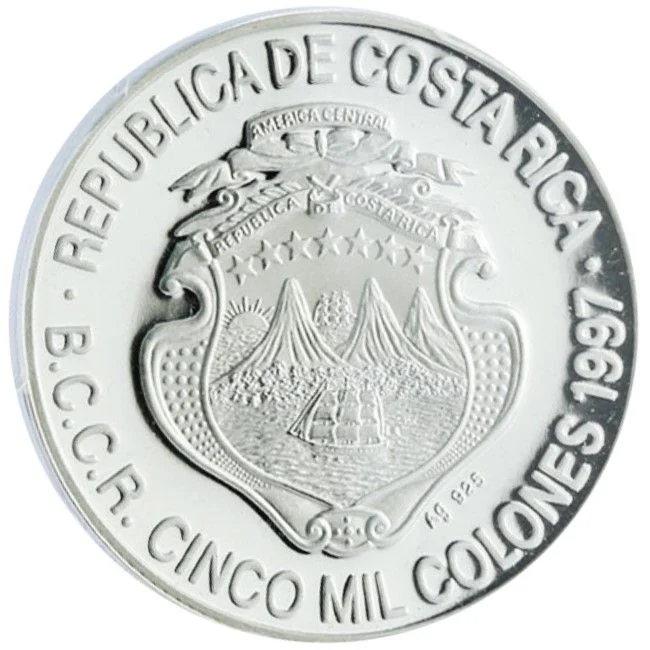
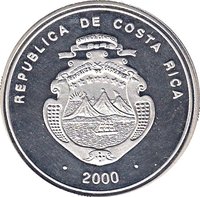
Coat of arms with value and date.
Inscription:
. REPUBLICA DE COSTA RICA .
AMERICA CENTRAL
REPUBLICA DE COSTA RICA
Ag 925
B.C.C.R. CINCO MIL COLONES 1997
AMERICA CENTRAL
REPUBLICA DE COSTA RICA
Ag 925
B.C.C.R. CINCO MIL COLONES 1997
Translation:
REPUBLIC OF COSTA RICA
CENTRAL AMERICA
REPUBLIC OF COSTA RICA
Ag 925
B.C.C.R. FIVE THOUSAND COLONES 1997
CENTRAL AMERICA
REPUBLIC OF COSTA RICA
Ag 925
B.C.C.R. FIVE THOUSAND COLONES 1997
Script: Latin
Language: Spanish
Reverse
Edge
Categories
| Symbols> Coat of Arms |
| Person> Explorer |
Mints
| Name | Mark |
|---|---|
| Casa de Moneda de Chile | — |
Mintings
| Year | Mint Mark | Mintage | Quality | Collection |
|---|---|---|---|---|
| 1997 | — | 10,000 |
Historical background
In 1997, Costa Rica's currency situation was characterized by a managed exchange rate regime facing significant external pressures. The country operated a crawling peg system for the colón, where the Central Bank (BCCR) would allow the currency to depreciate at a pre-announced, gradual rate (the deslizamiento) to maintain export competitiveness and manage inflation. This system had provided relative stability since the early 1990s, but by 1997, it was being tested by a growing current account deficit and substantial capital inflows, which complicated monetary policy.
The primary challenges stemmed from a combination of large-scale foreign direct investment (FDI), particularly into the booming electronics and tourism sectors, and rising public sector borrowing. These capital inflows created upward pressure on the colón, contradicting the BCCR's depreciation targets. To maintain the crawling peg, the Bank was forced to intervene heavily in the foreign exchange market, purchasing dollars and expanding the money supply. This contributed to inflationary pressures and raised concerns about the sustainability of the peg, as international reserves experienced volatility.
Consequently, 1997 was a year of transition and debate. The tensions within the managed system highlighted its limitations in a climate of financial globalization and set the stage for future reforms. While the crawling peg was maintained throughout the year, the accumulating imbalances and policy dilemmas paved the way for the more significant liberalization measures that would follow, including the move towards a crawling band system in 1999 and greater exchange rate flexibility in the early 2000s.
The primary challenges stemmed from a combination of large-scale foreign direct investment (FDI), particularly into the booming electronics and tourism sectors, and rising public sector borrowing. These capital inflows created upward pressure on the colón, contradicting the BCCR's depreciation targets. To maintain the crawling peg, the Bank was forced to intervene heavily in the foreign exchange market, purchasing dollars and expanding the money supply. This contributed to inflationary pressures and raised concerns about the sustainability of the peg, as international reserves experienced volatility.
Consequently, 1997 was a year of transition and debate. The tensions within the managed system highlighted its limitations in a climate of financial globalization and set the stage for future reforms. While the crawling peg was maintained throughout the year, the accumulating imbalances and policy dilemmas paved the way for the more significant liberalization measures that would follow, including the move towards a crawling band system in 1999 and greater exchange rate flexibility in the early 2000s.
💎 Very Rare