


50 Litų (Adam Mickiewicz) – Lithuania
Non-circulating coins
Commemoration: 200th birth Anniversary of Adam Mickiewicz (Adomas Mickevičius)
Lithuania
Context

Material

References
KM: #Click to copy to clipboard114
Numista: #56123
Value
Exchange value: 50 LTL
Bullion value: $62.52
Inflation-adjusted value: 119.32 LTL
Obverse
Description:
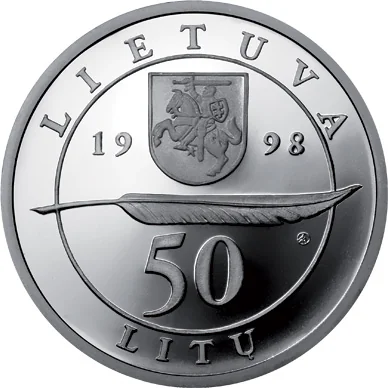
The obverse features Lithuania's coat of arms within a shield, above a stylized feather.
Inscription:
LIETUVA
19 98
LMK
50
LITŲ
19 98
LMK
50
LITŲ
Translation:
LITHUANIA
19 98
LMK
50
LITAS
19 98
LMK
50
LITAS
Script: Latin
Language: Lithuanian
Engraver: Algirdas Bosas
Reverse
Description:
The reverse features poet Adam Mickiewicz against Vilnius University.
Inscription:
1798
1855
ADOMAS MICKEVIČIUS
1855
ADOMAS MICKEVIČIUS
Translation:
1798
1855
ADAM MICKIEWICZ
1855
ADAM MICKIEWICZ
Script: Latin
Language: Lithuanian
Engraver: Algirdas Bosas
Edge
Lettering
Legend:
TEVYNĖ LIETUVA, MIELESNĖ UŽ SVEIKATĄ*
Translation:
HOMELAND LITHUANIA, DEARER THAN HEALTH
Language: Lithuanian
Mints
| Name | Mark |
|---|---|
| Lithuanian Mint | (LMK) |
Mintings
| Year | Mint Mark | Mintage | Quality | Collection |
|---|---|---|---|---|
| 1998 | LMK | 2,860 | Proof |
Historical background
In 1998, Lithuania was in the midst of a critical and challenging period of monetary transition, firmly adhering to its unique currency board arrangement. Following independence from the Soviet Union in 1990, the country had introduced the temporary talonas and then the permanent litas in 1993, pegging it at a fixed rate of 4 to 1 against the US dollar through a strict currency board. This system, which required full foreign reserve backing for all litas in circulation, was a cornerstone of government policy, designed to crush the hyperinflation of the early 1990s and import monetary stability and credibility.
However, by 1998, the rigidity of the dollar peg was being severely tested by external shocks. The Russian financial crisis of August 1998 was a massive blow, as Russia was a major trading partner. Lithuanian exports collapsed, leading to a sharp downturn in economic growth and exposing vulnerabilities. The fixed exchange rate, while ensuring stability, left Lithuania with no independent monetary policy to stimulate the economy, and high interest rates were needed to defend the peg. This contributed to a banking crisis, with several institutions failing, requiring government intervention and highlighting systemic fragilities.
Despite the intense pressure, Lithuanian authorities maintained an unwavering commitment to the currency board, viewing it as an essential anchor. The crisis of 1998 ultimately reinforced the strategic decision to seek a more stable and geographically relevant anchor, paving the way for the litas to be repegged from the US dollar to the euro at a rate of 3.4528 to 1 in February 2002. This move was a deliberate step toward Lithuania's strategic goal of European Union and, eventually, Eurozone membership, with the 1998 experience underscoring the perils of economic alignment with the East and the necessity of integration with the West.
However, by 1998, the rigidity of the dollar peg was being severely tested by external shocks. The Russian financial crisis of August 1998 was a massive blow, as Russia was a major trading partner. Lithuanian exports collapsed, leading to a sharp downturn in economic growth and exposing vulnerabilities. The fixed exchange rate, while ensuring stability, left Lithuania with no independent monetary policy to stimulate the economy, and high interest rates were needed to defend the peg. This contributed to a banking crisis, with several institutions failing, requiring government intervention and highlighting systemic fragilities.
Despite the intense pressure, Lithuanian authorities maintained an unwavering commitment to the currency board, viewing it as an essential anchor. The crisis of 1998 ultimately reinforced the strategic decision to seek a more stable and geographically relevant anchor, paving the way for the litas to be repegged from the US dollar to the euro at a rate of 3.4528 to 1 in February 2002. This move was a deliberate step toward Lithuania's strategic goal of European Union and, eventually, Eurozone membership, with the 1998 experience underscoring the perils of economic alignment with the East and the necessity of integration with the West.
💎 Extremely Rare