

50 Litų (Karaims and Tartars in Lithuania) – Lithuania
Non-circulating coins
Commemoration: 600th Anniversary of the settling down of Karaims and Tartars in Lithuania
Lithuania
Context

Material
References
KM: #Click to copy to clipboard105
Numista: #56122
Value
Exchange value: 50 LTL
Bullion value: $63.28
Inflation-adjusted value: 129.92 LTL
Obverse
Description:
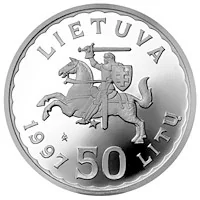
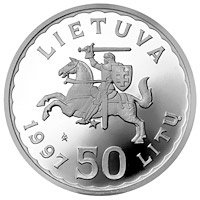
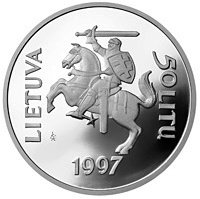
The obverse features Lithuania's Coat of Arms, encircled by the inscriptions LIETUVA, 50 LITŲ, and 1997.
Inscription:
LIETUVA
LMK
1997 50 LITŲ
LMK
1997 50 LITŲ
Translation:
Republic of Lithuania
LMK
1997 50 Litas
LMK
1997 50 Litas
Script: Latin
Language: Lithuanian
Engraver: Vladas Vildžiūnas
Reverse
Description:
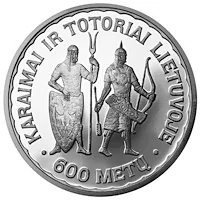
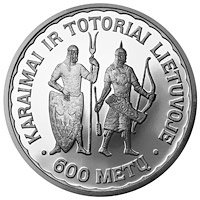
The reverse depicts a Karaite castle guard and a Tartar warrior, groups brought to Lithuania by Grand Duke Vytautas in the late 14th century.
Inscription:
KARAIMAI IR TOTORIAI LIETUVOJE
• 600 METŲ •
• 600 METŲ •
Translation:
KARAIMMS AND TATARS IN LITHUANIA
• 600 YEARS •
• 600 YEARS •
Script: Latin
Language: Lithuanian
Engraver: Vladas Vildžiūnas
Edge
Lettered
Legend:
LIETUVA, TEVYNĖ MŪSŲ ***
Translation:
LITHUANIA, HOMELAND OF OURS
Language: Lithuanian
Mints
| Name | Mark |
|---|---|
| Lithuanian Mint | LMK |
Mintings
| Year | Mint Mark | Mintage | Quality | Collection |
|---|---|---|---|---|
| 1997 | LMK | 2,635 | Proof |
Historical background
In 1997, Lithuania was in a period of significant monetary stability, anchored by its unique currency board arrangement established in 1994. Following the hyperinflation and economic turmoil after independence from the Soviet Union, Lithuania introduced the litas (LTL) as its national currency in 1993. To ensure credibility and curb inflation, the country adopted a strict currency board system in April 1994, pegging the litas at a fixed rate of 4 to 1 against the US dollar. This meant every litas in circulation was fully backed by foreign reserves, primarily US dollars, and the central bank relinquished its ability to conduct independent monetary policy.
By 1997, this system had largely succeeded in its primary goals. Inflation had been tamed, dropping from over 400% in the early 1990s to just 8.9% in 1997, fostering an environment for economic growth and foreign investment. The fixed peg provided predictability for trade and investment, which was crucial for a small, open economy integrating with the West. However, the Asian financial crisis that erupted in mid-1997 began to cast a shadow, highlighting a key vulnerability: the peg to the US dollar, rather than European currencies, created exchange rate risks with Lithuania's main trading partners in Europe, whose currencies were fluctuating against the strengthening dollar.
Consequently, 1997 became a pivotal year for planning a strategic shift in Lithuania's currency policy. Discussions intensified about re-pegging the litas from the US dollar to a European currency basket or directly to the Deutsche Mark, a move seen as a stepping stone towards eventual European Union membership. This period of stability under the dollar peg was thus simultaneously a time of preparation for a fundamental realignment, setting the stage for the 1998 announcement that the litas would be repegged to the euro (via the ECU and later the euro itself) in 2002, firmly reorienting Lithuania's monetary future towards European integration.
By 1997, this system had largely succeeded in its primary goals. Inflation had been tamed, dropping from over 400% in the early 1990s to just 8.9% in 1997, fostering an environment for economic growth and foreign investment. The fixed peg provided predictability for trade and investment, which was crucial for a small, open economy integrating with the West. However, the Asian financial crisis that erupted in mid-1997 began to cast a shadow, highlighting a key vulnerability: the peg to the US dollar, rather than European currencies, created exchange rate risks with Lithuania's main trading partners in Europe, whose currencies were fluctuating against the strengthening dollar.
Consequently, 1997 became a pivotal year for planning a strategic shift in Lithuania's currency policy. Discussions intensified about re-pegging the litas from the US dollar to a European currency basket or directly to the Deutsche Mark, a move seen as a stepping stone towards eventual European Union membership. This period of stability under the dollar peg was thus simultaneously a time of preparation for a fundamental realignment, setting the stage for the 1998 announcement that the litas would be repegged to the euro (via the ECU and later the euro itself) in 2002, firmly reorienting Lithuania's monetary future towards European integration.
💎 Extremely Rare