

20 Drachmai – Greece
Circulating commemorative coins
Commemoration: The Regime of the Colonels of 21 April 1967
Greece
Context
Year: 1973
Issuer: Greece 
Period:
(1967—1974)
Ruler: Constantine II
Currency:
(1954—2001)
Demonetized: Yes
Total mintage: 3,092,087
Material
References
KM: #Click to copy to clipboard111
Numista: #561
Value
Exchange value: 20 GRD
Inflation-adjusted value: 1603.92 GRD
Obverse
Description:
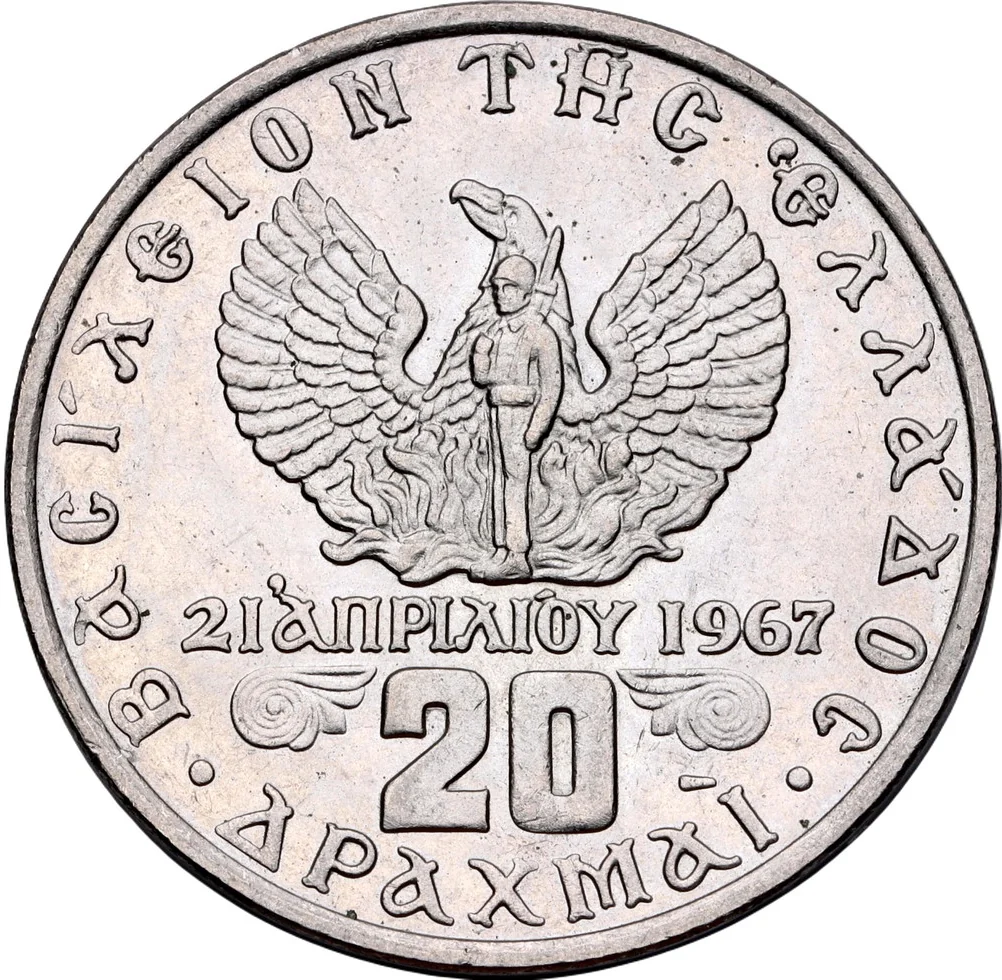
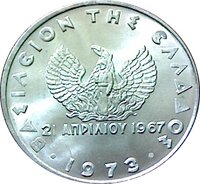
The Junta's emblem—a phoenix rising and a soldier with fixed bayonet—flanks the coup's date, surrounded by the face value and "ΒΑΣΙΛΕΙΟΝ ΤΗΣ ΕΛΛΑΔΟΣ."
Inscription:
ΒaCΙλΕΙΟΝ ΤΗC ΕλλaΔΟC
21 aΠΡΙλΙΟΥ 1967
20
• ΔΡaΧΜaΙ •
21 aΠΡΙλΙΟΥ 1967
20
• ΔΡaΧΜaΙ •
Translation:
Royal of Greece
21 April 1967
20
Drachmai
21 April 1967
20
Drachmai
Script: Greek
Language: Greek
Engraver: V. Phalireas
Reverse
Description:
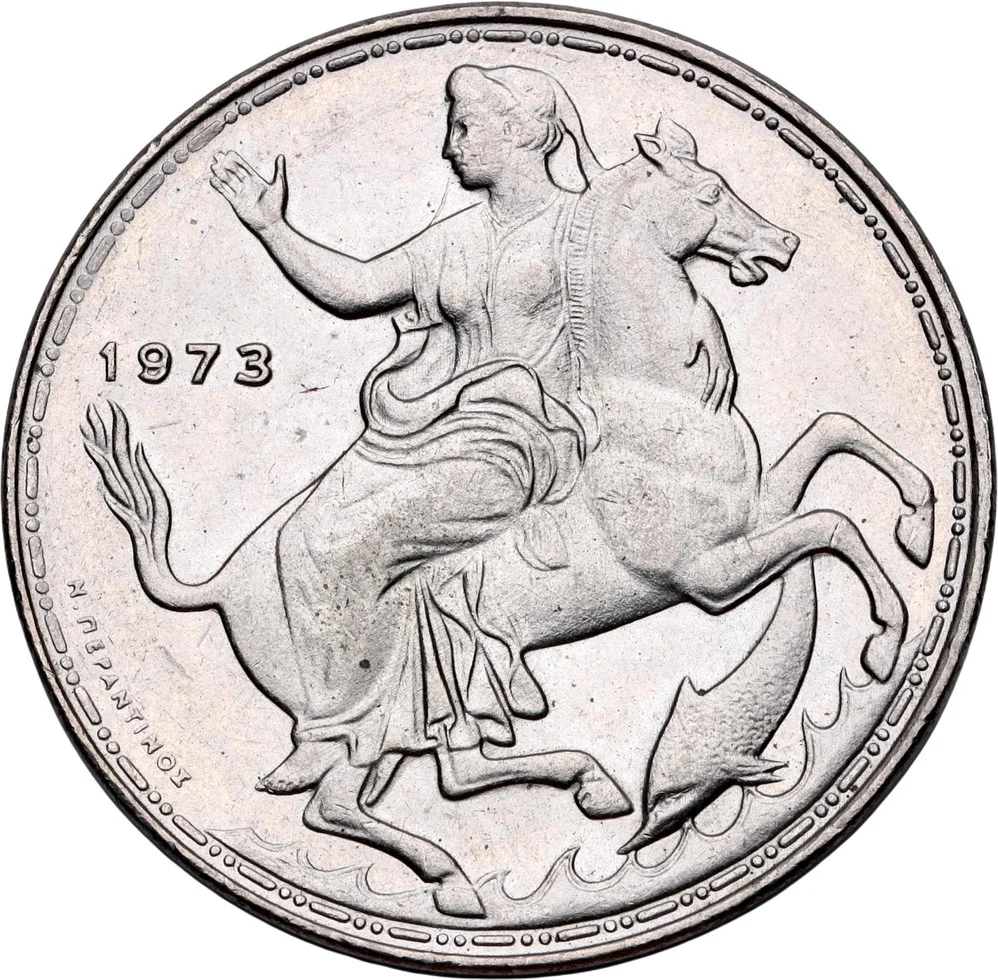
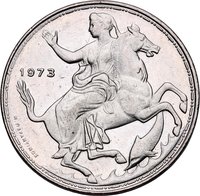
Selene rides sidesaddle on a rearing horse above a leaping dolphin.
Inscription:
1973
Ν. ΠΕΡΑΝΤΙΝΟΣ
Ν. ΠΕΡΑΝΤΙΝΟΣ
Translation:
N. Perantinos
Script: Greek
Language: Greek
Engraver: Nikos Perantinos
Edge
Plain
Categories
| Mythology> Fantastic animal |
| Animal> Bird |
| Animal> Horse |
| Animal> Marine mammal |
Mints
| Name | Mark |
|---|---|
| National Mint of the Bank of Greece | — |
Mintings
| Year | Mint Mark | Mintage | Quality | Collection |
|---|---|---|---|---|
| 1973 | — | 3,092,087 |
Historical background
In 1973, Greece's currency situation was defined by the authoritarian rule of the "Regime of the Colonels" and its struggle to control a deteriorating economy. The official currency, the drachma, was under severe pressure due to a combination of internal mismanagement and external shocks. The government of Georgios Papadopoulos, seeking a veneer of economic legitimacy, had pursued rapid industrialization and infrastructure projects fueled by heavy borrowing and loose monetary policy. This led to significant inflationary pressures, which were dramatically exacerbated by the global 1973 oil crisis. As energy costs skyrocketed, Greece's balance of payments worsened, and inflation surged into double digits, eroding purchasing power and creating widespread economic anxiety.
The regime responded with strict, politically motivated controls rather than sound economic adjustment. To defend the drachma's fixed exchange rate and conserve foreign reserves, the government imposed severe import restrictions and capital controls. These measures aimed to prevent currency flight and maintain an artificial stability, but they ultimately stifled business activity and created shortages of goods. The economic distortions were compounded by international isolation, as many democracies maintained a distant stance toward the junta, limiting access to favorable credit and investment.
Consequently, 1973 represented the calm before a deeper storm. The currency controls papered over fundamental weaknesses, storing up severe problems for the near future. The underlying inflationary crisis and loss of confidence would erupt fully after the regime's collapse in 1974, leading to a major devaluation of the drachma and setting the stage for the chronic economic instability that would challenge Greece's democratic governments in the subsequent decades.
The regime responded with strict, politically motivated controls rather than sound economic adjustment. To defend the drachma's fixed exchange rate and conserve foreign reserves, the government imposed severe import restrictions and capital controls. These measures aimed to prevent currency flight and maintain an artificial stability, but they ultimately stifled business activity and created shortages of goods. The economic distortions were compounded by international isolation, as many democracies maintained a distant stance toward the junta, limiting access to favorable credit and investment.
Consequently, 1973 represented the calm before a deeper storm. The currency controls papered over fundamental weaknesses, storing up severe problems for the near future. The underlying inflationary crisis and loss of confidence would erupt fully after the regime's collapse in 1974, leading to a major devaluation of the drachma and setting the stage for the chronic economic instability that would challenge Greece's democratic governments in the subsequent decades.
🌱 Very Common