

50 Centimes – Martinique
France
Context
Years: 1897–1922
Country: France 
Issuer: Martinique
Period:
(1870—1940)
Currency:
(1795—1959)
Demonetized: Yes
Total mintage: 1,100,000
Material
Diameter: 22.2 mm
Weight: 5 g
Thickness: 1.6 mm
Shape: Round
Composition: Copper-nickel
Technique: Milled
Alignment: Coin alignment
flip
References
KM: #Click to copy to clipboard40
Numista: #5609
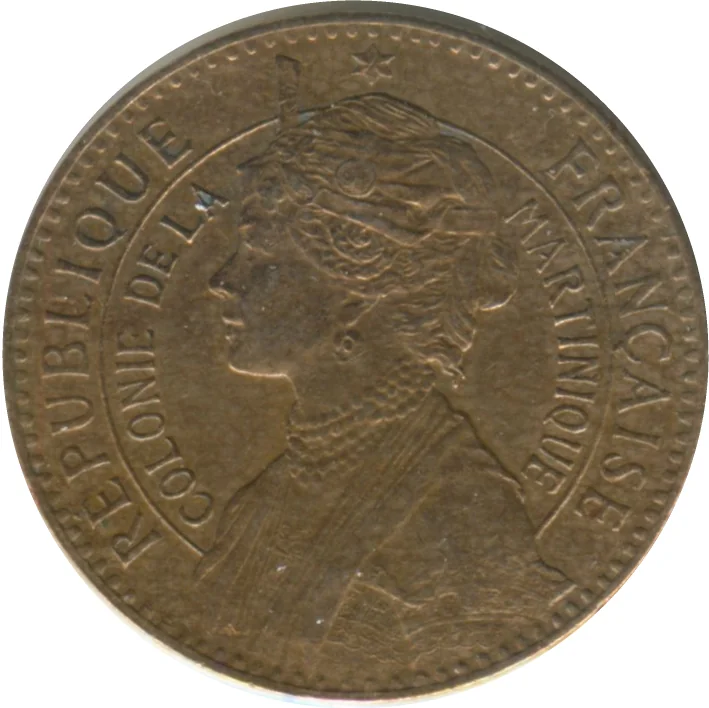
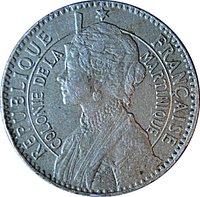
Obverse
Description:
Bust left in circle, star above.
Inscription:
RÉPUBLIQUE * FRANÇAISE
COLONIE DE LA MARTINIQUE
COLONIE DE LA MARTINIQUE
Translation:
FRENCH REPUBLIC
COLONY OF MARTINIQUE
COLONY OF MARTINIQUE
Script: Latin
Language: French
Engraver: Alfred Borrel
Reverse
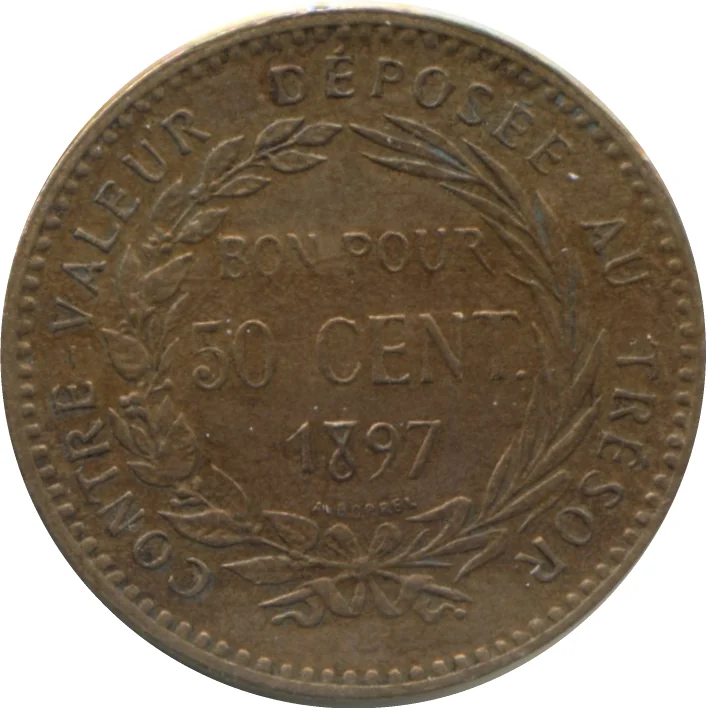
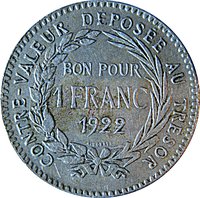
Description:
Value and date encircled.
Inscription:
CONTRE-VALEUR DÉPOSÉE AU TRÉSOR
BON POUR 50 CENT.
1897
A. BORREL
BON POUR 50 CENT.
1897
A. BORREL
Translation:
DEPOSITED COUNTER-VALUE AT THE TREASURY
GOOD FOR 50 CENT.
1897
A. BORREL
GOOD FOR 50 CENT.
1897
A. BORREL
Script: Latin
Language: French
Engraver: Alfred Borrel
Edge
Plain
Mints
| Name | Mark |
|---|---|
| Monnaie de Paris | — |
Mintings
| Year | Mint Mark | Mintage | Quality | Collection |
|---|---|---|---|---|
| 1897 | — | 600,000 | ||
| 1922 | — | 500,000 |
Historical background
In 1897, Martinique, as a French colony, operated under the established franc currency system of metropolitan France. The official legal tender was the French franc, issued by the Banque de France, which had fully replaced older colonial and foreign currencies earlier in the century. This integration meant that Martinique's monetary policy was entirely directed from Paris, with no local issuing authority, firmly tying the island's economic fortunes to the financial decisions and stability of the mainland.
The local economy in 1897, heavily dependent on sugar cane and rum exports, experienced a currency environment that was stable in terms of exchange but could be restrictive. While the franc provided reliable parity for trade with France, the money supply was largely dictated by the needs of the metropole rather than the specific seasonal cycles of Caribbean agriculture. This sometimes led to liquidity constraints, particularly for planters and merchants who required capital for harvest and export operations. Consequently, commercial credit and banking relationships, often with branches of French banks, were crucial for facilitating day-to-day business beyond physical cash.
Despite this formal system, some practical complexities persisted. Alongside French coinage, it was not uncommon for older Spanish and Portuguese gold coins, or even British sovereigns, to circulate informally in port areas and commerce due to the island's historical and ongoing trade connections within the region. However, these were transacted at negotiated values relative to the franc. Thus, the currency situation in 1897 was one of formal colonial uniformity overlayering a more pragmatic, if minor, pluralism in actual circulation, all set against the backdrop of an agricultural export economy fully integrated into the French imperial market.
The local economy in 1897, heavily dependent on sugar cane and rum exports, experienced a currency environment that was stable in terms of exchange but could be restrictive. While the franc provided reliable parity for trade with France, the money supply was largely dictated by the needs of the metropole rather than the specific seasonal cycles of Caribbean agriculture. This sometimes led to liquidity constraints, particularly for planters and merchants who required capital for harvest and export operations. Consequently, commercial credit and banking relationships, often with branches of French banks, were crucial for facilitating day-to-day business beyond physical cash.
Despite this formal system, some practical complexities persisted. Alongside French coinage, it was not uncommon for older Spanish and Portuguese gold coins, or even British sovereigns, to circulate informally in port areas and commerce due to the island's historical and ongoing trade connections within the region. However, these were transacted at negotiated values relative to the franc. Thus, the currency situation in 1897 was one of formal colonial uniformity overlayering a more pragmatic, if minor, pluralism in actual circulation, all set against the backdrop of an agricultural export economy fully integrated into the French imperial market.
🌱 Common