

50 cents – Hong Kong
Add to wishlist
China
Context
Years: 1988–1990
Country: China
Issuer: Hong Kong
Ruler: Elizabeth II
Currency:
(since 1863)
Total mintage: 27,075,000
Material
References
KM: #
Numista: #5586
Value
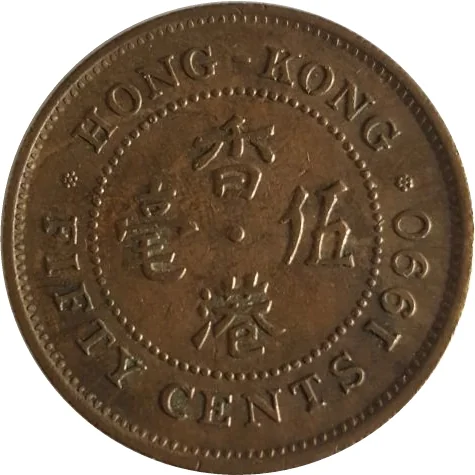
Exchange value: 0.50 HKD
Inflation-adjusted value: 2.36 HKD
Obverse
Description:
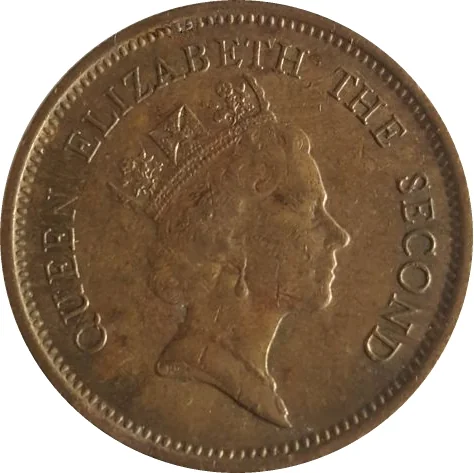
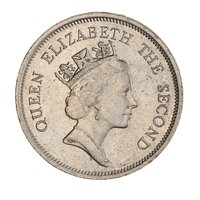
Right-facing crowned bust.
Inscription:
QUEEN ELIZABETH THE SECOND
Script: Latin
Engraver: Raphael David Maklouf
Reverse
Edge
Reeded
Mints
| Name | Mark |
|---|---|
| Royal Mint | — |
Mintings
| Year | Mint Mark | Mintage | Quality | Collection |
|---|---|---|---|---|
| 1988 | — | 25,000 | Proof | |
| 1988 | — | 50,000 | ||
| 1990 | — | 27,000,000 |
Historical background
In 1988, the Hong Kong dollar was operating under a unique and robust currency board system, established just five years earlier in 1983. This system, known as the Linked Exchange Rate System (LERS), was a direct response to a crisis of confidence that had caused the currency to plummet. It mandated that the Hong Kong dollar be pegged at a fixed rate of HK$7.80 to one US dollar, with the Hong Kong Monetary Authority (HKMA, established later in 1993) and the note-issuing banks required to hold full US dollar reserves to back the currency in circulation. This arrangement successfully eliminated exchange rate volatility and restored monetary stability, which was crucial for Hong Kong's status as an international financial and trade hub.
The economic context of 1988 was one of strong growth and rising inflation. Hong Kong was booming as a gateway to China, which was itself deepening its economic reforms. However, the currency peg imported the monetary policy of the United States, where the Federal Reserve was combating its own inflation, leading to higher interest rates. Consequently, Hong Kong experienced elevated local interest rates despite its own rapid economic expansion. This created a tension, as the peg prioritized exchange rate stability over using interest rates to manage domestic inflationary pressures, a trade-off that was generally accepted as the cost of guaranteed stability.
Politically, the currency's stability was seen as an anchor of confidence during a period of significant uncertainty regarding the territory's future, as the 1997 handover from British to Chinese sovereignty approached. The system enjoyed broad support from both the business community and the public, who viewed a stable currency as a bulwark against potential turbulence. By 1988, the LERS was considered a settled and successful policy, having weathered initial tests. Its continued operation without change that year underscored a collective commitment to maintaining this cornerstone of financial stability throughout the transition period and beyond.
The economic context of 1988 was one of strong growth and rising inflation. Hong Kong was booming as a gateway to China, which was itself deepening its economic reforms. However, the currency peg imported the monetary policy of the United States, where the Federal Reserve was combating its own inflation, leading to higher interest rates. Consequently, Hong Kong experienced elevated local interest rates despite its own rapid economic expansion. This created a tension, as the peg prioritized exchange rate stability over using interest rates to manage domestic inflationary pressures, a trade-off that was generally accepted as the cost of guaranteed stability.
Politically, the currency's stability was seen as an anchor of confidence during a period of significant uncertainty regarding the territory's future, as the 1997 handover from British to Chinese sovereignty approached. The system enjoyed broad support from both the business community and the public, who viewed a stable currency as a bulwark against potential turbulence. By 1988, the LERS was considered a settled and successful policy, having weathered initial tests. Its continued operation without change that year underscored a collective commitment to maintaining this cornerstone of financial stability throughout the transition period and beyond.
🌱 Common