

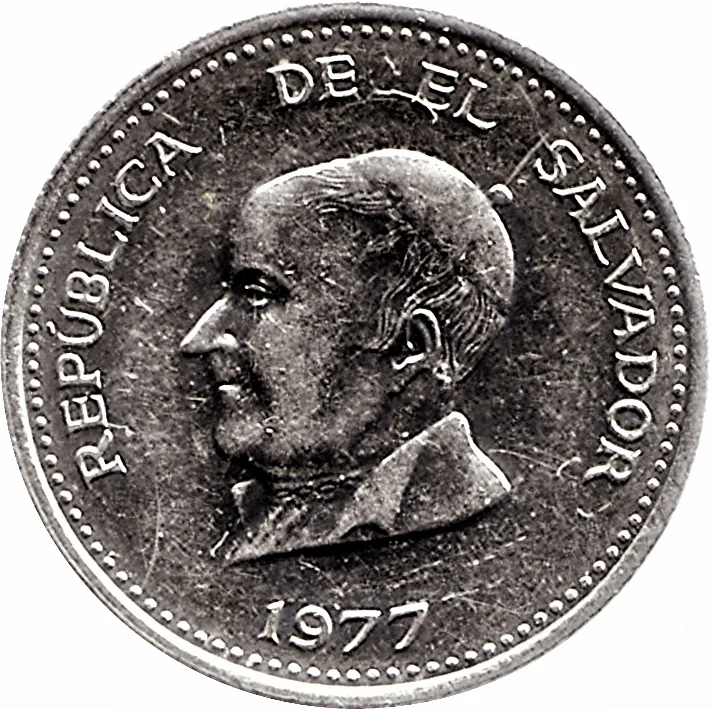
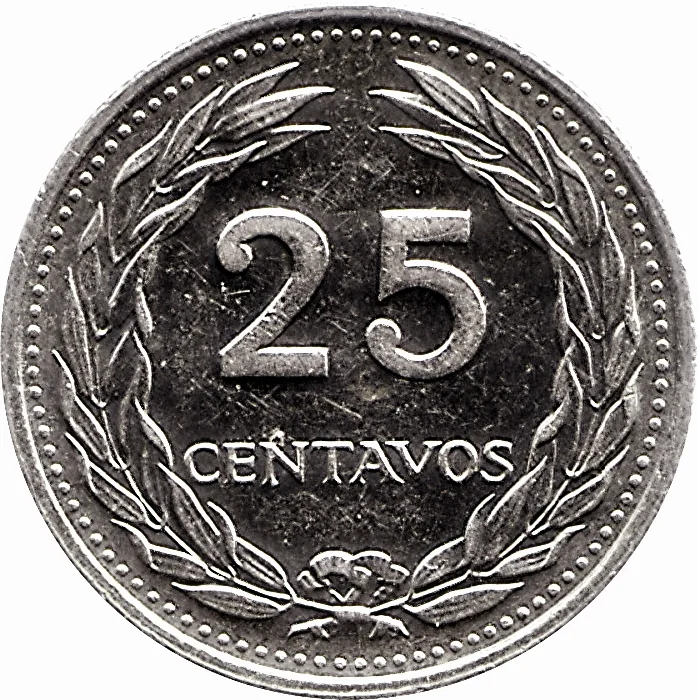
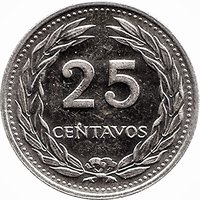
25 Centavos – El Salvador
El Salvador
Context
Years: 1970–1977
Issuer: El Salvador 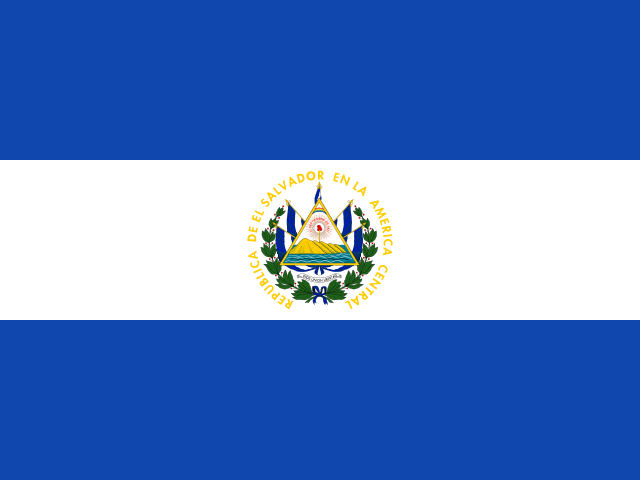
Issuing organization: Central Reserve Bank of El Salvador
Period:
(since 1841)
Currency:
(since 1892)
Demonetization: 1 January 2001
Total mintage: 84,400,000
Material
References
KM: #Click to copy to clipboard139
Numista: #5582
Value
Exchange value: 0.25 SVC
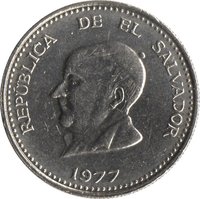
Obverse
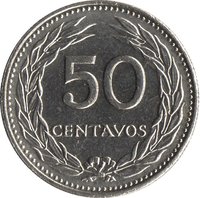
Reverse
Edge
Reeded
Categories
| Symbols> Coat of Arms |
| Person> Politician |
Mints
| Name | Mark |
|---|---|
| Royal Mint | — |
| Sherritt Mint | — |
Mintings
| Year | Mint Mark | Mintage | Quality | Collection |
|---|---|---|---|---|
| 1970 | — | — | ||
| 1970 | 1970-1971 | 14,000,000 | ||
| 1973 | — | 28,000,000 | ||
| 1975 | — | 20,000,000 | ||
| 1977 | — | 22,400,000 |
Historical background
In 1970, El Salvador operated under a fixed exchange rate system, with its currency, the colón, pegged to the United States dollar at a rate of 2.5 colones per dollar. This peg, established in 1934, provided a long-standing anchor for monetary stability and was a cornerstone of the country's economic policy. The system was managed by the Central Reserve Bank of El Salvador, which held sufficient foreign reserves, primarily in U.S. dollars, to maintain the fixed parity and ensure full convertibility. This stability was crucial for an economy heavily dependent on agricultural exports, particularly coffee, which accounted for nearly half of all export earnings.
The fixed exchange rate facilitated predictable conditions for the powerful agro-export oligarchy, known as "the fourteen families," who dominated the political and economic landscape. It minimized currency risk for their lucrative coffee and sugar exports and for importing manufactured goods. However, this monetary rigidity also reflected and reinforced the structural inequalities of Salvadoran society. The system offered little flexibility to address broader economic challenges, such as the needs of a growing urban population or an industrial sector stifled by cheap imports and a lack of competitive devaluation.
Beneath this surface stability, pressures were building. While the peg was not under immediate threat in 1970, the economy's extreme dependence on a single commodity made it vulnerable to global price shocks. Furthermore, the government's fiscal policy was increasingly constrained by its commitment to the fixed rate, limiting its ability to use monetary tools for domestic stimulus. These underlying tensions existed within a context of profound social unrest and growing inequality, which would eventually erupt into civil war—a conflict that would later severely test the endurance of the colón's decades-old dollar peg.
The fixed exchange rate facilitated predictable conditions for the powerful agro-export oligarchy, known as "the fourteen families," who dominated the political and economic landscape. It minimized currency risk for their lucrative coffee and sugar exports and for importing manufactured goods. However, this monetary rigidity also reflected and reinforced the structural inequalities of Salvadoran society. The system offered little flexibility to address broader economic challenges, such as the needs of a growing urban population or an industrial sector stifled by cheap imports and a lack of competitive devaluation.
Beneath this surface stability, pressures were building. While the peg was not under immediate threat in 1970, the economy's extreme dependence on a single commodity made it vulnerable to global price shocks. Furthermore, the government's fiscal policy was increasingly constrained by its commitment to the fixed rate, limiting its ability to use monetary tools for domestic stimulus. These underlying tensions existed within a context of profound social unrest and growing inequality, which would eventually erupt into civil war—a conflict that would later severely test the endurance of the colón's decades-old dollar peg.
🌱 Very Common