

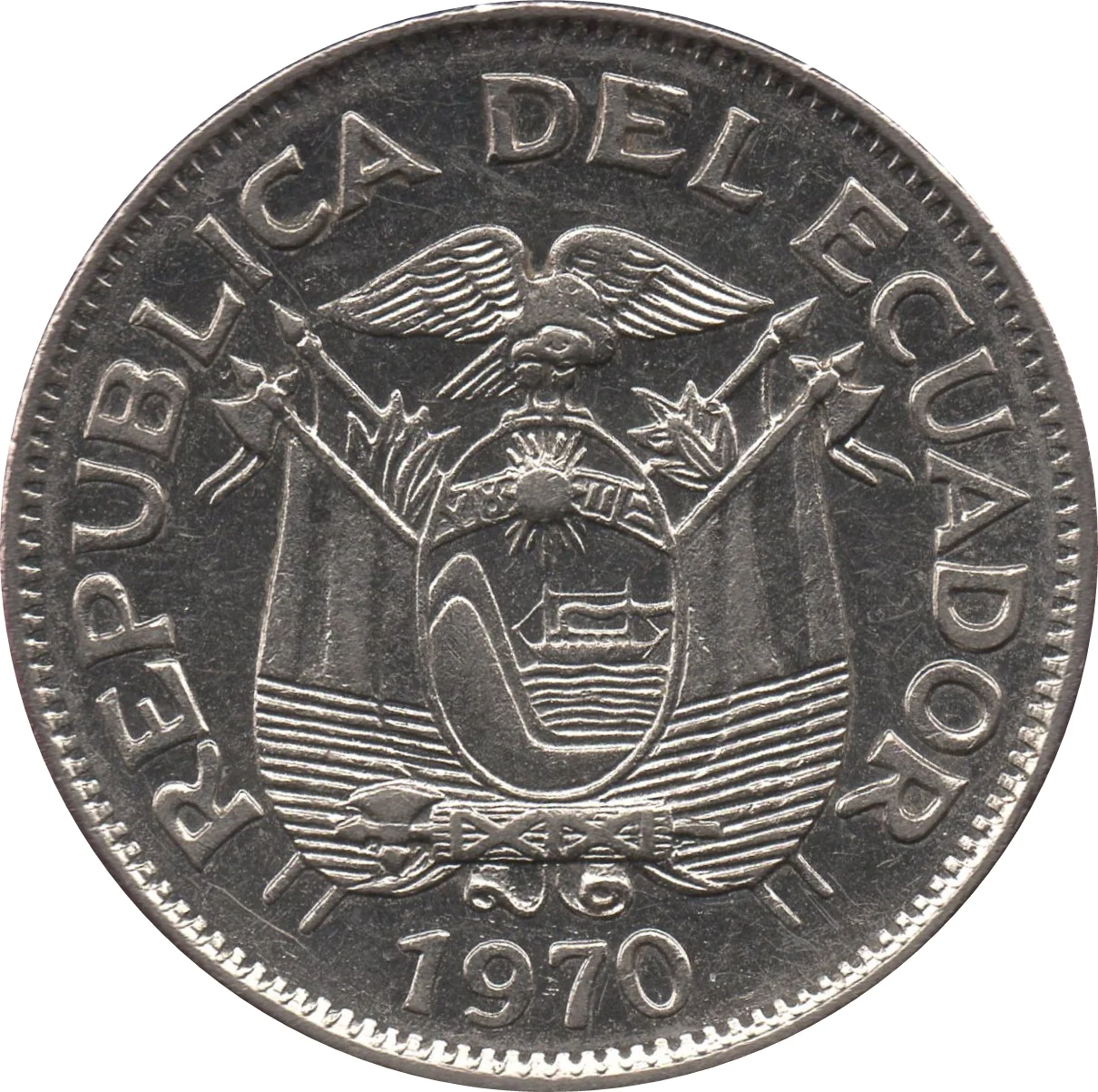
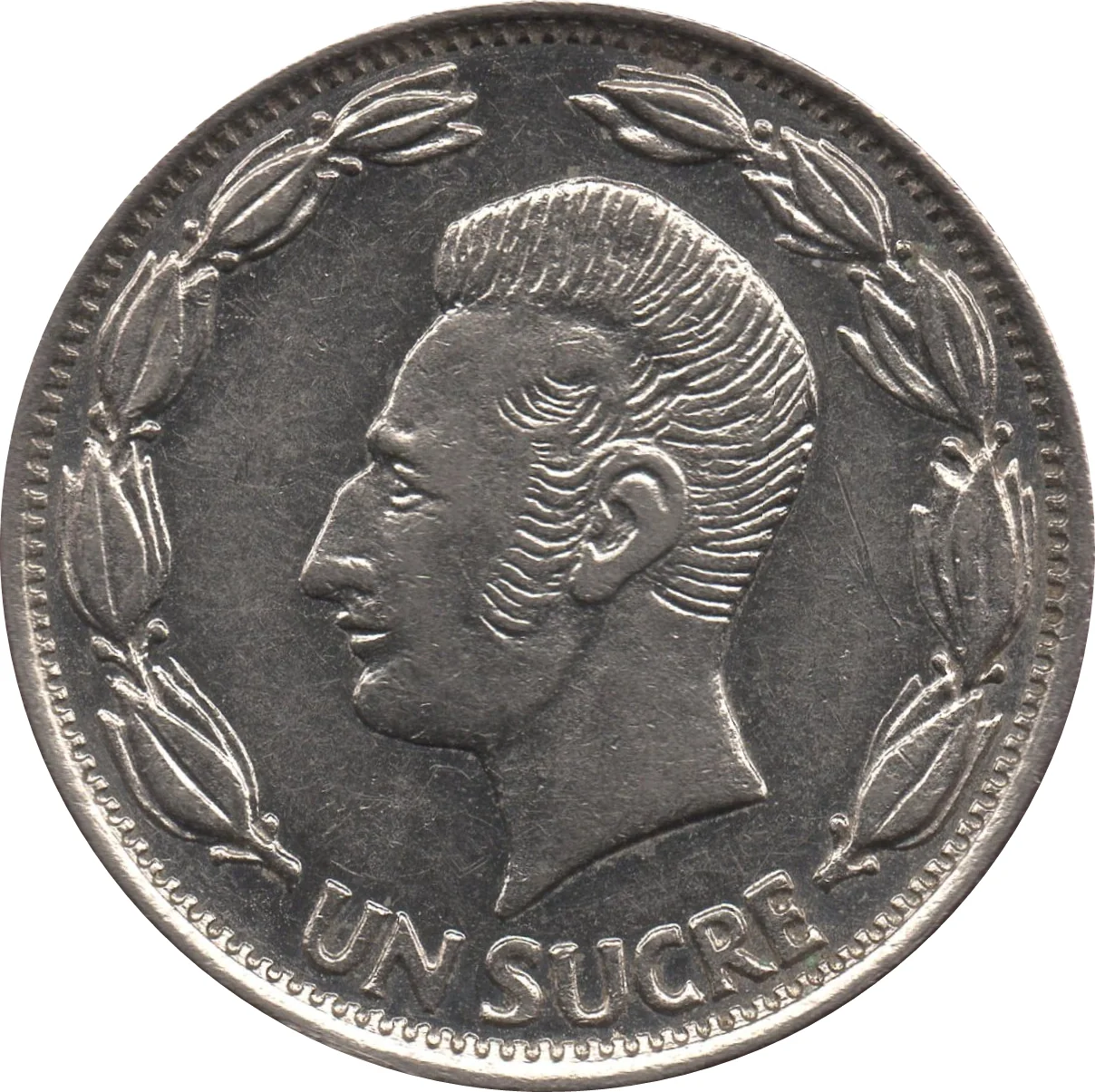
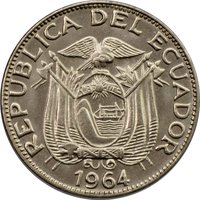
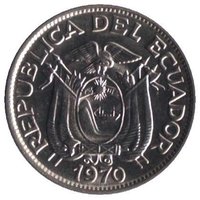
Obverse
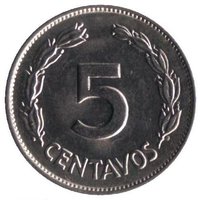
Reverse
Edge
Reeded
Categories
| Symbols> Coat of Arms |
| Person> Military leader |
| Person> Politician |
Mints
| Name | Mark |
|---|---|
| Hamburgische Münze | — |
| VDM Metals / Vereinigte Deutsche Metallwerke | — |
Mintings
| Year | Mint Mark | Mintage | Quality | Collection |
|---|---|---|---|---|
| 1964 | — | 20,000,000 | ||
| 1970 | — | 24,000,000 | ||
| 1971 | — | 8,092,000 | BU | |
| 1974 | — | 40,308,000 | ||
| 1978 | — | 32,000,000 | ||
| 1979 | — | 32,000,000 | ||
| 1980 | — | 110,000,000 | ||
| 1981 | — | 70,000,000 |
Historical background
In 1964, Ecuador's currency situation was characterized by the sucre operating under a fixed exchange rate regime, pegged to the U.S. dollar within the framework of the Bretton Woods system. This peg provided a degree of monetary stability and predictability for international trade, which was crucial for an economy heavily dependent on agricultural exports, primarily bananas, cocoa, and coffee. However, this stability was increasingly superficial, masking underlying structural economic weaknesses.
The period was one of growing fiscal and balance of payments pressures. Government spending often outpaced revenues, leading to budget deficits. While the country experienced modest growth, its export base was narrow and vulnerable to volatile global commodity prices. Furthermore, a reliance on imported manufactured goods and capital equipment contributed to a persistent trade deficit, putting steady pressure on the country's foreign exchange reserves needed to maintain the dollar peg.
Consequently, 1964 fell within a period of mounting strain that would lead to a major devaluation within a few years. The fixed exchange rate, while officially stable, was becoming increasingly overvalued, hurting the competitiveness of non-traditional exports and encouraging capital flight. Although a significant devaluation of the sucre did not occur until 1970, the economic pressures evident in 1964 were clear precursors, highlighting the difficulty of maintaining a rigid peg in the face of fiscal imbalances and a vulnerable export sector.
The period was one of growing fiscal and balance of payments pressures. Government spending often outpaced revenues, leading to budget deficits. While the country experienced modest growth, its export base was narrow and vulnerable to volatile global commodity prices. Furthermore, a reliance on imported manufactured goods and capital equipment contributed to a persistent trade deficit, putting steady pressure on the country's foreign exchange reserves needed to maintain the dollar peg.
Consequently, 1964 fell within a period of mounting strain that would lead to a major devaluation within a few years. The fixed exchange rate, while officially stable, was becoming increasingly overvalued, hurting the competitiveness of non-traditional exports and encouraging capital flight. Although a significant devaluation of the sucre did not occur until 1970, the economic pressures evident in 1964 were clear precursors, highlighting the difficulty of maintaining a rigid peg in the face of fiscal imbalances and a vulnerable export sector.

🌱 Very Common