

10 Drachmai – Greece
Greece
Context
Year: 1968
Issuer: Greece 
Ruler: Constantine II
Currency:
(1954—2001)
Demonetized: Yes
Total mintage: 40,000,000
Material
References
KM: #Click to copy to clipboard96
Numista: #556
Value
Exchange value: 10 GRD
Inflation-adjusted value: 913.50 GRD
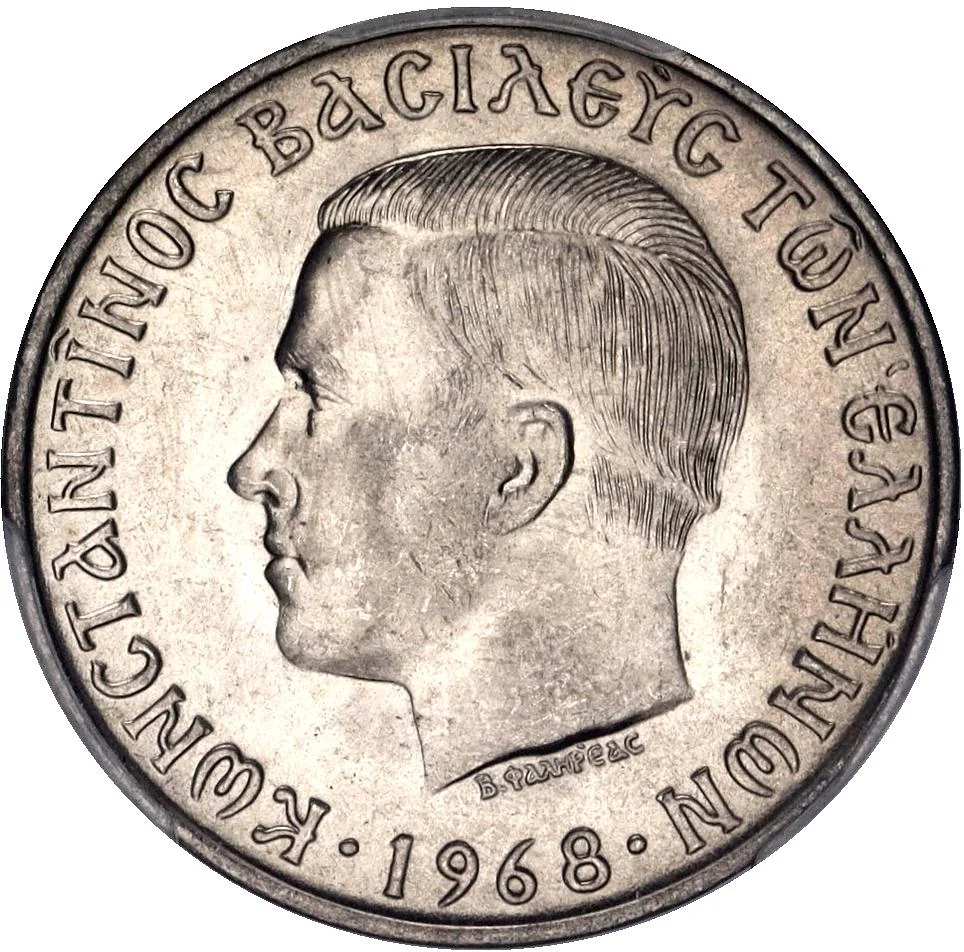
Obverse
Description:
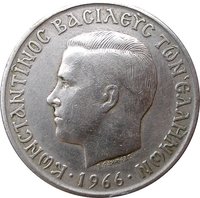
Young Constantine facing left, dated below.
Inscription:
ΚωΝCΤaΝΤΊΝΟC ΒaCΙλΕΎC ΤωΝ ΕλλΉΝωΝ
Β.ΦaλΗΡΈaC
·1968·
Β.ΦaλΗΡΈaC
·1968·
Translation:
Constantine, King of the Greeks
V. Faleras
·1968·
V. Faleras
·1968·
Script: Greek
Language: Greek
Engraver: V. Phalireas
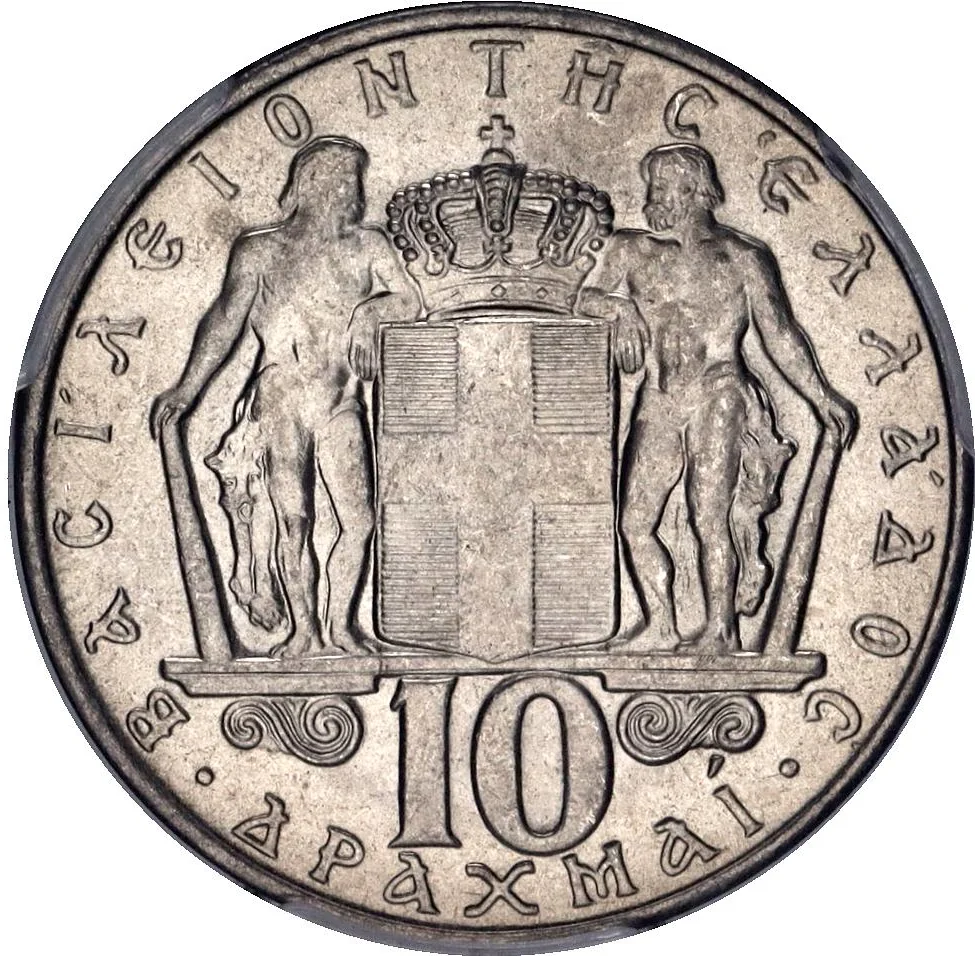
Reverse
Description:
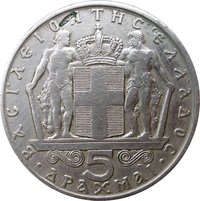
Crowned Greek arms (shield with cross) flanked by supporters, denomination below.
Inscription:
ΒaCΙλΕΙΟΝ ΤΗC ΕλλaΔΟC
10
• ΔΡaΧΜaΙ •
10
• ΔΡaΧΜaΙ •
Translation:
KINGDOM OF GREECE
10
DRACHMAI
10
DRACHMAI
Script: Greek
Language: Greek
Engraver: V. Phalireas
Edge
Plain
Mints
| Name | Mark |
|---|---|
| Kremnica | — |
Mintings
| Year | Mint Mark | Mintage | Quality | Collection |
|---|---|---|---|---|
| 1968 | — | 40,000,000 |
Historical background
In 1968, Greece's currency situation was defined by the economic policies of the military junta that had seized power the previous year. The regime, seeking to project an image of stability and attract foreign investment, maintained a fixed exchange rate of 30 drachmas to the US dollar, a peg established in 1953. This rigid parity was upheld through strict capital controls and was supported by healthy foreign exchange reserves, bolstered by a surge in tourism and remittances from Greeks working abroad. On the surface, the drachma appeared stable, and the junta touted low inflation and economic growth as signs of its successful management.
However, this stability was largely artificial and masked underlying structural weaknesses. The regime's economic strategy prioritized large-scale infrastructure projects and military spending, fueled by increased public borrowing. This led to a growing public debt and, over time, began to generate inflationary pressures that the fixed exchange rate struggled to contain. Furthermore, while certain sectors prospered, income inequality widened, and productive investment in industry remained sluggish. The economy became increasingly dependent on volatile external inflows rather than robust domestic production.
Consequently, by 1968, the foundations for future currency instability were being laid. The fixed exchange rate, while a symbol of nominal order, was becoming progressively misaligned with economic realities. The junta's politically motivated spending created imbalances that would later contribute to inflationary crises and devaluation pressures in the 1970s, after the regime's fall. Thus, the currency situation of 1968 represented a period of enforced calm, preserving an outdated parity through controls and foreign capital, but at the cost of accumulating significant economic distortions for the post-dictatorship era.
However, this stability was largely artificial and masked underlying structural weaknesses. The regime's economic strategy prioritized large-scale infrastructure projects and military spending, fueled by increased public borrowing. This led to a growing public debt and, over time, began to generate inflationary pressures that the fixed exchange rate struggled to contain. Furthermore, while certain sectors prospered, income inequality widened, and productive investment in industry remained sluggish. The economy became increasingly dependent on volatile external inflows rather than robust domestic production.
Consequently, by 1968, the foundations for future currency instability were being laid. The fixed exchange rate, while a symbol of nominal order, was becoming progressively misaligned with economic realities. The junta's politically motivated spending created imbalances that would later contribute to inflationary crises and devaluation pressures in the 1970s, after the regime's fall. Thus, the currency situation of 1968 represented a period of enforced calm, preserving an outdated parity through controls and foreign capital, but at the cost of accumulating significant economic distortions for the post-dictatorship era.
🌱 Very Common