

1 lats – Latvia
Add to wishlist
Non-circulating coins
Commemoration: Riga Cathedral
Latvia
Context
Material
References
KM: #
Numista: #55445
Value
Exchange value: 1 LVL
Bullion value: $50.79
Inflation-adjusted value: 1.57 LVL
Obverse
Description:
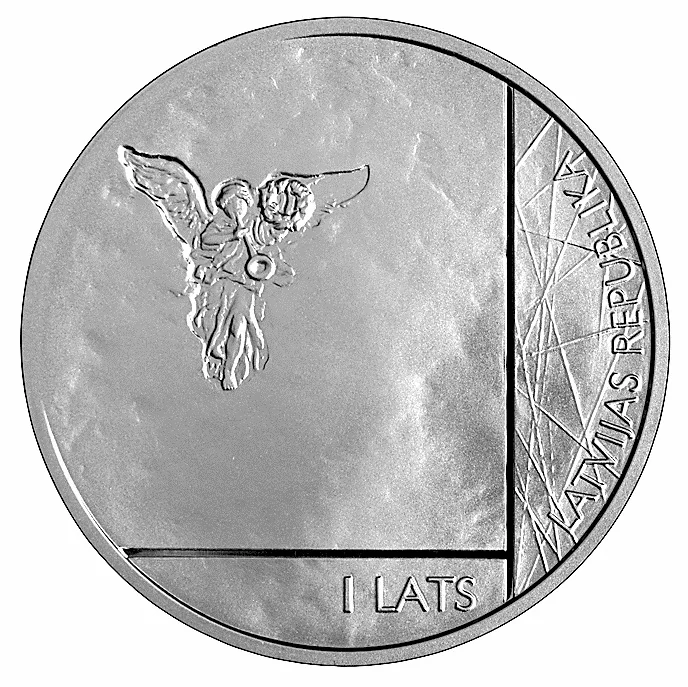
The obverse features the Riga Cathedral angel on the left, LATVIJAS REPUBLIKA on the right, and 1 LATS at the bottom, each in separate segments.
Inscription:
1 LATS
LATVIJAS REPUBLIKA
LATVIJAS REPUBLIKA
Translation:
REPUBLIC OF LATVIA
1 LATS
1 LATS
Script: Latin
Engraver: Ligita Franckeviča
Designer: Kristaps Ģelzis
Reverse
Description:
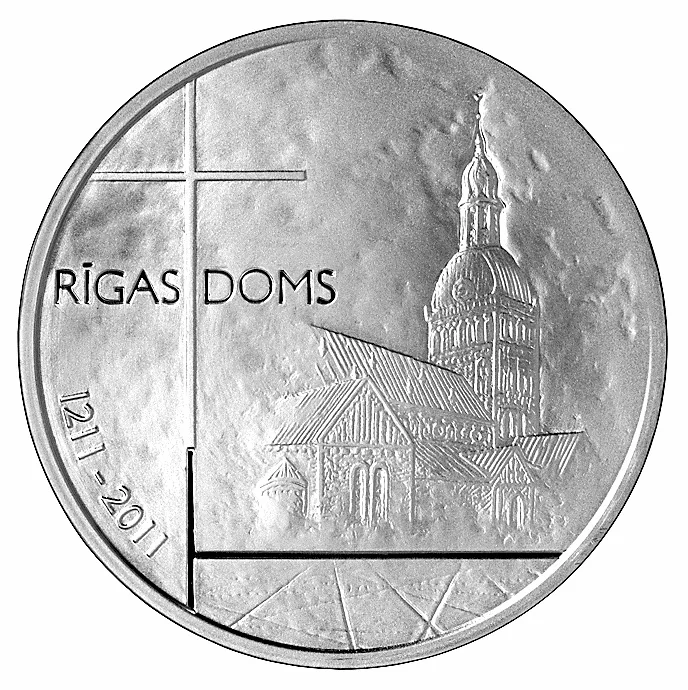
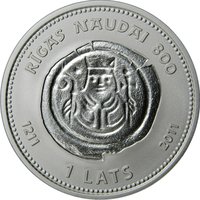
The reverse shows Riga Cathedral's building with "RĪGAS DOMS" split by a cross, and the dates 1211–2011 in a semicircle below.
Inscription:
RĪGAS DOMS
1211–2011
1211–2011
Translation:
Riga Cathedral
1211–2011
1211–2011
Script: Latin
Engraver: Ligita Franckeviča
Designer: Kristaps Ģelzis
Edge
Two inscriptions Latvijas Banka (Bank of Latvia) separated by rhombic dots.
Legend:
LATVIJAS BANKA ◊ LATVIJAS BANKA ◊
Translation:
LATVIJAS BANKA ◊ LATVIJAS BANKA ◊
Language: Latvian
Categories
| Building> Religious building |
Mints
| Name | Mark |
|---|---|
| Mint of Finland | — |
Mintings
| Year | Mint Mark | Mintage | Quality | Collection |
|---|---|---|---|---|
| 2011 | — | 5,000 | Proof |
Historical background
In 2011, Latvia was in the final stages of a remarkable recovery from a profound economic crisis. The country had been hit exceptionally hard by the 2008-2009 global financial turmoil, experiencing one of the deepest recessions in the world, with GDP contracting by over 20%. In response, the government implemented severe austerity measures and internal devaluation to restore fiscal stability, all while maintaining its long-standing currency peg to the euro. This fixed exchange rate, established in 2005, was a cornerstone of economic policy, tying the Latvian lats (LVL) to the euro at a rate of 0.702804 LVL per 1 EUR, and was seen as a critical anchor for stability and a prerequisite for eventual Eurozone membership.
The primary currency debate in 2011 centered not on devaluation—which was resolutely rejected by authorities—but on the timeline for adopting the euro. Having entered the European Exchange Rate Mechanism II (ERM II) in 2005, Latvia was formally in the euro's "waiting room." The government, led by Prime Minister Valdis Dombrovskis, was determined to meet the Maastricht convergence criteria (on inflation, budget deficit, debt, and interest rates) as swiftly as possible. The goal was to join the Eurozone in 2014, a target seen as vital for securing long-term investor confidence, reducing transaction costs, and further integrating with the European core after the trauma of the crisis.
Despite meeting the formal fiscal criteria in 2011, significant public skepticism about the euro remained. Many Latvians associated the lats with restored national independence and worried that switching to the euro would lead to a hidden rise in the cost of living, a sentiment fueled by experiences in other new Eurozone members. However, the political and economic establishment was overwhelmingly in favor, viewing euro adoption as the ultimate guarantee of financial stability and a final step away from the volatility of the crisis years. Thus, 2011 was a year of preparation and convergence, setting the stage for Latvia's successful application to join the Eurozone, which it ultimately did on January 1, 2014.
The primary currency debate in 2011 centered not on devaluation—which was resolutely rejected by authorities—but on the timeline for adopting the euro. Having entered the European Exchange Rate Mechanism II (ERM II) in 2005, Latvia was formally in the euro's "waiting room." The government, led by Prime Minister Valdis Dombrovskis, was determined to meet the Maastricht convergence criteria (on inflation, budget deficit, debt, and interest rates) as swiftly as possible. The goal was to join the Eurozone in 2014, a target seen as vital for securing long-term investor confidence, reducing transaction costs, and further integrating with the European core after the trauma of the crisis.
Despite meeting the formal fiscal criteria in 2011, significant public skepticism about the euro remained. Many Latvians associated the lats with restored national independence and worried that switching to the euro would lead to a hidden rise in the cost of living, a sentiment fueled by experiences in other new Eurozone members. However, the political and economic establishment was overwhelmingly in favor, viewing euro adoption as the ultimate guarantee of financial stability and a final step away from the volatility of the crisis years. Thus, 2011 was a year of preparation and convergence, setting the stage for Latvia's successful application to join the Eurozone, which it ultimately did on January 1, 2014.
💎 Extremely Rare