

10 Francs – French West Africa
Context
Year: 1957
Issuer: French West Africa
Issuing organization: Issuing Institute of French West Africa and Togo
Period:
(1946—1958)
Currency:
(1944—1958)
Demonetized: Yes
Total mintage: 30,000,000
Material
References
KM: #Click to copy to clipboard8
Numista: #10057
Value
Exchange value: 10 FCFA
Obverse
Description:
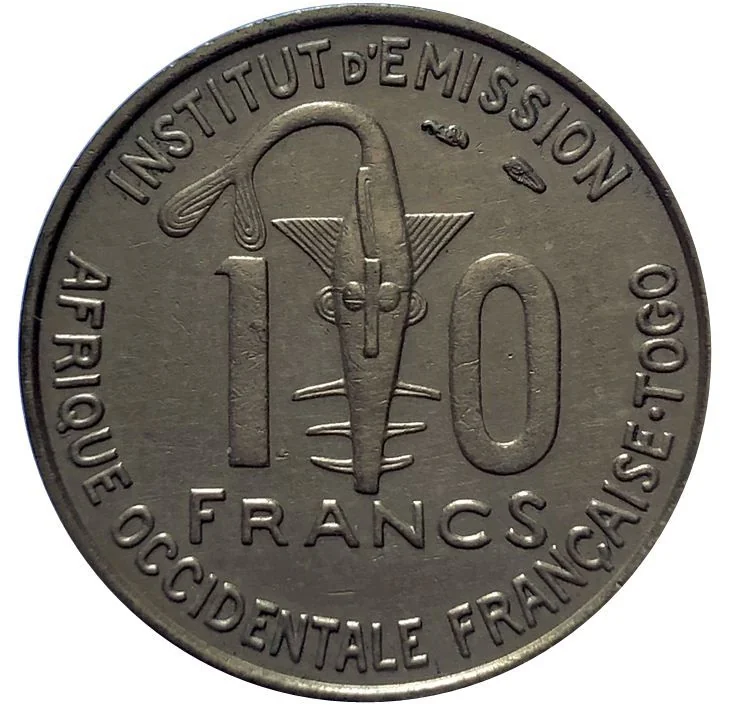
“Taku,” a prosperity symbol, divides the value.
Inscription:
INSTITUT D'EMISSION
10 FRANCS
AFRIQUE OCCIDENTALE FRANCAISE.TOGO
10 FRANCS
AFRIQUE OCCIDENTALE FRANCAISE.TOGO
Translation:
Institute of Issue
10 Francs
French West Africa. Togo
10 Francs
French West Africa. Togo
Script: Latin
Language: French
Engraver: Lucien Georges Bazor
Reverse
Description:
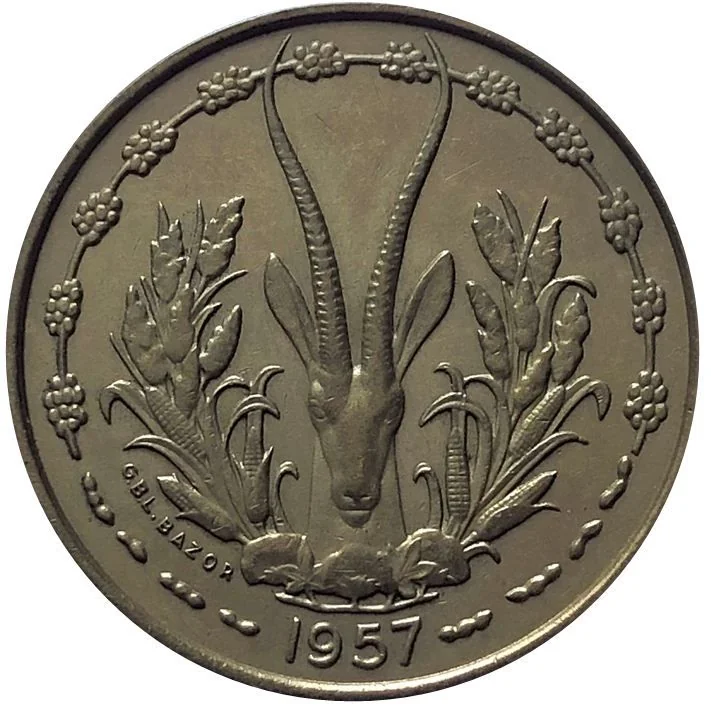
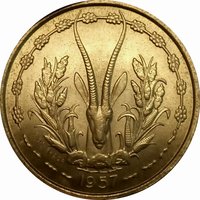
Slender-horned gazelle head among corn plants.
Inscription:
G.B.L. BAZOR
1957
1957
Script: Latin
Engraver: Lucien Georges Bazor
Edge
Plain
Mints
| Name | Mark |
|---|---|
| Monnaie de Paris | — |
Mintings
| Year | Mint Mark | Mintage | Quality | Collection |
|---|---|---|---|---|
| 1957 | — | 30,000,000 |
Historical background
In 1957, the currency situation in French West Africa (Afrique-Occidentale française, AOF) was defined by its integration into the Franc Zone and the use of the CFA franc (Colonies Françaises d'Afrique). This currency, created in 1945, was pegged to the French franc at a fixed parity and was fully guaranteed by the French Treasury, ensuring its stability and convertibility. The system was highly centralized, with monetary policy controlled from Paris by the Banque de France and implemented locally by the public institution Institut d'Emission de l’AOF et du Togo, which issued the notes and coins. This arrangement facilitated trade with France but limited the federation's autonomous economic policymaking.
Politically, this monetary framework existed in a state of tension with rising nationalist movements and the impending independence of the constituent territories. The year 1957 fell within the period of the loi-cadre (Framework Law) of 1956, which granted internal autonomy to the colonies. While this devolved some political powers, critical economic and monetary sovereignty remained firmly in French hands. Leaders like Félix Houphouët-Boigny of Côte d'Ivoire saw the guaranteed CFA franc as a source of stability for development, while others viewed it as a vestige of colonial control that would need renegotiation upon independence.
Consequently, the currency situation was a cornerstone of the broader debate about the future relationship between France and its soon-to-be-independent African colonies. The fixed parity and French guarantee provided predictability for investors and the emerging administrative elites, but they also symbolized continued economic dependency. The fundamental question in 1957 was whether this arrangement would persist after independence—a question answered the following year (1958) when the CFA franc's meaning was redefined as the Communauté Financière Africaine franc, maintaining the monetary union as most territories chose to remain within the French Community.
Politically, this monetary framework existed in a state of tension with rising nationalist movements and the impending independence of the constituent territories. The year 1957 fell within the period of the loi-cadre (Framework Law) of 1956, which granted internal autonomy to the colonies. While this devolved some political powers, critical economic and monetary sovereignty remained firmly in French hands. Leaders like Félix Houphouët-Boigny of Côte d'Ivoire saw the guaranteed CFA franc as a source of stability for development, while others viewed it as a vestige of colonial control that would need renegotiation upon independence.
Consequently, the currency situation was a cornerstone of the broader debate about the future relationship between France and its soon-to-be-independent African colonies. The fixed parity and French guarantee provided predictability for investors and the emerging administrative elites, but they also symbolized continued economic dependency. The fundamental question in 1957 was whether this arrangement would persist after independence—a question answered the following year (1958) when the CFA franc's meaning was redefined as the Communauté Financière Africaine franc, maintaining the monetary union as most territories chose to remain within the French Community.

🌱 Very Common