

5 Drachmai – Greece
Circulating commemorative coins
Commemoration: The Regime of the Colonels of 21 April 1967
Greece
Context
Years: 1971–1973
Issuer: Greece 
Period:
(1967—1974)
Ruler: Constantine II
Currency:
(1954—2001)
Demonetized: Yes
Total mintage: 7,180,153
Material
References
KM: #Click to copy to clipboard100
Numista: #552
Value
Exchange value: 5 GRD
Inflation-adjusted value: 432.11 GRD
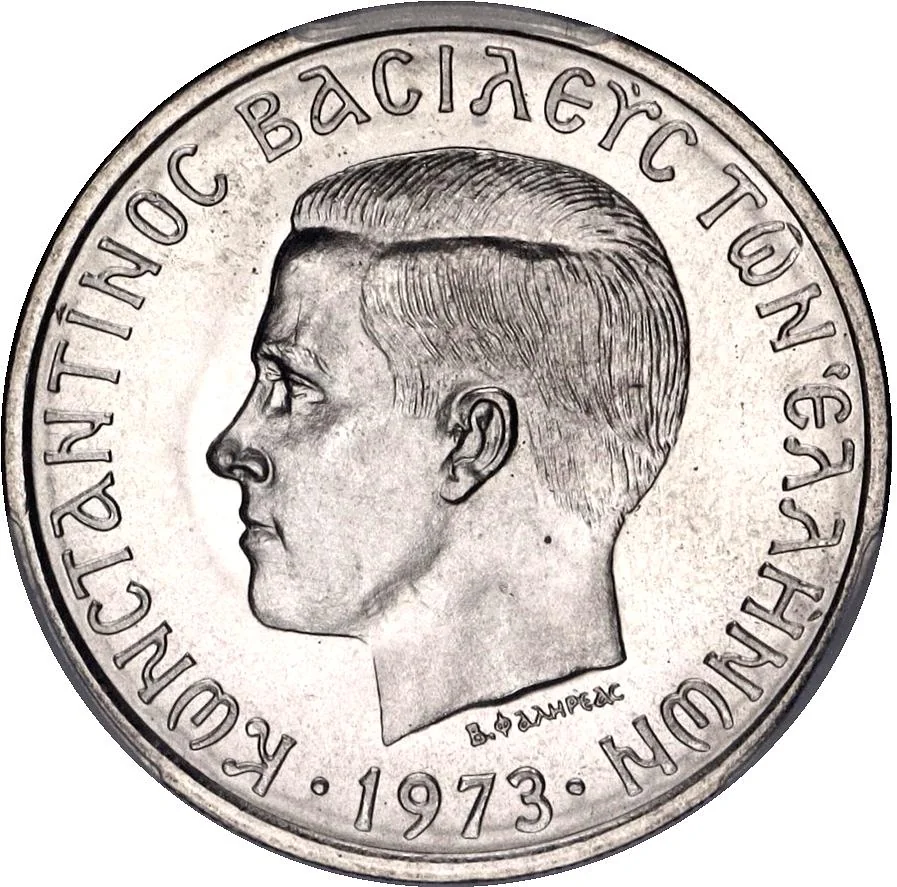
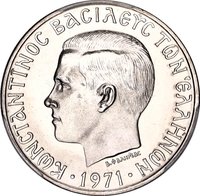
Obverse
Description:
Young Constantine II portrait left, engraver's signature beneath, date below.
Inscription:
ΚωΝCΤaΝΤΙΝΟC ΒaCΙλΕΥC ΤωΝ ΕλλΗΝωΝ
Β. ΦaλΗΡΕaC
·1973·
Β. ΦaλΗΡΕaC
·1973·
Translation:
Constantine, King of the Greeks
B. Phaleron
·1973·
B. Phaleron
·1973·
Script: Greek
Language: Greek
Engraver: Vasos Falireas
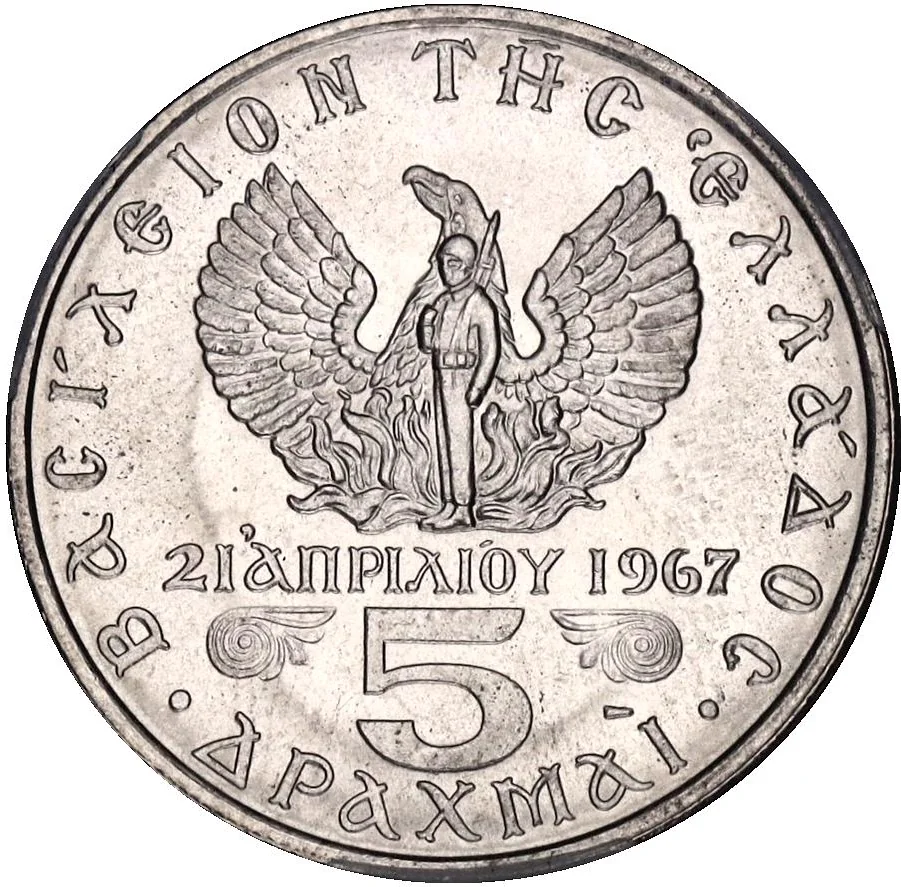
Reverse
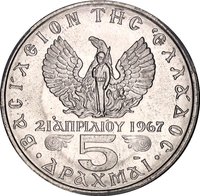
Description:
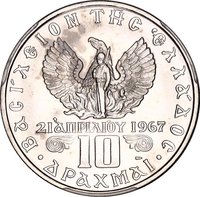
Soldier before a phoenix (Junta emblem), with anniversary date and denomination below.
Inscription:
ΒaCΙλΕΙΟΝ ΤΗC ΕλλaΔΟC
21 aΠΡΙλΙΟΥ 1967
5
• ΔΡaΧΜaΙ •
21 aΠΡΙλΙΟΥ 1967
5
• ΔΡaΧΜaΙ •
Translation:
ROYAL HELLENIC
21 APRIL 1967
5
• DRACHMAI •
21 APRIL 1967
5
• DRACHMAI •
Script: Greek
Language: Greek
Engraver: Vasos Falireas
Edge
Reeded
Mints
| Name | Mark |
|---|---|
| National Mint of the Bank of Greece | — |
Mintings
| Year | Mint Mark | Mintage | Quality | Collection |
|---|---|---|---|---|
| 1971 | — | 4,014,180 | ||
| 1973 | — | 3,165,973 |
Historical background
In 1971, Greece's currency situation was defined by its participation in the Bretton Woods system of fixed exchange rates, which pegged the Greek drachma to the US dollar. This arrangement, managed by the Bank of Greece, provided a framework of monetary stability that was crucial for the country's rapid economic growth during the post-war "Greek economic miracle." The drachma's fixed parity facilitated trade and investment, supporting the industrial and tourism-led expansion under the military junta that had been in power since 1967.
However, this stability existed against a backdrop of growing international monetary turbulence. The Bretton Woods system itself was under severe strain in 1971, primarily due to pressures on the US dollar. This culminated in the Nixon Shock in August 1971, when President Richard Nixon suspended the dollar's convertibility into gold, effectively ending the Bretton Woods system. For Greece, this global event immediately threw its currency peg into question and introduced significant uncertainty regarding future exchange rate policy and the value of its foreign reserves.
Consequently, the Greek authorities were forced to navigate a new and volatile international monetary environment. In the immediate aftermath, Greece initially maintained the drachma's peg to the now-floating US dollar, but the foundational guarantee of the old system was gone. This marked the beginning of a transitional period where Greece, like many nations, had to reconsider its exchange rate regime, setting the stage for the currency realignments, inflationary pressures, and eventual devaluations that would characterize the following decade.
However, this stability existed against a backdrop of growing international monetary turbulence. The Bretton Woods system itself was under severe strain in 1971, primarily due to pressures on the US dollar. This culminated in the Nixon Shock in August 1971, when President Richard Nixon suspended the dollar's convertibility into gold, effectively ending the Bretton Woods system. For Greece, this global event immediately threw its currency peg into question and introduced significant uncertainty regarding future exchange rate policy and the value of its foreign reserves.
Consequently, the Greek authorities were forced to navigate a new and volatile international monetary environment. In the immediate aftermath, Greece initially maintained the drachma's peg to the now-floating US dollar, but the foundational guarantee of the old system was gone. This marked the beginning of a transitional period where Greece, like many nations, had to reconsider its exchange rate regime, setting the stage for the currency realignments, inflationary pressures, and eventual devaluations that would characterize the following decade.
🌱 Very Common