

10 reais – Brazil
Add to wishlist
Non-circulating coins
Commemoration: FIFA World Cup 2014
Brazil
Obverse
Description:
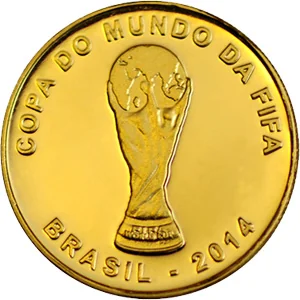
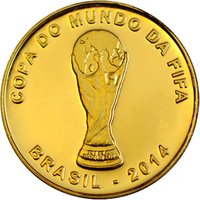
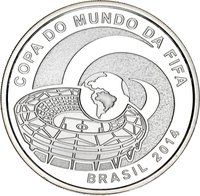
The FIFA World Cup trophy bears the inscriptions "FIFA WORLD CUP" and "BRAZIL 2014".
Inscription:
COPA DO MUNDO DA FIFA
BRASIL 2014
BRASIL 2014
Translation:
FIFA World Cup
Brazil 2014
Brazil 2014
Script: Latin
Language: Portuguese
Reverse
Description:
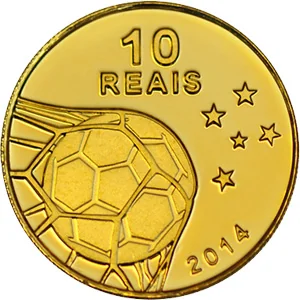
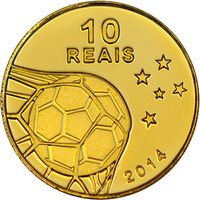
A ball stretching the net, simulating a goal, under the value of 10 REAIS. To the right, the Southern Cross stars. Below, the date on the rim.
Inscription:
10
REAIS
2014
REAIS
2014
Script: Latin
Edge
Reeded
Categories
| Sport> Football> FIFA World Cup |
Mints
| Name | Mark |
|---|---|
| Casa da Moeda do Brasil | — |
Mintings
| Year | Mint Mark | Mintage | Quality | Collection |
|---|---|---|---|---|
| 2014 | — | 5,000 | Proof |
Historical background
In 2014, Brazil's currency, the Real (BRL), faced significant pressure amidst a deteriorating economic and political landscape. The year began with the BRL trading around 2.25 to the US dollar, but it weakened steadily, closing the year near 2.65. This depreciation was driven by a combination of external and internal factors, including the tapering of quantitative easing by the US Federal Reserve, which reduced global liquidity and investor appetite for emerging market assets like Brazil's. Concurrently, global commodity prices, a crucial source of Brazil's export revenue, began to soften, worsening the country's current account deficit.
Domestically, the situation was exacerbated by profound economic mismanagement. President Dilma Rousseff's administration, having used significant fiscal stimulus to combat the 2008 financial crisis, was now grappling with the consequences: high inflation, stagnant growth, and a loss of investor confidence. The central bank, under pressure to control inflation which was breaching the upper limit of its target band, was in a difficult position, as raising interest rates to support the currency and curb inflation would further stifle an economy already entering a recession. This policy dilemma created uncertainty in financial markets.
Furthermore, the currency's decline was accelerated by the unfolding Petrobras corruption scandal (Operação Lava Jato), which erupted in early 2014. The investigation revealed massive graft and mismanagement at the state-controlled oil company, symbolizing a broader crisis of governance. This political shock severely damaged Brazil's investment-grade credibility, prompting capital flight and increasing the risk premium demanded by investors to hold Brazilian assets. Thus, by the end of 2014, the Real's weakness was a clear reflection of a "perfect storm" of fading global tailwinds, domestic economic stagnation, and a profound political crisis that eroded institutional trust.
Domestically, the situation was exacerbated by profound economic mismanagement. President Dilma Rousseff's administration, having used significant fiscal stimulus to combat the 2008 financial crisis, was now grappling with the consequences: high inflation, stagnant growth, and a loss of investor confidence. The central bank, under pressure to control inflation which was breaching the upper limit of its target band, was in a difficult position, as raising interest rates to support the currency and curb inflation would further stifle an economy already entering a recession. This policy dilemma created uncertainty in financial markets.
Furthermore, the currency's decline was accelerated by the unfolding Petrobras corruption scandal (Operação Lava Jato), which erupted in early 2014. The investigation revealed massive graft and mismanagement at the state-controlled oil company, symbolizing a broader crisis of governance. This political shock severely damaged Brazil's investment-grade credibility, prompting capital flight and increasing the risk premium demanded by investors to hold Brazilian assets. Thus, by the end of 2014, the Real's weakness was a clear reflection of a "perfect storm" of fading global tailwinds, domestic economic stagnation, and a profound political crisis that eroded institutional trust.
💎 Extremely Rare