

10 Florin – Aruba
Non-circulating coins
Commemoration: Death of Queen Juliana
Netherlands
Context
Year: 2005
Country: Netherlands 
Issuer: Aruba
Ruler: Beatrix
Currency:
(since 1986)
Total mintage: 10,000
Material
References
KM: #Click to copy to clipboard33
Numista: #54873
Value
Exchange value: 10 AWG
Bullion value: $207.97
Inflation-adjusted value: 15.48 AWG
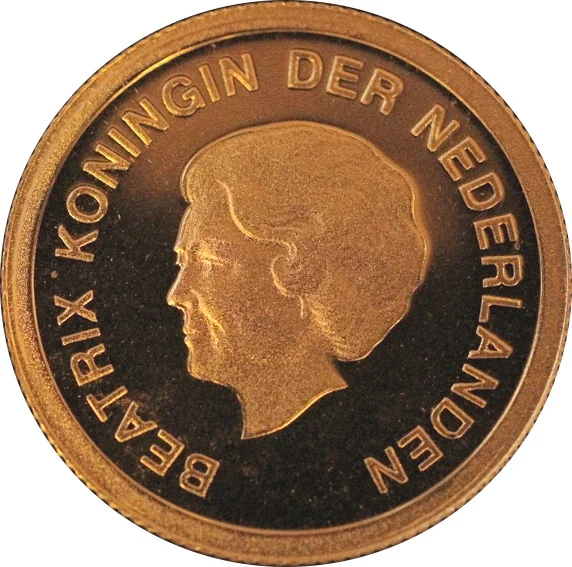
Obverse
Description:
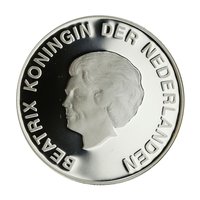
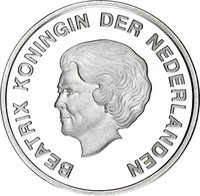
Queen Beatrix facing right.
Inscription:
BEATRIX KONINGIN DER NEDERLANDEN
Translation:
Beatrix Queen of the Netherlands
Script: Latin
Language: Dutch
Engraver: Evelino Fingal
Reverse
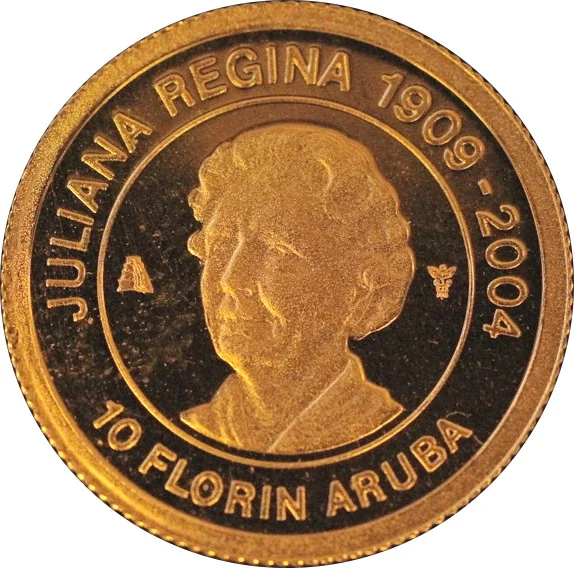
Description:
Queen Juliana bust, denomination beneath.
Inscription:
JULIANA REGINA 1909-2004
10 FLORIN ARUBA
10 FLORIN ARUBA
Script: Latin
Engraver: Willem Vis
Edge
Reeded
Categories
| Event> Death anniversary |
| Person> Monarch |
Mints
| Name | Mark |
|---|---|
| Royal Dutch Mint | — |
Mintings
| Year | Mint Mark | Mintage | Quality | Collection |
|---|---|---|---|---|
| 2005 | — | 10,000 |
Historical background
In 2005, Aruba's currency situation was defined by its long-standing and stable peg to the United States dollar. Since 1986, the Aruban florin (AWG) had been fixed at a rate of 1.79 florin to 1 US dollar. This monetary policy, managed by the Central Bank of Aruba (CBA), provided a crucial anchor for the island's tourism-dependent economy, offering predictability for importers, exporters, and the vital hospitality sector, which primarily transacted in dollars. The peg was supported by adequate foreign exchange reserves and was considered a cornerstone of Aruba's economic stability, helping to control inflation and foster investor confidence.
The year 2005, however, fell within a period of notable economic challenge for the island. Aruba was still navigating the aftermath of a severe recession triggered earlier in the decade by the collapse of its major industry, tourism, following the September 11, 2001 attacks. While recovery was underway, public debt levels were high, exceeding 70% of GDP, placing fiscal pressure on the government. Despite this strain, the currency peg itself remained robust and was not under immediate threat, as the Central Bank maintained its commitment to the fixed exchange rate as a non-negotiable element of financial policy.
Consequently, the monetary landscape in 2005 was one of stability in the exchange rate regime amidst broader economic fragility. The Central Bank's focus was on maintaining the peg while managing the side effects, such as limited independent monetary policy tools to stimulate the economy. Discussions in financial circles occasionally touched on the pros and cons of dollarization, but the official stance was firmly in favor of retaining the managed florin. Thus, the currency situation reflected a strategic choice to prioritize exchange rate stability as a foundation for continued economic recovery and growth.
The year 2005, however, fell within a period of notable economic challenge for the island. Aruba was still navigating the aftermath of a severe recession triggered earlier in the decade by the collapse of its major industry, tourism, following the September 11, 2001 attacks. While recovery was underway, public debt levels were high, exceeding 70% of GDP, placing fiscal pressure on the government. Despite this strain, the currency peg itself remained robust and was not under immediate threat, as the Central Bank maintained its commitment to the fixed exchange rate as a non-negotiable element of financial policy.
Consequently, the monetary landscape in 2005 was one of stability in the exchange rate regime amidst broader economic fragility. The Central Bank's focus was on maintaining the peg while managing the side effects, such as limited independent monetary policy tools to stimulate the economy. Discussions in financial circles occasionally touched on the pros and cons of dollarization, but the official stance was firmly in favor of retaining the managed florin. Thus, the currency situation reflected a strategic choice to prioritize exchange rate stability as a foundation for continued economic recovery and growth.
💎 Extremely Rare