

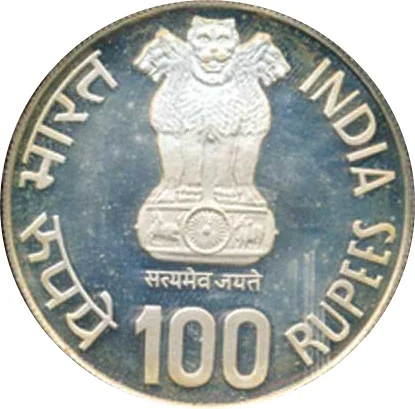
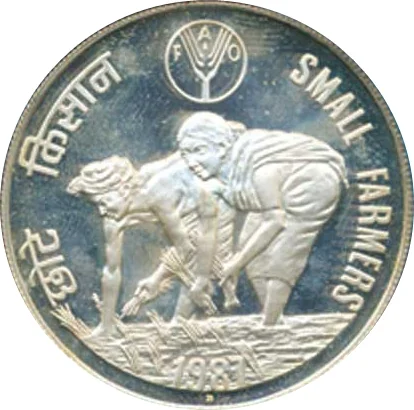
100 rupees – India
Add to wishlist
Non-circulating coins
Commemoration: Small Farmers Development Oriented
India
Material

References
KM: #
Numista: #54663
Value
Exchange value: 100 INR
Bullion value: $44.87
Inflation-adjusted value: 1440.33 INR
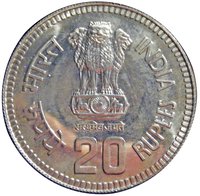
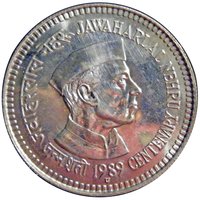
Obverse
Reverse
Edge
Categories
| Organization> FAO |
Mints
| Name | Mark |
|---|---|
| Mumbai / Bombay | ♦ |
| Mumbai / Bombay | B |
Historical background
In 1987, India's currency situation was characterized by a tightly controlled and complex exchange rate regime operating within a broader context of economic strain. The Indian Rupee (INR) was not freely convertible and was pegged to a basket of currencies of India's major trading partners, with the Reserve Bank of India (RBI) managing its value. This period fell squarely within the era of the "License Raj," where extensive government regulations and protectionist policies, including stringent foreign exchange controls under the Foreign Exchange Regulation Act (FERA), dictated all international transactions. The official exchange rate was artificially maintained, leading to a significant and persistent gap with the black-market rate for currencies like the US dollar, a clear indicator of the underlying economic pressures and excess demand for foreign exchange.
The macroeconomic backdrop was challenging, with the country facing large fiscal and current account deficits, high inflation, and dwindling foreign exchange reserves. These deficits were primarily financed by borrowing, leading to a growing external debt burden. The overvalued official exchange rate, maintained to keep import costs low for essentials like oil and fertilizers, inadvertently discouraged exports and made the balance of payments position increasingly precarious. Consequently, India had to repeatedly seek assistance from the International Monetary Fund (IMF), with the 1987 period being part of the aftermath of a large loan taken in 1981.
Overall, the currency situation in 1987 reflected a system under severe duress, masking deeper structural economic weaknesses. The controlled regime was becoming increasingly unsustainable, failing to address fundamental issues of competitiveness and fiscal discipline. While a full-scale crisis was still a few years away, the pressures evident in 1987 set the stage for the profound economic reforms and the balance of payments crisis of 1991, which would ultimately lead to the devaluation of the rupee and a decisive shift towards a market-determined exchange rate system.
The macroeconomic backdrop was challenging, with the country facing large fiscal and current account deficits, high inflation, and dwindling foreign exchange reserves. These deficits were primarily financed by borrowing, leading to a growing external debt burden. The overvalued official exchange rate, maintained to keep import costs low for essentials like oil and fertilizers, inadvertently discouraged exports and made the balance of payments position increasingly precarious. Consequently, India had to repeatedly seek assistance from the International Monetary Fund (IMF), with the 1987 period being part of the aftermath of a large loan taken in 1981.
Overall, the currency situation in 1987 reflected a system under severe duress, masking deeper structural economic weaknesses. The controlled regime was becoming increasingly unsustainable, failing to address fundamental issues of competitiveness and fiscal discipline. While a full-scale crisis was still a few years away, the pressures evident in 1987 set the stage for the profound economic reforms and the balance of payments crisis of 1991, which would ultimately lead to the devaluation of the rupee and a decisive shift towards a market-determined exchange rate system.

💎 Very Rare