

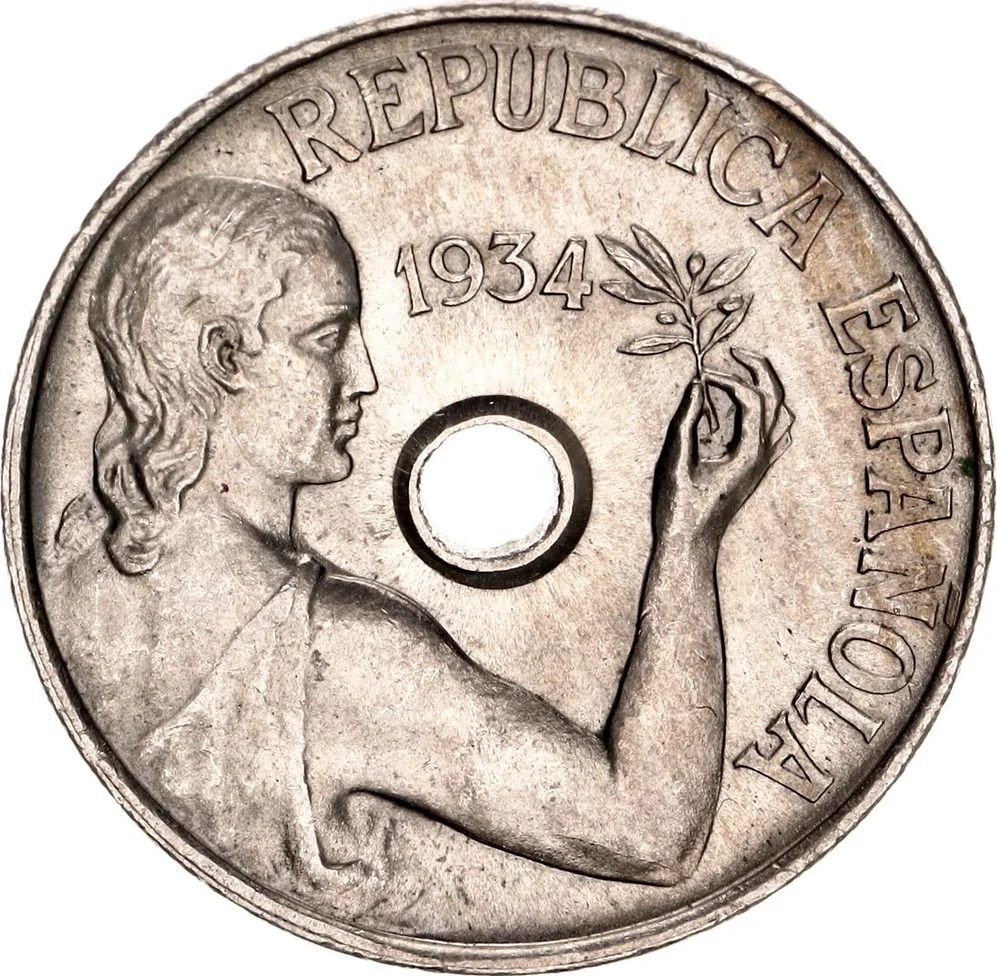
25 centimos – Spain
Add to wishlist
Spain
Context
Year: 1934
Issuer: Spain
Period:
(1931—1939)
Currency:
(1868—2001)
Demonetized: Yes
Total mintage: 12,272,000
Material
Diameter: 25 mm
Weight: 7 g
Thickness: 1.6 mm
Shape: Round with a round hole
Composition: Copper-nickel
Technique: Milled
Alignment: Coin alignment
flip
References
KM: #
Numista: #5465
Value
Exchange value: 0.25 ESP
Obverse
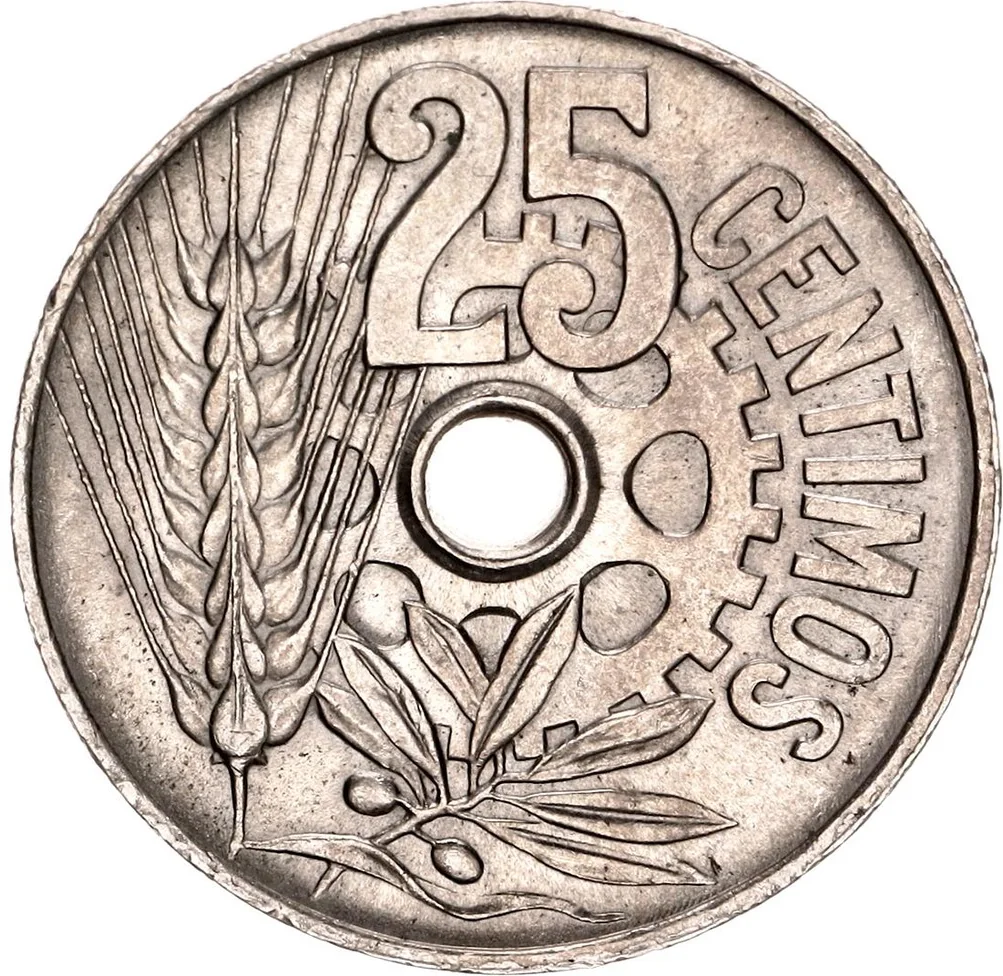
Reverse
Description:
Cogwheel with central hole, flanked by a left wheat ear and a lower olive branch.
Inscription:
25 CENTIMOS
Script: Latin
Edge
Plain
Categories
| Agriculture |
| Industry |
| Symbol> Allegory |
Mints
| Name | Mark |
|---|---|
| Royal Mint of Madrid | — |
Mintings
| Year | Mint Mark | Mintage | Quality | Collection |
|---|---|---|---|---|
| 1934 | — | 12,272,000 |
Historical background
In 1934, Spain's currency situation was deeply unstable, reflecting the profound political and social turmoil of the Second Republic. The peseta, while still the official currency, suffered from a crisis of confidence and significant devaluation on international markets. This was primarily driven by large budget deficits, which the government financed through borrowing from the Bank of Spain, effectively printing money. The political climate—marked by the left-wing government's sweeping agrarian and anti-clerical reforms, the miners' uprising in Asturias, and the growing polarization between right and left—scared away foreign investment and triggered capital flight, further weakening the currency.
Economically, the country was still reeling from the Great Depression, which had devastated its key agricultural exports. A persistent trade deficit drained gold and foreign exchange reserves, limiting the government's ability to defend the peseta's value. While not experiencing the hyperinflation seen in Weimar Germany, Spain endured significant inflationary pressures that eroded purchasing power, exacerbating social unrest. The government's attempts to control the situation, including exchange controls and protectionist policies, proved largely ineffective in stabilizing the monetary system.
Ultimately, the currency instability of 1934 was a symptom of the Republic's broader failure to establish a cohesive economic policy or political consensus. The lack of confidence in the government translated directly into a lack of confidence in its money. This financial fragility contributed to the atmosphere of crisis that culminated in the military uprising of July 1936 and the outbreak of the Spanish Civil War, which would completely dismantle the national economy and its monetary system.
Economically, the country was still reeling from the Great Depression, which had devastated its key agricultural exports. A persistent trade deficit drained gold and foreign exchange reserves, limiting the government's ability to defend the peseta's value. While not experiencing the hyperinflation seen in Weimar Germany, Spain endured significant inflationary pressures that eroded purchasing power, exacerbating social unrest. The government's attempts to control the situation, including exchange controls and protectionist policies, proved largely ineffective in stabilizing the monetary system.
Ultimately, the currency instability of 1934 was a symptom of the Republic's broader failure to establish a cohesive economic policy or political consensus. The lack of confidence in the government translated directly into a lack of confidence in its money. This financial fragility contributed to the atmosphere of crisis that culminated in the military uprising of July 1936 and the outbreak of the Spanish Civil War, which would completely dismantle the national economy and its monetary system.
🌱 Very Common