

150 rupees (Motilal Nehru) – India
Add to wishlist
Non-circulating coins
Commemoration: 150th Birth Anniversary of Motilal Nehru
India
Material
References
KM: #
Numista: #54630
Value
Exchange value: 150 INR
Bullion value: $43.68
Inflation-adjusted value: 327.98 INR
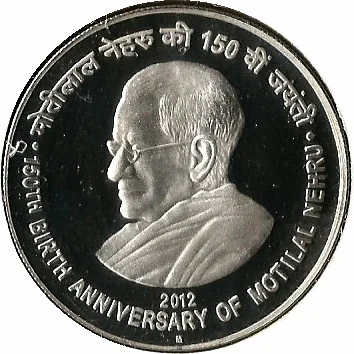
Obverse
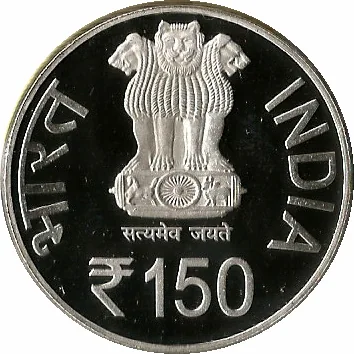
Reverse
Description:
Motilal Nehru faces left in the center. The top reads "मोतीलाल नेहरू की 150वी जयंती" and the bottom "150th BIRTH ANNIVERSARY OF MOTILAL NEHRU," with "2012" below the portrait.
Inscription:
मोतीलाल नेहरू की 150वी जयंती
150th BIRTH ANNIVERSARY OF MOTILAL NEHRU
2012
150th BIRTH ANNIVERSARY OF MOTILAL NEHRU
2012
Translation:
150th Birth Anniversary of Motilal Nehru
2012
2012
Language: Hindi
Edge
Categories
| Event> Birth anniversary |
Mints
| Name | Mark |
|---|---|
| Mumbai / Bombay | ♦ |
| Mumbai / Bombay | M |
Historical background
In 2012, India's currency situation was dominated by a sharp and concerning depreciation of the Indian Rupee (INR) against the US Dollar, alongside persistent domestic inflation. The rupee, which traded around 53 to the dollar at the start of the year, weakened significantly, breaching the psychologically critical level of 57 by June. This decline was driven by a combination of global and domestic factors, including a widening current account deficit (CAD), which ballooned to nearly 5% of GDP due to high gold and oil imports, and a general "risk-off" sentiment in global markets stemming from the Eurozone debt crisis. Foreign Institutional Investors (FIIs) were pulling capital out of emerging markets, exacerbating the pressure on the rupee.
Domestically, the economic backdrop complicated the Reserve Bank of India's (RBI) policy response. While growth was slowing, inflation, particularly for food and fuel, remained stubbornly high, limiting the central bank's ability to cut interest rates aggressively to stimulate the economy. High fiscal deficits also contributed to macroeconomic instability, undermining investor confidence. The government attempted to curb the CAD by raising import duties on gold and taking administrative measures to attract foreign capital, but these actions provided only temporary relief. The rupee's volatility created significant challenges for businesses, especially those with foreign currency debt, and raised the cost of crucial imports like crude oil, further fuelling inflationary pressures.
By the latter half of 2012, the situation began to stabilize modestly following assertive measures by the new RBI Governor, Raghuram Rajan, who took office in September 2013, and a gradual improvement in global risk appetite. However, the year 2012 served as a stark reminder of India's external vulnerabilities. It highlighted the structural issues of a high CAD coupled with reliance on volatile capital flows to finance it, setting the stage for the more profound macroeconomic reforms and the focus on building foreign exchange reserves that would characterize the subsequent years.
Domestically, the economic backdrop complicated the Reserve Bank of India's (RBI) policy response. While growth was slowing, inflation, particularly for food and fuel, remained stubbornly high, limiting the central bank's ability to cut interest rates aggressively to stimulate the economy. High fiscal deficits also contributed to macroeconomic instability, undermining investor confidence. The government attempted to curb the CAD by raising import duties on gold and taking administrative measures to attract foreign capital, but these actions provided only temporary relief. The rupee's volatility created significant challenges for businesses, especially those with foreign currency debt, and raised the cost of crucial imports like crude oil, further fuelling inflationary pressures.
By the latter half of 2012, the situation began to stabilize modestly following assertive measures by the new RBI Governor, Raghuram Rajan, who took office in September 2013, and a gradual improvement in global risk appetite. However, the year 2012 served as a stark reminder of India's external vulnerabilities. It highlighted the structural issues of a high CAD coupled with reliance on volatile capital flows to finance it, setting the stage for the more profound macroeconomic reforms and the focus on building foreign exchange reserves that would characterize the subsequent years.

⭐ Rare