

100 drachmai – Greece
Add to wishlist
Circulating commemorative coins
Commemoration: VI World Championships in Athletics
Greece
Context
Year: 1997
Issuer: Greece
Period:
(since 1974)
Currency:
(1954—2001)
Demonetization: 28 February 2002
Total mintage: 5,000,000
Material
Diameter: 29.48 mm
Weight: 9.87 g
Thickness: 2.22 mm
Shape: Round
Composition: Aluminium bronze
Magnetic: No
Technique: Milled
Alignment: Medal alignment
flip
References
KM: #
Numista: #5449
Value
Exchange value: 100 GRD
Inflation-adjusted value: 193.23 GRD
Obverse
Description:
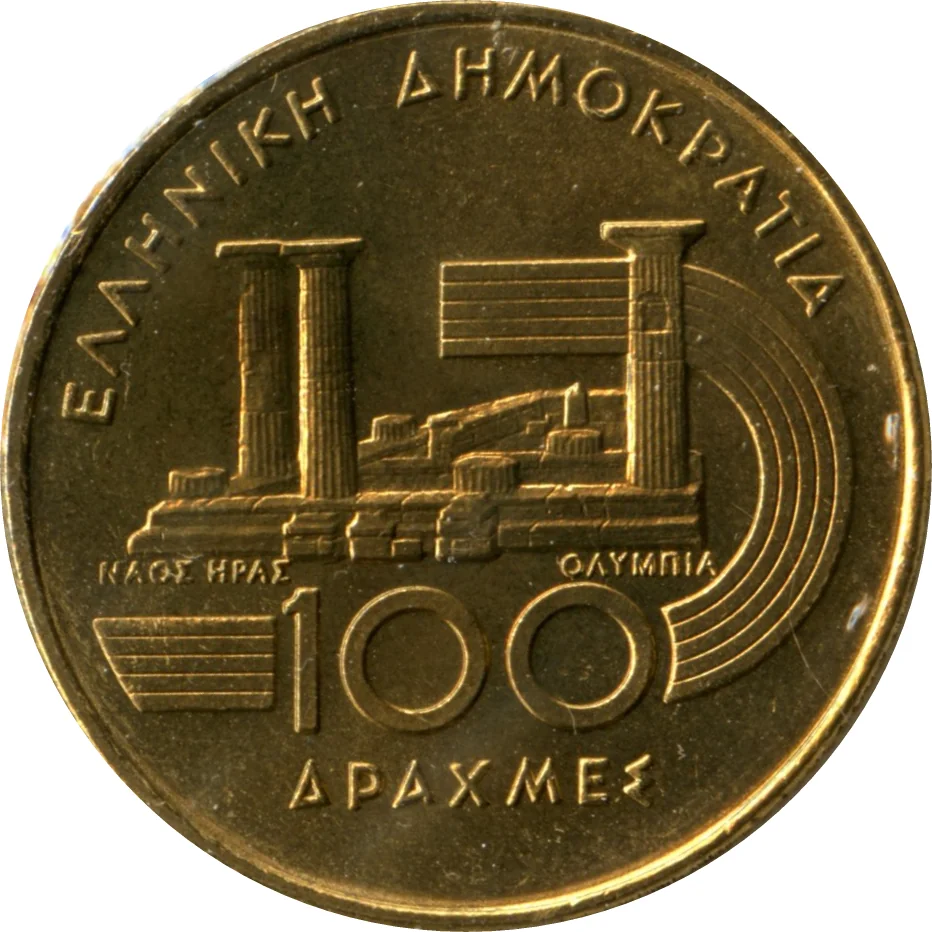
Ancient cityscape and trail
Inscription:
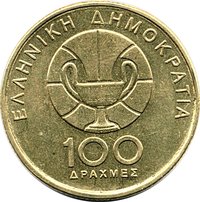
ΕΛΛΗΝΙΚΗ ΔΗΜΟΚΡΑΤΙΑ
ΝΑΟΣ ΗΡΑΣ ΟΛΥΜΠΙΑ
100
ΔΡΑΧΜΕΣ
ΝΑΟΣ ΗΡΑΣ ΟΛΥΜΠΙΑ
100
ΔΡΑΧΜΕΣ
Translation:
HELLENIC REPUBLIC
TEMPLE OF HERA AT OLYMPIA
100
DRACHMAS
TEMPLE OF HERA AT OLYMPIA
100
DRACHMAS
Script: Greek
Language: Greek
Engraver: Stamatopoulos
Reverse
Description:
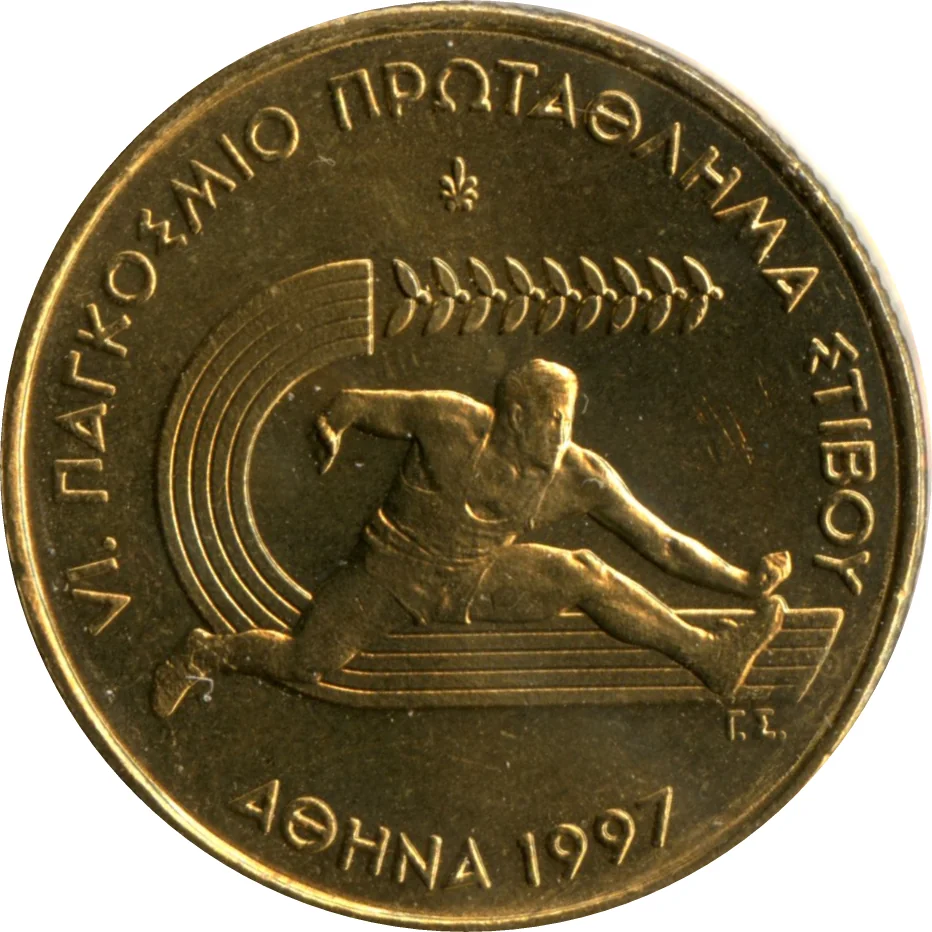
Runner on track
Inscription:
VI. ΠΑΓΚΟΣΜΙΟ ΠΡΩΤΑΘΛΗΜΑ ΣΤΙΒΟΥ
Γ.Σ.
ΑΘΗΝΑ 1997
Γ.Σ.
ΑΘΗΝΑ 1997
Translation:
VI. WORLD ATHLETICS CHAMPIONSHIPS
G.S.
ATHENS 1997
G.S.
ATHENS 1997
Script: Greek
Language: Greek
Engraver: G. Stamatopoulos
Edge
Alternating smooth and reeded segments
Mints
| Name | Mark |
|---|---|
| National Mint of the Bank of Greece | — |
Mintings
| Year | Mint Mark | Mintage | Quality | Collection |
|---|---|---|---|---|
| 1997 | — | 5,000,000 |
Historical background
In 1997, Greece's currency situation was defined by its determined pursuit to join the European Economic and Monetary Union (EMU) and adopt the euro. The country was still operating with its national currency, the Greek drachma, but its economic policies were entirely oriented toward meeting the strict convergence criteria outlined in the 1992 Maastricht Treaty. These criteria included targets for inflation, interest rates, budget deficits, public debt, and exchange rate stability. For Greece, which had a history of high inflation and fiscal imbalances, this was a formidable challenge, requiring significant austerity measures and structural reforms.
The primary focus was on stabilizing the drachma within the European Exchange Rate Mechanism (ERM), which Greece had entered in March 1998, just after the period in question. Throughout 1997, the government, under Prime Minister Costas Simitis, implemented a "hard drachma" policy, maintaining tight monetary control and high interest rates to strengthen the currency and curb inflation. This period was marked by a painful but deliberate squeeze, as the government worked to demonstrate its commitment to European integration and convince skeptical EU partners, particularly Germany, of its economic discipline and readiness for the single currency.
However, underlying this drive for convergence were persistent and severe structural weaknesses. Greece's public debt burden, at well over 100% of GDP, was by far the highest among EU aspirants and nearly double the Maastricht reference value of 60%. There were also serious concerns regarding the reliability of its economic statistics, which would later erupt into scandal. Thus, while 1997 was a year of outward progress and preparation for eurozone entry, it was also a period where the foundations of future crisis—excessive debt and questionable fiscal reporting—were being cemented beneath a surface of nominal convergence.
The primary focus was on stabilizing the drachma within the European Exchange Rate Mechanism (ERM), which Greece had entered in March 1998, just after the period in question. Throughout 1997, the government, under Prime Minister Costas Simitis, implemented a "hard drachma" policy, maintaining tight monetary control and high interest rates to strengthen the currency and curb inflation. This period was marked by a painful but deliberate squeeze, as the government worked to demonstrate its commitment to European integration and convince skeptical EU partners, particularly Germany, of its economic discipline and readiness for the single currency.
However, underlying this drive for convergence were persistent and severe structural weaknesses. Greece's public debt burden, at well over 100% of GDP, was by far the highest among EU aspirants and nearly double the Maastricht reference value of 60%. There were also serious concerns regarding the reliability of its economic statistics, which would later erupt into scandal. Thus, while 1997 was a year of outward progress and preparation for eurozone entry, it was also a period where the foundations of future crisis—excessive debt and questionable fiscal reporting—were being cemented beneath a surface of nominal convergence.
🌱 Very Common