

5000 Lire – San Marino
Non-circulating coins
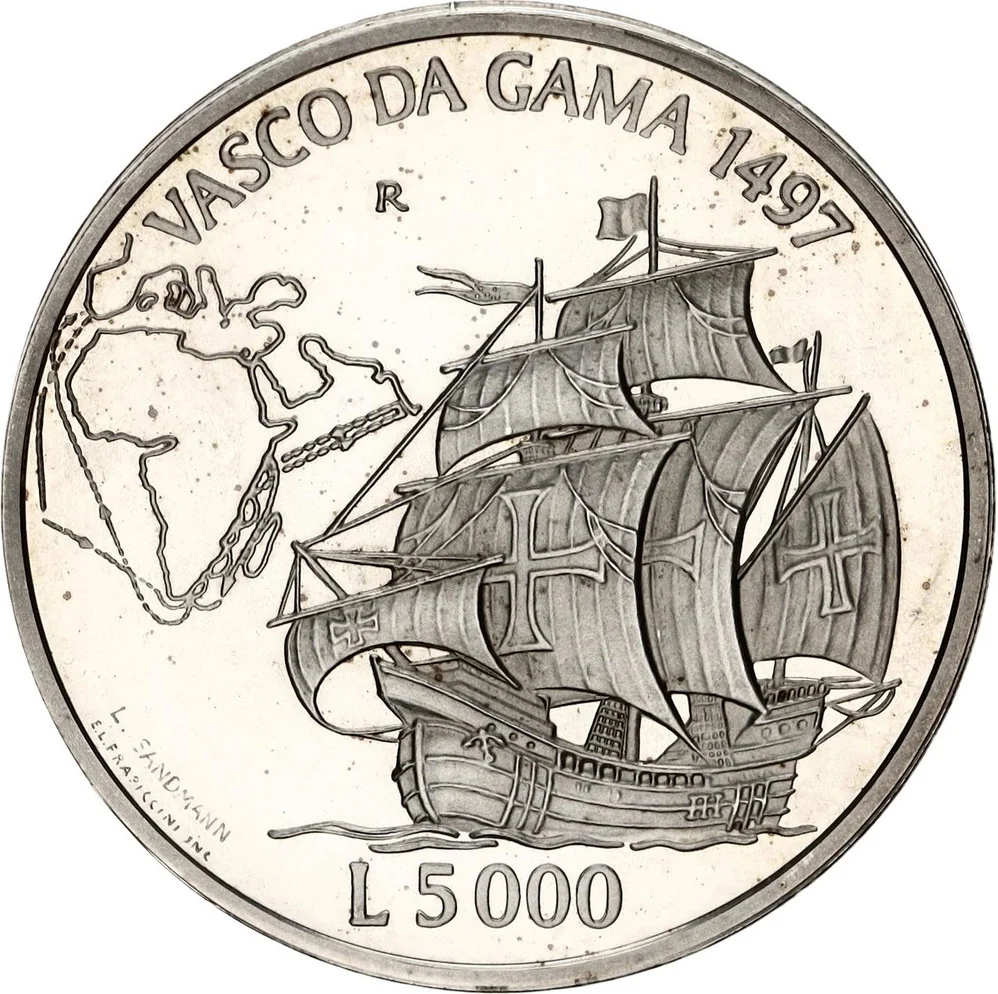
Commemoration: Great navigators: Vasco da Gama
San Marino
Context
Year: 1997
Issuer: San Marino 
Period:
(since 301)
Currency:
(1864—2001)
Demonetized: Yes
Total mintage: 32,000
Material
References
KM: #Click to copy to clipboard370
Numista: #54268
Value
Exchange value: 5000 SML
Bullion value: $42.73
Obverse
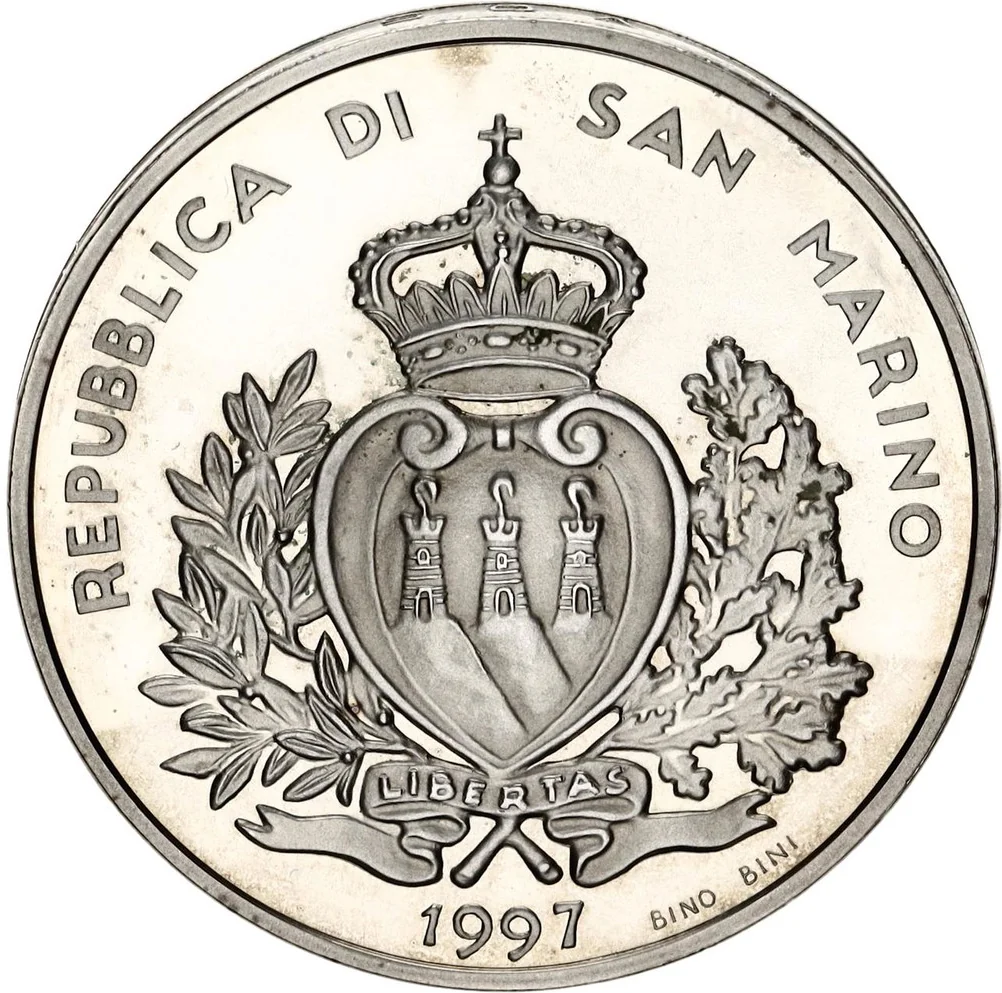
Reverse
Description:
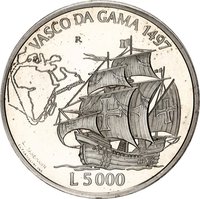
Vasco da Gama's 1497 ship, with his route around the Cape of Good Hope behind it.
Inscription:
VASCO DA GAMA 1497
R
L 5 000
L. SANDMANN
E.L. FRAPICCINI INC
R
L 5 000
L. SANDMANN
E.L. FRAPICCINI INC
Script: Latin
Engravers: Lutz Sandmann, Ettore Lorenzo Frapiccini
Edge
Categories
| Transportation> Watercraft |
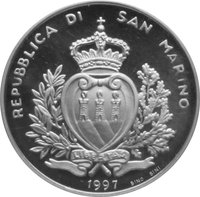
| Symbols> Coat of Arms |
| Map |
| Person> Explorer |
Mints
| Name | Mark |
|---|---|
| Rome | R |
Mintings
| Year | Mint Mark | Mintage | Quality | Collection |
|---|---|---|---|---|
| 1997 | R | 32,000 | Proof |
Historical background
In 1997, the currency situation in the Republic of San Marino was defined by its long-standing and intricate monetary relationship with Italy, formalized in a series of conventions. While San Marino possessed the sovereign right to issue its own coinage—the Sammarinese lira—these coins were minted in limited quantities, primarily for collectors and commemorative purposes. Crucially, the Sammarinese lira was pegged at par and was fully interchangeable with the Italian lira, which served as the de facto everyday circulating currency for all commercial and financial transactions within the small republic. This arrangement effectively ceded monetary policy to the Banca d'Italia.
The year 1997 was a period of significant transition, as it fell within the final run-up to the launch of the euro. San Marino, though not a member of the European Union, was deeply integrated into the Italian economy and was therefore directly impacted by Italy's participation in the European Monetary Union (EMU). Throughout the year, preparations were underway, in close consultation with Italian and EU authorities, to negotiate a replacement monetary agreement that would allow San Marino to adopt the euro as its official currency alongside Italy, thereby preserving its traditional monetary link.
Consequently, the domestic currency landscape in 1997 was one of stability on the surface, with the Italian lira circulating freely, but with an underlying awareness of imminent change. The focus for Sammarinese authorities shifted from managing a dual-currency system with Italy to securing a formal arrangement with the newly forming Eurozone. This successful negotiation would culminate in a 1998 agreement, allowing San Marino to adopt the euro in 1999 (as a scriptural currency) and later mint its own limited-edition euro coins from 2002, thus transitioning its currency status from a satellite of the Italian lira to a special associate of the euro.
The year 1997 was a period of significant transition, as it fell within the final run-up to the launch of the euro. San Marino, though not a member of the European Union, was deeply integrated into the Italian economy and was therefore directly impacted by Italy's participation in the European Monetary Union (EMU). Throughout the year, preparations were underway, in close consultation with Italian and EU authorities, to negotiate a replacement monetary agreement that would allow San Marino to adopt the euro as its official currency alongside Italy, thereby preserving its traditional monetary link.
Consequently, the domestic currency landscape in 1997 was one of stability on the surface, with the Italian lira circulating freely, but with an underlying awareness of imminent change. The focus for Sammarinese authorities shifted from managing a dual-currency system with Italy to securing a formal arrangement with the newly forming Eurozone. This successful negotiation would culminate in a 1998 agreement, allowing San Marino to adopt the euro in 1999 (as a scriptural currency) and later mint its own limited-edition euro coins from 2002, thus transitioning its currency status from a satellite of the Italian lira to a special associate of the euro.
⭐ Rare