

10 Euro – Malta
Non-circulating coins
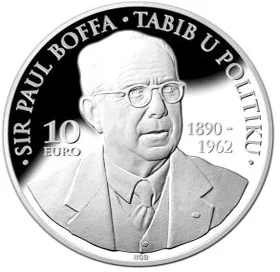
Commemoration: Sir Paul Boffa.
Malta
Context
Material
References
KM: #Click to copy to clipboard148
Numista: #53649
Value
Exchange value: 10 EUR = $11.81
Bullion value: $74.87
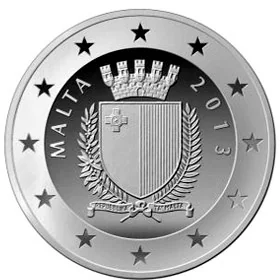
Obverse
Description:
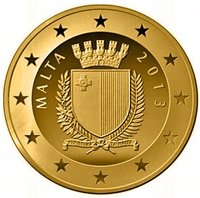
Republic of Malta coat of arms at center, surrounded by edge text and twelve stars.
Inscription:
MALTA 2013
REPUBBLIKA TA' MALTA
REPUBBLIKA TA' MALTA
Translation:
MALTA 2013
REPUBLIC OF MALTA
REPUBLIC OF MALTA
Script: Latin
Engraver: Noel Galea Bason
Reverse
Description:
A man is centered on the coin. Years are inscribed to his right, the coin's value to his left, and text runs along the top edge.
Inscription:
· SIR PAUL BOFFA · TABIB U POLITIKU ·
10 EURO
1890-1962
NGB
10 EURO
1890-1962
NGB
Script: Latin
Engraver: Noel Galea Bason
Edge
Categories
| Person> Politician |
| Symbols> Coat of Arms |
Mints
| Name | Mark |
|---|---|
| Royal Dutch Mint | — |
Mintings
| Year | Mint Mark | Mintage | Quality | Collection |
|---|---|---|---|---|
| 2013 | — | 2,500 | Proof |
Historical background
In 2013, Malta was in its final full year using the Maltese lira (Lm), more commonly known as the pound, before its planned transition to the euro. Having joined the European Union in 2004, Malta had committed to adopting the single currency and had been part of the Exchange Rate Mechanism II (ERM II) since 2005, which pegged the lira to the euro at a fixed central rate of €1 = Lm 0.4293. This period was characterised by careful economic management to meet the strict Maastricht convergence criteria on inflation, interest rates, budget deficits, and public debt, which Malta had successfully achieved, paving the way for euro adoption on 1 January 2008.
The currency situation in 2013 was therefore one of post-adoption stability and full integration. The Maltese lira had ceased to be legal tender on 31 January 2008, and by 2013, the euro had been the sole official currency for over five years. The Central Bank of Malta continued to offer a permanent service for the free conversion of any remaining lira banknotes and coins into euros at the fixed rate, but everyday economic life was entirely conducted in euros. This transition was widely regarded as successful, having eliminated exchange rate risk and transaction costs with Malta's main trading partners, and bolstered investor confidence.
Consequently, 2013 saw Malta operating firmly within the Eurozone's monetary policy framework, with the European Central Bank setting interest rates. The country benefited from the euro's stability during the lingering aftermath of the European debt crisis, which had peaked in 2012. While some sectors, like tourism, adjusted to price transparency with European competitors, the overall economic context was one of a small, open economy leveraging its Eurozone membership for trade, financial services, and sustained growth, leaving the legacy currency firmly in the past.
The currency situation in 2013 was therefore one of post-adoption stability and full integration. The Maltese lira had ceased to be legal tender on 31 January 2008, and by 2013, the euro had been the sole official currency for over five years. The Central Bank of Malta continued to offer a permanent service for the free conversion of any remaining lira banknotes and coins into euros at the fixed rate, but everyday economic life was entirely conducted in euros. This transition was widely regarded as successful, having eliminated exchange rate risk and transaction costs with Malta's main trading partners, and bolstered investor confidence.
Consequently, 2013 saw Malta operating firmly within the Eurozone's monetary policy framework, with the European Central Bank setting interest rates. The country benefited from the euro's stability during the lingering aftermath of the European debt crisis, which had peaked in 2012. While some sectors, like tourism, adjusted to price transparency with European competitors, the overall economic context was one of a small, open economy leveraging its Eurozone membership for trade, financial services, and sustained growth, leaving the legacy currency firmly in the past.
✨ Legendary