

Obverse
Description:
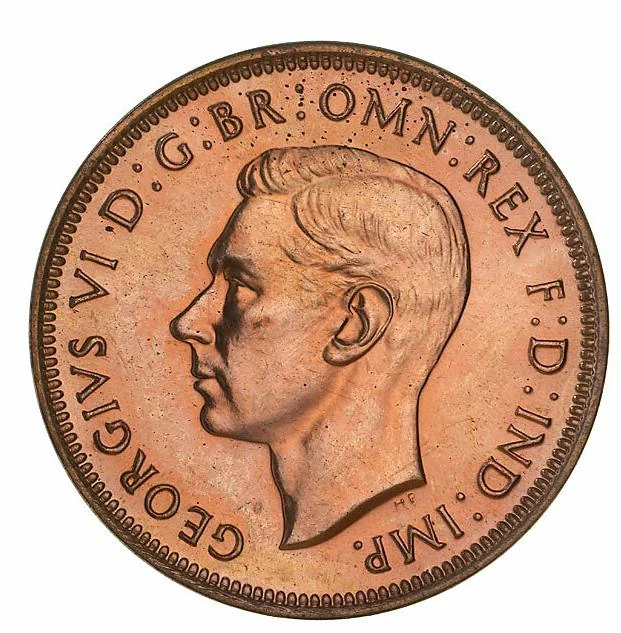
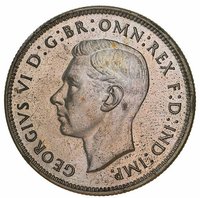
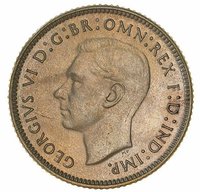
King George VI, left-facing portrait.
Inscription:
GEORGIVS VI D:G:BR:OMN:REX F:D:IND:IMP.
HP
HP
Translation:
George VI by the Grace of God King of all the Britains Defender of the Faith Emperor of India.
Script: Latin
Language: Latin
Engraver: Thomas Humphrey Paget
Reverse
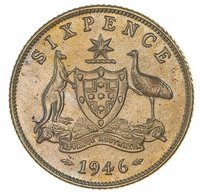
Description:
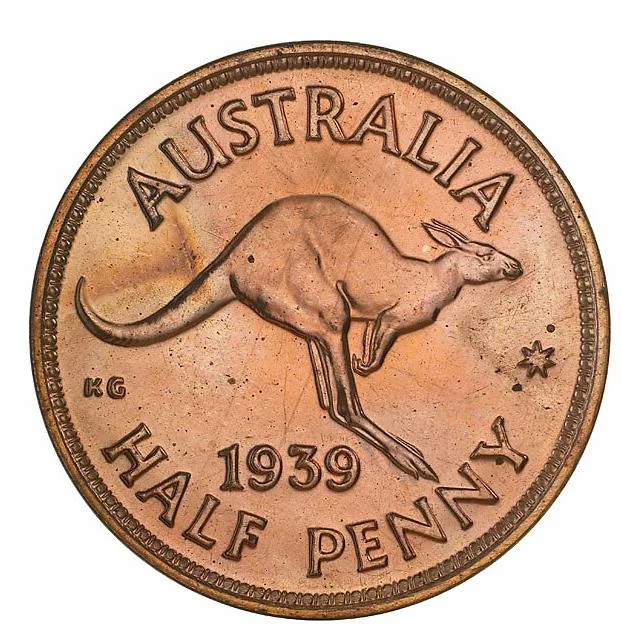
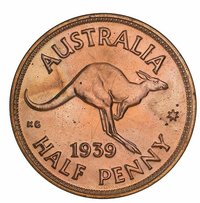
Kangaroo leaping right, country above, date above denomination.
Inscription:
AUSTRALIA
KG
1939
HALF PENNY
KG
1939
HALF PENNY
Script: Latin
Engraver: George Kruger Gray
Edge
Plain
Mints
| Name | Mark |
|---|---|
| Mumbai / Bombay | — |
| Perth Mint | — |
| Royal Mint | — |
Mintings
| Year | Mint Mark | Mintage | Quality | Collection |
|---|---|---|---|---|
| 1939 | — | 504,000 | ||
| 1939 | — | — | Proof | |
| 1940 | — | 2,294,000 | ||
| 1940 | — | — | Proof | |
| 1941 | — | 5,011,000 | ||
| 1941 | — | — | Proof | |
| 1942 | — | — | Proof | |
| 1942 | • | 4,334,000 | ||
| 1942 | I | — | Proof | |
| 1942 | I | 6,000,000 | ||
| 1942 | — | 720,000 | ||
| 1942 | • | — | Proof | |
| 1943 | — | 33,989,000 | ||
| 1943 | • | — | Proof | |
| 1943 | I | 6,000,000 | ||
| 1943 | I | — | Proof | |
| 1944 | — | 720,000 | ||
| 1945 | • | 3,033,000 | ||
| 1945 | — | — | ||
| 1945 | • | — | Proof | |
| 1946 | • | 13,747,000 | ||
| 1946 | • | — | Proof | |
| 1947 | • | 9,293,000 | ||
| 1947 | • | — | Proof | |
| 1948 | — | 4,608,000 | ||
| 1948 | — | — | Proof | |
| 1948 | • | 25,553,000 | ||
| 1948 | • | — | Proof |
Historical background
In 1939, Australia's currency was fundamentally a sterling-based system, operating under the framework of the Australian Pound (A£). It was pegged to British Pound Sterling (£) at parity, meaning one Australian pound was officially equal to one British pound. This arrangement was managed through the Exchange Equalisation Account, which held gold and sterling reserves in London to maintain the fixed exchange rate. The currency was not freely convertible but was part of the Sterling Area, a bloc of countries that held their reserves in London and conducted trade primarily in sterling, ensuring a stable and predictable environment for trade with Britain, which was still Australia's dominant economic partner.
The outbreak of World War II in September 1939 triggered immediate and profound changes to this system. The Australian government, like others in the Commonwealth, instituted strict exchange controls to prevent a flight of capital and to conserve vital foreign exchange for the war effort. All dealings in foreign currency were brought under the authority of the Treasury, and the export of gold was prohibited. The primary objective was to marshal all financial resources towards supporting Britain's war purchases and funding Australia's own rapidly expanding military and domestic production, effectively locking the currency into a controlled war economy.
Consequently, by the end of 1939, the theoretical parity with sterling was maintained, but in practice, the currency was subject to stringent administrative control rather than market forces. The war accelerated a shift in economic dependence, foreshadowing a closer financial relationship with the United States, which would become a critical source of war materiel and funding. The currency regime of 1939 thus marked the end of a relatively stable pre-war order and the beginning of a period of direct government intervention that would shape Australia's financial policies for decades to come.
The outbreak of World War II in September 1939 triggered immediate and profound changes to this system. The Australian government, like others in the Commonwealth, instituted strict exchange controls to prevent a flight of capital and to conserve vital foreign exchange for the war effort. All dealings in foreign currency were brought under the authority of the Treasury, and the export of gold was prohibited. The primary objective was to marshal all financial resources towards supporting Britain's war purchases and funding Australia's own rapidly expanding military and domestic production, effectively locking the currency into a controlled war economy.
Consequently, by the end of 1939, the theoretical parity with sterling was maintained, but in practice, the currency was subject to stringent administrative control rather than market forces. The war accelerated a shift in economic dependence, foreshadowing a closer financial relationship with the United States, which would become a critical source of war materiel and funding. The currency regime of 1939 thus marked the end of a relatively stable pre-war order and the beginning of a period of direct government intervention that would shape Australia's financial policies for decades to come.
🌱 Very Common