

5 Pence – United Kingdom
United Kingdom
Context
Years: 1982–1984
Issuer: United Kingdom 
Ruler: Elizabeth II
Currency:
(since 1971)
Demonetization: 31 December 1990
Total mintage: 1,322,040
Material
References
KM: #Click to copy to clipboard929
Numista: #11027
Value
Exchange value: 0.05 GBP = $0.07
Inflation-adjusted value: 0.24 GBP
Obverse
Description:
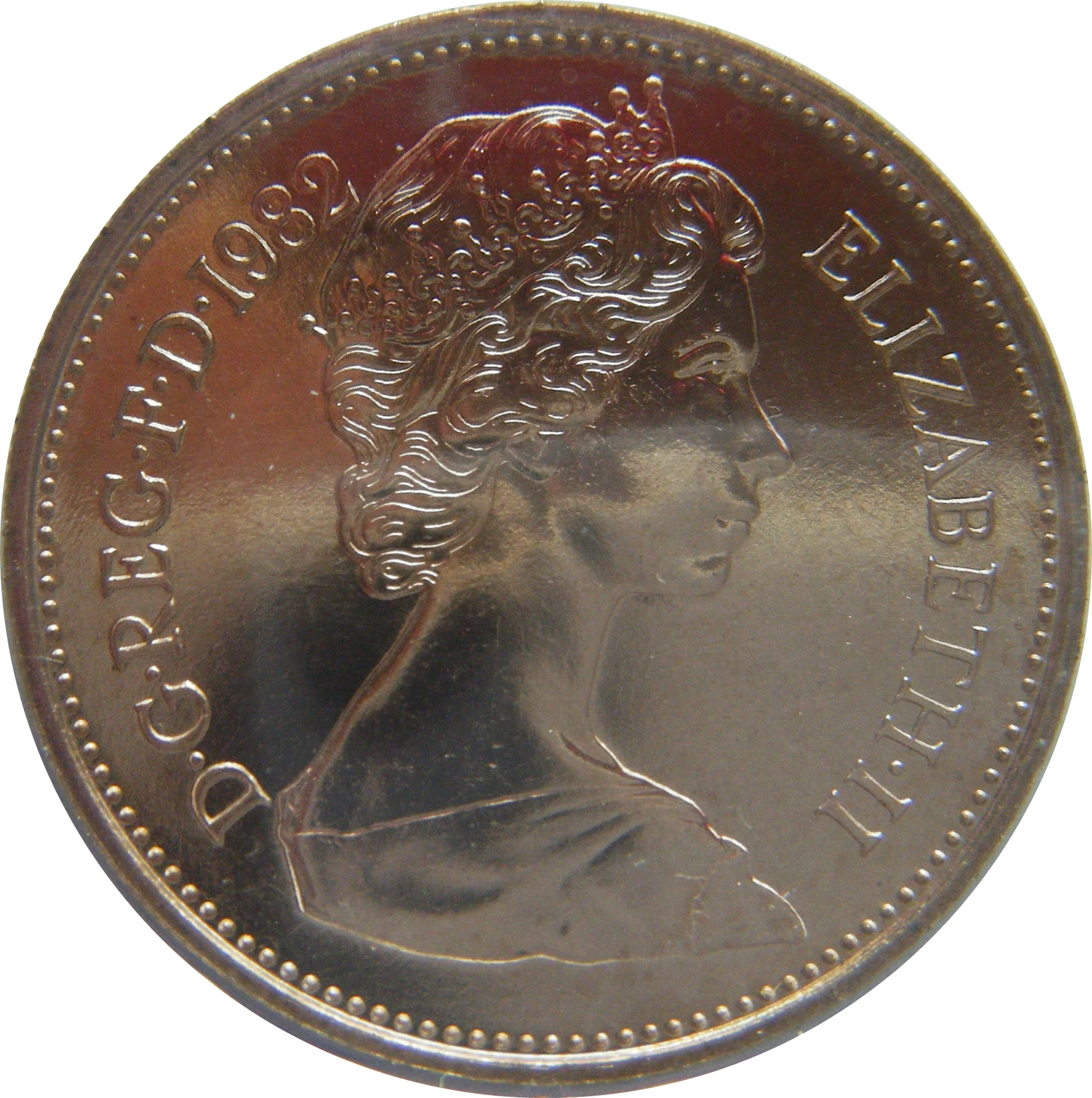
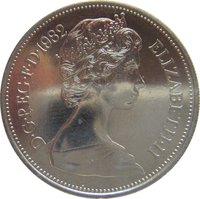
Queen Elizabeth II facing right, wearing the Girls of Great Britain and Ireland tiara.
Inscription:
ELIZABETH·II D·G·REG·F·D·1982
Translation:
Elizabeth the Second, by the Grace of God, Queen, Defender of the Faith, 1982.
Script: Latin
Language: Latin
Designer: Arnold Machin
Reverse
Description:
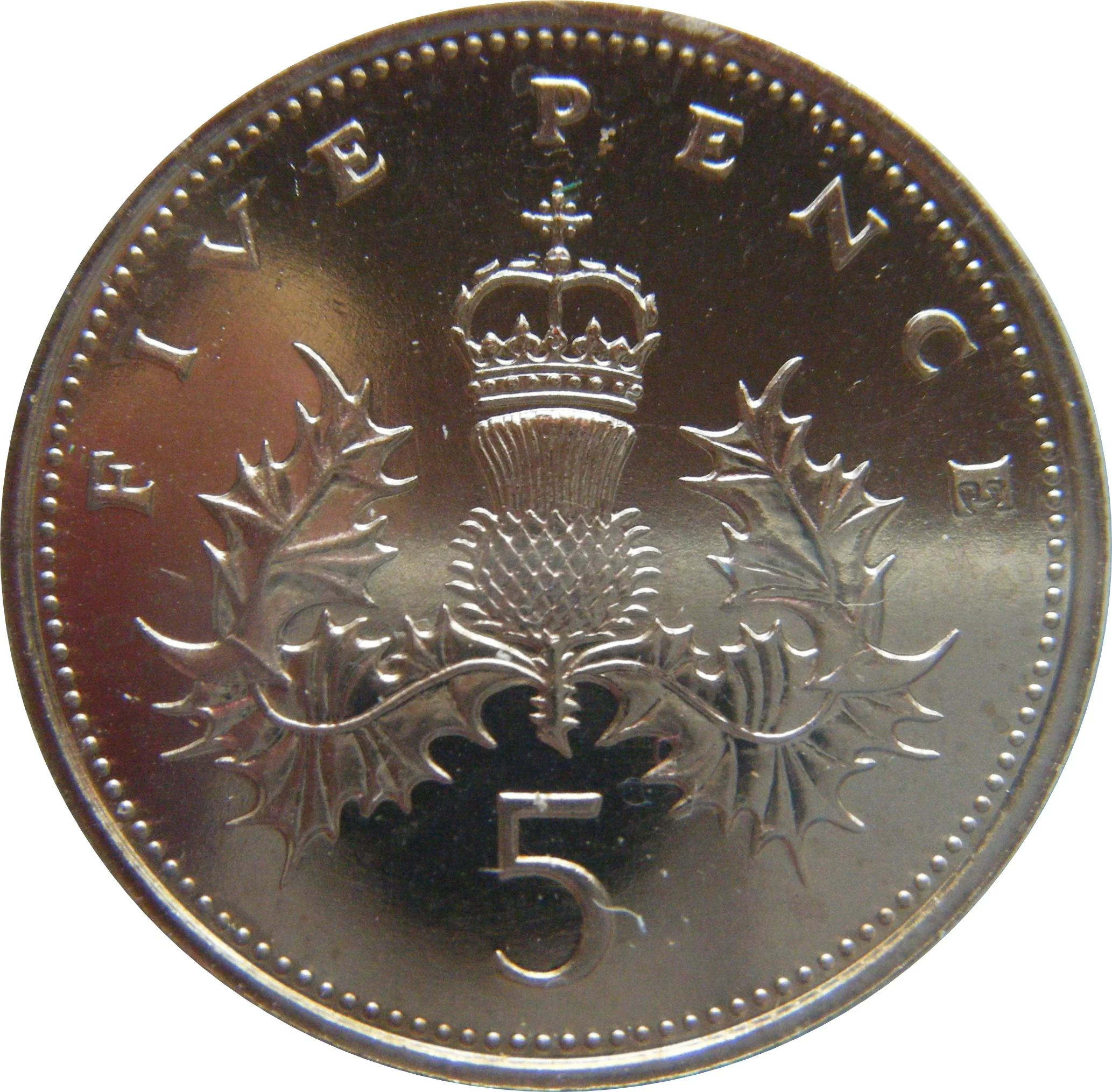
Thistle royally crowned, legend above, denomination below.
Inscription:
FIVE PENCE
5
5
Script: Latin
Designer: Christopher Ironside
Edge
Milled
Mints
| Name | Mark |
|---|---|
| Royal Mint | — |
Mintings
| Year | Mint Mark | Mintage | Quality | Collection |
|---|---|---|---|---|
| 1982 | — | 205,000 | BU | |
| 1982 | — | 106,800 | Proof | |
| 1983 | — | 637,100 | BU | |
| 1983 | — | 107,800 | Proof | |
| 1984 | — | 158,820 | BU | |
| 1984 | — | 106,520 | Proof |
Historical background
In 1982, the United Kingdom's currency situation was dominated by the ongoing struggle to control inflation and stabilise the pound sterling within a challenging global economic climate. The Conservative government under Prime Minister Margaret Thatcher, having come to power in 1979, had prioritised defeating inflation through tight monetary control and high interest rates, a policy that had contributed to a deep recession and soaring unemployment. The pound, which had experienced a sharp and damaging appreciation in 1979-81 due to North Sea oil revenues and high interest rates, had begun to retreat from its peak, but remained volatile. This "overvalued" pound severely hampered the competitiveness of British manufacturing exports, deepening the industrial decline that characterised the early 1980s.
The institutional framework for the currency was in a state of transition. The UK had entered the European Exchange Rate Mechanism (ERM) in 1979 as part of the new European Monetary System (EMS), but notably chose not to participate in its core feature, the Exchange Rate Mechanism (ERM), which would have pegged sterling to other European currencies. This decision reflected the government's reluctance to cede control of domestic monetary policy to external exchange rate targets, preferring instead to use interest rates to target the money supply. Consequently, sterling floated freely, with its value set by market forces, albeit with periodic Bank of England intervention to smooth out excessive fluctuations.
By the end of 1982, the immediate pressure had eased slightly. Inflation had fallen from its 1980 peak of 18% to around 8%, partly validating the government's harsh medicine, though the social cost remained enormous. The pound found a somewhat lower and less turbulent trading range, aided by a global economic recovery and a slight moderation in UK interest rates. However, the underlying tensions remained unresolved: the conflict between domestic monetary goals and exchange rate stability, the structural weakness of industry, and the political debate over European monetary integration. These issues would continue to define UK currency policy, culminating in the disastrous ERM entry in 1990 and exit in 1992.
The institutional framework for the currency was in a state of transition. The UK had entered the European Exchange Rate Mechanism (ERM) in 1979 as part of the new European Monetary System (EMS), but notably chose not to participate in its core feature, the Exchange Rate Mechanism (ERM), which would have pegged sterling to other European currencies. This decision reflected the government's reluctance to cede control of domestic monetary policy to external exchange rate targets, preferring instead to use interest rates to target the money supply. Consequently, sterling floated freely, with its value set by market forces, albeit with periodic Bank of England intervention to smooth out excessive fluctuations.
By the end of 1982, the immediate pressure had eased slightly. Inflation had fallen from its 1980 peak of 18% to around 8%, partly validating the government's harsh medicine, though the social cost remained enormous. The pound found a somewhat lower and less turbulent trading range, aided by a global economic recovery and a slight moderation in UK interest rates. However, the underlying tensions remained unresolved: the conflict between domestic monetary goals and exchange rate stability, the structural weakness of industry, and the political debate over European monetary integration. These issues would continue to define UK currency policy, culminating in the disastrous ERM entry in 1990 and exit in 1992.
🌱 Common