

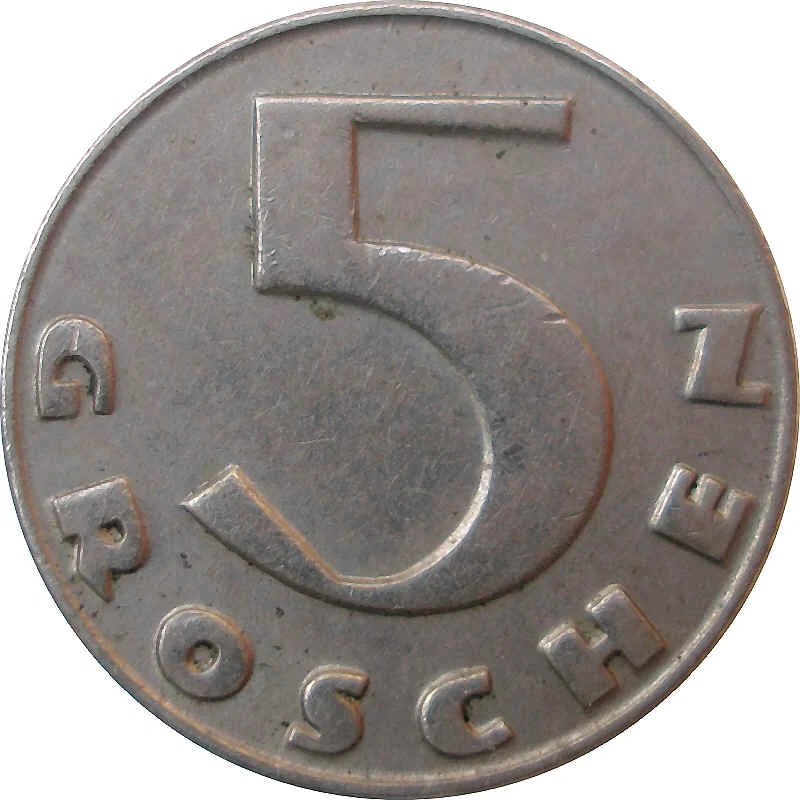
5 groschen – Austria
Add to wishlist
Austria
Context
Years: 1931–1938
Issuer: Austria
Period:
(1919—1934)
Currency:
(1925—1938)
Demonetized: Yes
Total mintage: 28,574,000
Material
Diameter: 17 mm
Weight: 3 g
Thickness: 1.5 mm
Shape: Round
Composition: Copper-nickel
Technique: Milled
Alignment: Medal alignment
flip
References
KM: #
Numista: #5318
Obverse
Description:
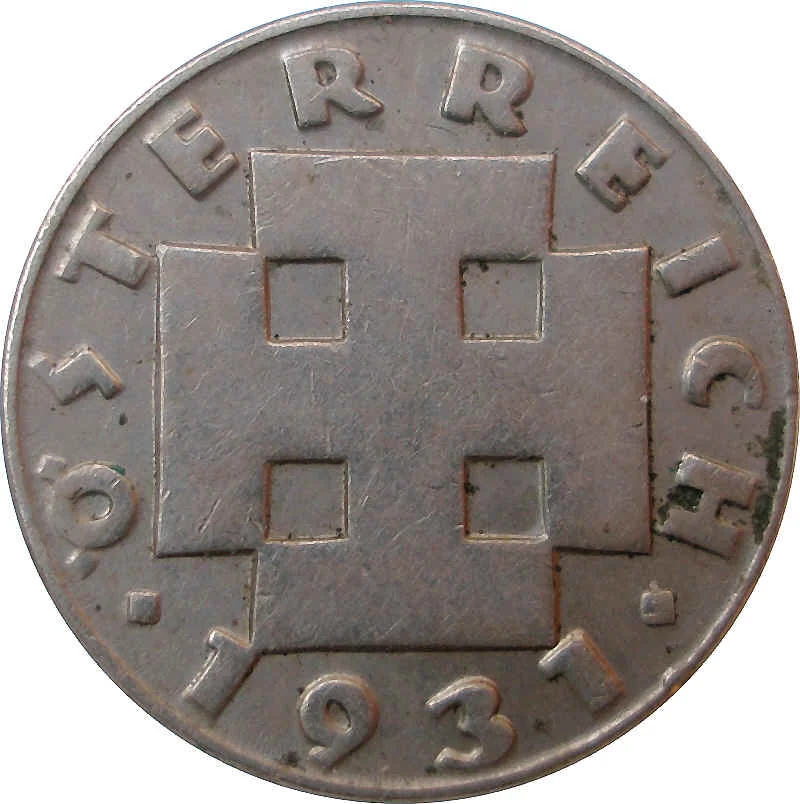
Cross potent center, encircled by lettering, date beneath.
Inscription:
ÖSTERREICH
·1931·
·1931·
Translation:
AUSTRIA
·1931·
·1931·
Script: Latin
Language: German
Engraver: Philipp Häusler
Reverse
Edge
Plain
Mints
| Name | Mark |
|---|---|
| Münze Österreich | — |
Mintings
| Year | Mint Mark | Mintage | Quality | Collection |
|---|---|---|---|---|
| 1931 | — | 17,389,000 | ||
| 1932 | — | 3,727,000 | ||
| 1934 | — | 3,426,000 | ||
| 1936 | — | 2,233,000 | ||
| 1937 | — | 923,000 | ||
| 1938 | — | 876,000 |
Historical background
In 1931, Austria stood at the epicenter of a European financial hurricane that threatened to shatter its currency and banking system. The crisis had its roots in the fragile postwar economic order, where Austria’s new republic struggled with the legacy of the Habsburg Empire's dissolution, territorial loss, and reparations. Heavily dependent on foreign, primarily American, short-term loans to finance reconstruction and municipal projects, the Austrian economy was acutely vulnerable to a withdrawal of that capital. The failure of the prominent Creditanstalt bank in May 1931 acted as the detonator. As Austria’s largest and most influential bank, its collapse revealed massive hidden losses, instantly triggering a catastrophic crisis of confidence.
The immediate consequence was a devastating run on the Austrian schilling, as both domestic and international investors scrambled to withdraw funds and convert them into foreign currency or gold. The Austrian National Bank’s reserves hemorrhaged, losing nearly 70% of their foreign exchange holdings in just two months. In a desperate bid to halt the collapse, the government imposed strict exchange controls in the autumn of 1931, effectively abandoning the gold standard and splitting the currency into a controlled "clearing schilling" for international trade and a depreciated domestic schilling. This move marked the end of a freely convertible currency and isolated Austria from international capital markets.
The currency crisis rapidly spiraled into a political and international disaster. Austria’s distress spread contagiously to Germany and across Central Europe, amplifying the global Great Depression. Domestically, the economic devastation fueled extreme political polarization, weakening the democratic government and strengthening both the fascist and authoritarian right. The financial collapse created the conditions for the fascist coup attempt of 1933 and ultimately paved the way for the end of Austrian independence, as it sought external salvation, first through League of Nations loans with political strings attached, and later through annexation by Nazi Germany in 1938.
The immediate consequence was a devastating run on the Austrian schilling, as both domestic and international investors scrambled to withdraw funds and convert them into foreign currency or gold. The Austrian National Bank’s reserves hemorrhaged, losing nearly 70% of their foreign exchange holdings in just two months. In a desperate bid to halt the collapse, the government imposed strict exchange controls in the autumn of 1931, effectively abandoning the gold standard and splitting the currency into a controlled "clearing schilling" for international trade and a depreciated domestic schilling. This move marked the end of a freely convertible currency and isolated Austria from international capital markets.
The currency crisis rapidly spiraled into a political and international disaster. Austria’s distress spread contagiously to Germany and across Central Europe, amplifying the global Great Depression. Domestically, the economic devastation fueled extreme political polarization, weakening the democratic government and strengthening both the fascist and authoritarian right. The financial collapse created the conditions for the fascist coup attempt of 1933 and ultimately paved the way for the end of Austrian independence, as it sought external salvation, first through League of Nations loans with political strings attached, and later through annexation by Nazi Germany in 1938.
🌱 Very Common