

10 Paisas – Saqqawist Emirate
Afghanistan
Context
Year: 1930
Islamic (Hijri) Year: 1348
Country: Afghanistan 
Issuer: Saqqawist Emirate
Ruler: Habibullah Kalakani
Currency:
(1891—1923)
Demonetized: Yes
Material

References
KM: #Click to copy to clipboard901
Numista: #110255
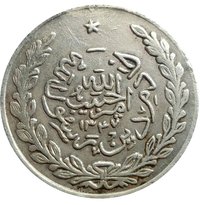
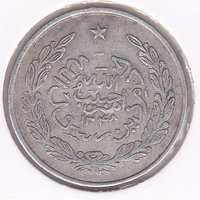
Obverse
Description:
*Text & date*
*Leaves below*
*Leaves below*
Script: Arabic
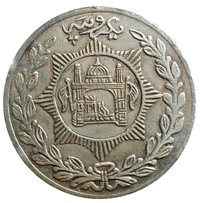
Reverse
Description:
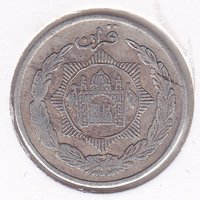
Stars frame the inscription above a mosque, all within an eight-pointed star over leaves.
Script: Arabic
Edge
Plain
Categories
| Building> Religious building |
Mintings
| Year | Mint Mark | Mintage | Quality | Collection |
|---|---|---|---|---|
| 1930 | — | — |
Historical background
The currency situation in the Saqqawist Emirate of Afghanistan in 1930 was one of profound crisis and improvisation, reflecting the Emirate's brief and tumultuous existence. Having seized Kabul in 1929, Habibullāh Kalakāni (often called "Bacha-i Saqao") inherited a treasury depleted by the civil war and the preceding reign of Amānullāh Khan. The state's formal currency, the Afghan rupee, remained in circulation but its legitimacy and value were severely undermined. The Saqqawist administration, lacking international recognition and access to the nation's gold and silver reserves held by the ousted monarchy, had limited capacity to mint new, trusted coinage or back the paper money in circulation.
In response, Kalakāni's government resorted to emergency measures that further destabilized the monetary system. Most notably, they issued a crude form of fiat paper money, often simple promissory notes stamped with official seals. More damagingly, they are historically reported to have debased the existing silver and copper coinage by recalling it and re-minting it with a reduced precious metal content, or by overstamping coins to forcibly alter their value. This practice, essentially a form of currency confiscation, destroyed public trust and led to widespread hoarding of older, purer coins from the Amanullah era, which circulated at a premium.
Consequently, the economy regressed towards barter and a dual-currency system, especially in rural areas. While the official but distrusted Saqqawist currency was used under coercion in Kabul, transactions elsewhere were often conducted in kind, in older Afghan rupees, or even in British Indian rupees, which were seen as a more stable store of value. This monetary chaos exacerbated hyperinflation and severe shortages of basic goods, crippling the Saqqawist regime's ability to govern and pay its troops, contributing significantly to its collapse in October 1930 when forces loyal to Nādir Shah retook the capital.
In response, Kalakāni's government resorted to emergency measures that further destabilized the monetary system. Most notably, they issued a crude form of fiat paper money, often simple promissory notes stamped with official seals. More damagingly, they are historically reported to have debased the existing silver and copper coinage by recalling it and re-minting it with a reduced precious metal content, or by overstamping coins to forcibly alter their value. This practice, essentially a form of currency confiscation, destroyed public trust and led to widespread hoarding of older, purer coins from the Amanullah era, which circulated at a premium.
Consequently, the economy regressed towards barter and a dual-currency system, especially in rural areas. While the official but distrusted Saqqawist currency was used under coercion in Kabul, transactions elsewhere were often conducted in kind, in older Afghan rupees, or even in British Indian rupees, which were seen as a more stable store of value. This monetary chaos exacerbated hyperinflation and severe shortages of basic goods, crippling the Saqqawist regime's ability to govern and pay its troops, contributing significantly to its collapse in October 1930 when forces loyal to Nādir Shah retook the capital.
💎 Extremely Rare