

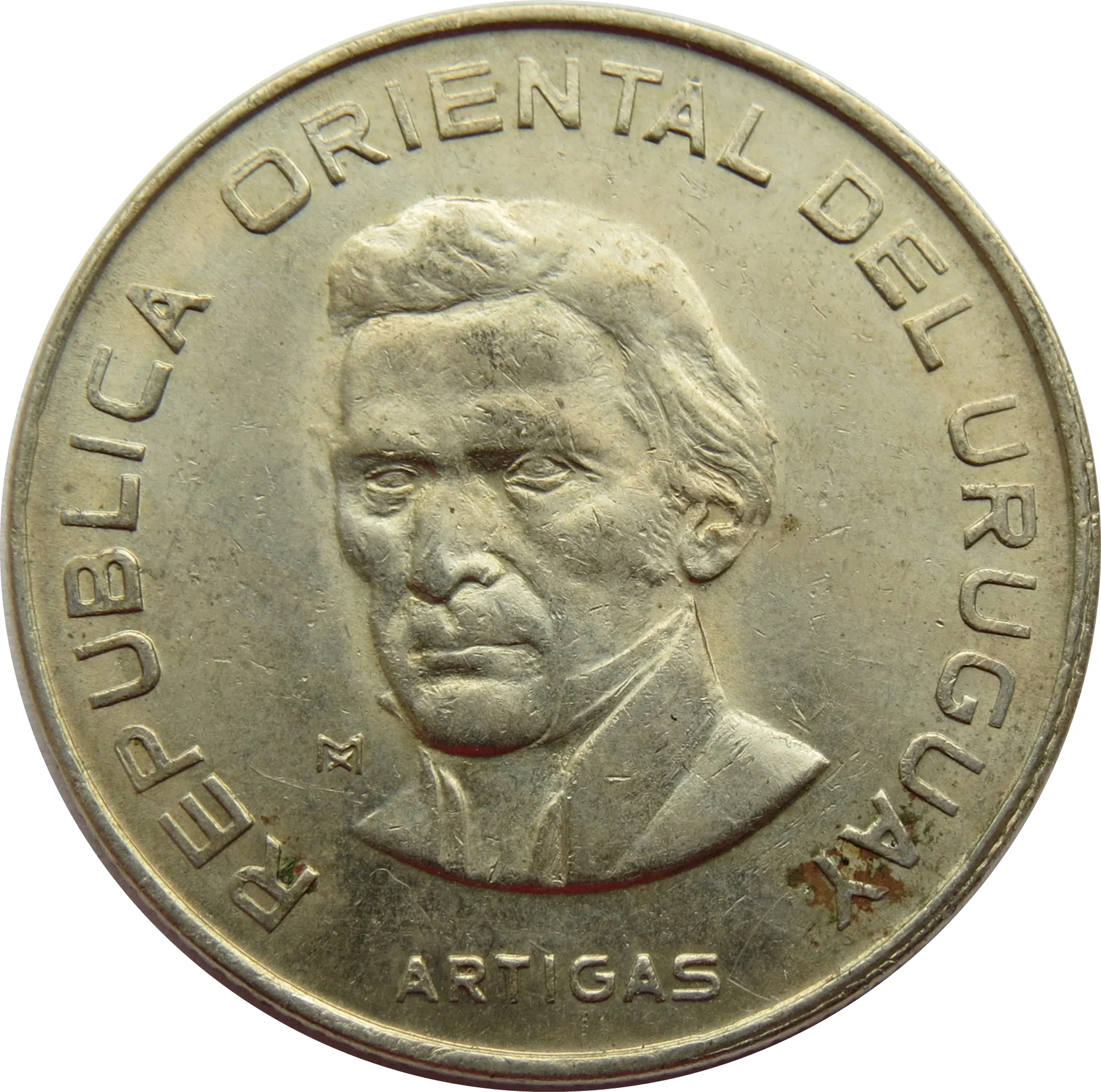
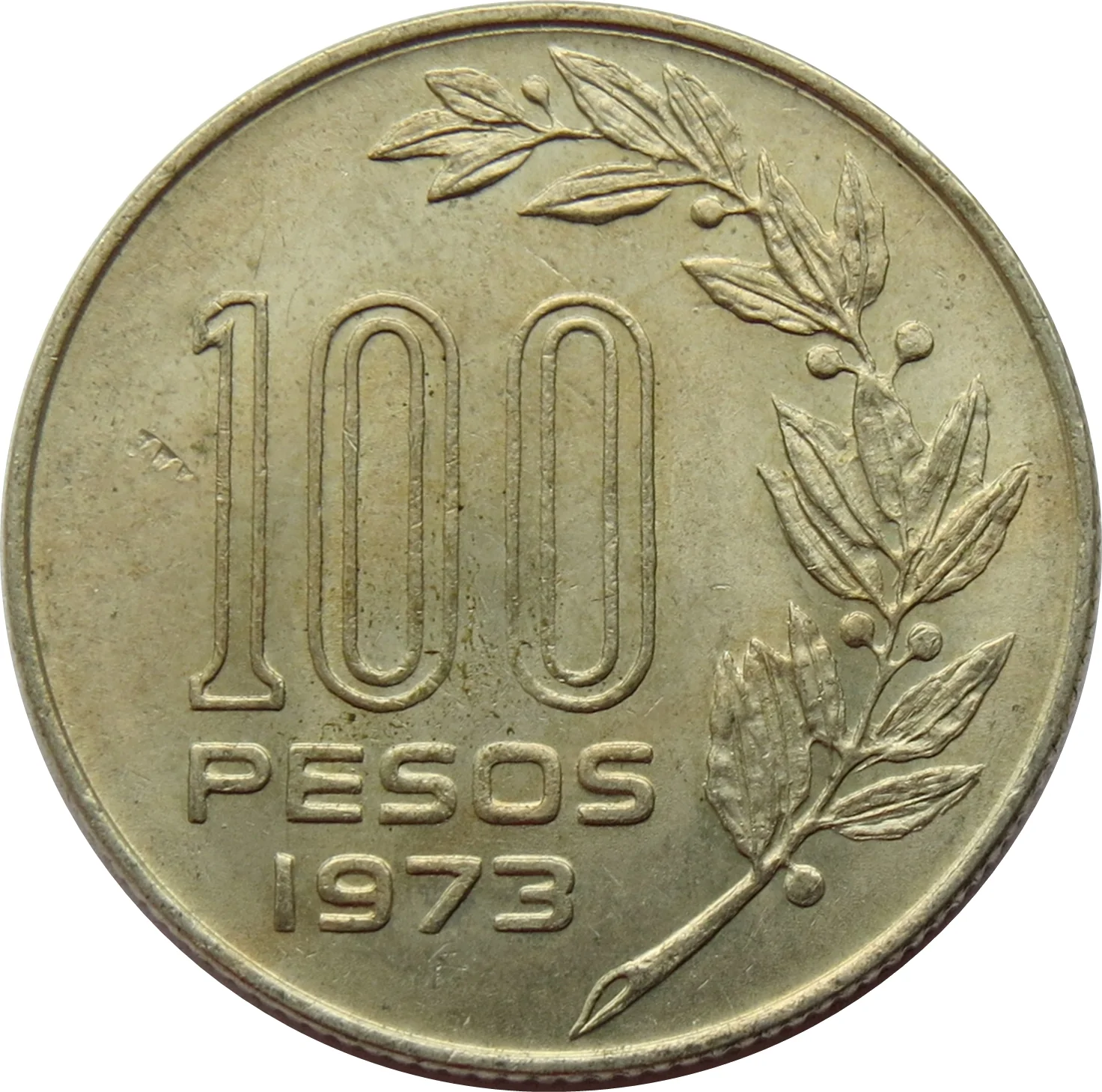
100 pesos – Uruguay
Add to wishlist
Uruguay
Context
Year: 1973
Issuer: Uruguay
Issuing organization: Central Bank of Uruguay
Period:
(since 1825)
Currency:
(1863—1975)
Demonetization: 1 December 1977
Total mintage: 20,000,000
Material
Diameter: 27.6 mm
Weight: 8 g
Thickness: 1.8 mm
Shape: Round
Composition: Copper-nickel
Technique: Milled
Alignment: Coin alignment
flip
References
KM: #
Numista: #5296
Value
Exchange value: 100 UYP
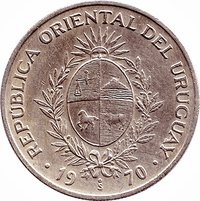
Obverse
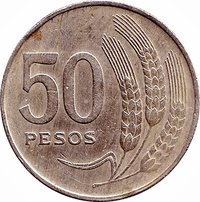
Reverse
Edge
Reeded
Categories
| Person> Military leader |
| Person> Politician |
Mints
| Name | Mark |
|---|---|
| Mexican Mint | — |
Mintings
| Year | Mint Mark | Mintage | Quality | Collection |
|---|---|---|---|---|
| 1973 | Mx | 20,000,000 |
Historical background
By 1973, Uruguay was in the midst of a profound economic and political crisis that had severely destabilized its currency, the peso. The model of a stable welfare state, once known as "the Switzerland of America," had collapsed under the weight of stagflation, high external debt, and social unrest. Chronic budget deficits were financed by the Central Bank, leading to rampant money printing and an accelerating inflationary spiral. This eroded purchasing power and fueled capital flight, as citizens and businesses lost confidence in the peso, seeking refuge in the US dollar or moving assets abroad.
The government's response in the years leading up to 1973 was a chaotic cycle of devaluations, wage and price controls, and multiple exchange rates. A crawling peg system failed to keep pace with inflation, creating a vast gap between the official exchange rate and the black-market rate. This disparity crippled the crucial export sector, encouraged speculation, and created severe distortions throughout the economy. The situation was exacerbated by the global oil shock and the decline in prices for Uruguay's key agricultural exports, further straining foreign reserves.
The currency turmoil was both a cause and a symptom of the wider breakdown that culminated in the presidential coup of June 27, 1973, which established a civic-military dictatorship. The new regime immediately prioritized economic control, implementing a drastic stabilization plan. This included a sharp, one-time maxi-devaluation to unify exchange rates, severe wage repression, and the lifting of price controls, all enforced by authoritarian rule. Thus, the currency situation of 1973 marked the final economic unraveling of Uruguay's democratic period and became a primary justification for the dictatorship's radical and painful economic restructuring.
The government's response in the years leading up to 1973 was a chaotic cycle of devaluations, wage and price controls, and multiple exchange rates. A crawling peg system failed to keep pace with inflation, creating a vast gap between the official exchange rate and the black-market rate. This disparity crippled the crucial export sector, encouraged speculation, and created severe distortions throughout the economy. The situation was exacerbated by the global oil shock and the decline in prices for Uruguay's key agricultural exports, further straining foreign reserves.
The currency turmoil was both a cause and a symptom of the wider breakdown that culminated in the presidential coup of June 27, 1973, which established a civic-military dictatorship. The new regime immediately prioritized economic control, implementing a drastic stabilization plan. This included a sharp, one-time maxi-devaluation to unify exchange rates, severe wage repression, and the lifting of price controls, all enforced by authoritarian rule. Thus, the currency situation of 1973 marked the final economic unraveling of Uruguay's democratic period and became a primary justification for the dictatorship's radical and painful economic restructuring.

🌱 Very Common