

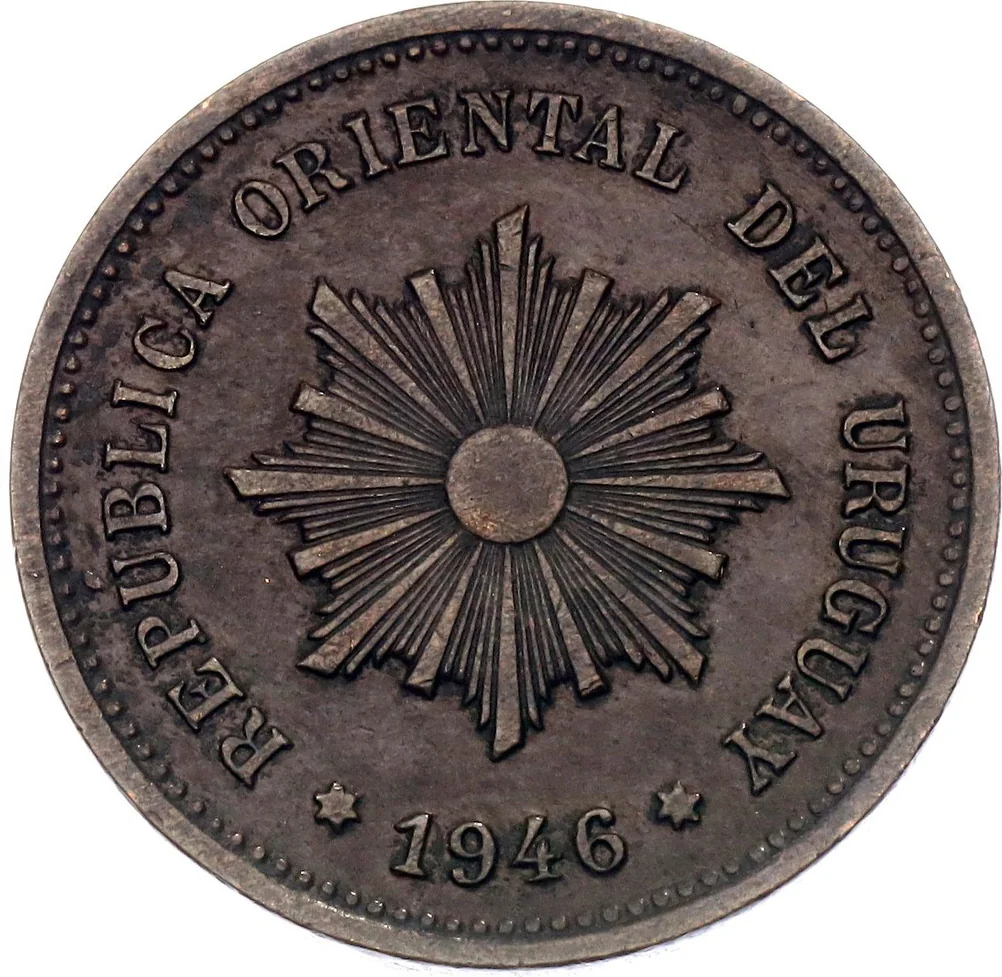
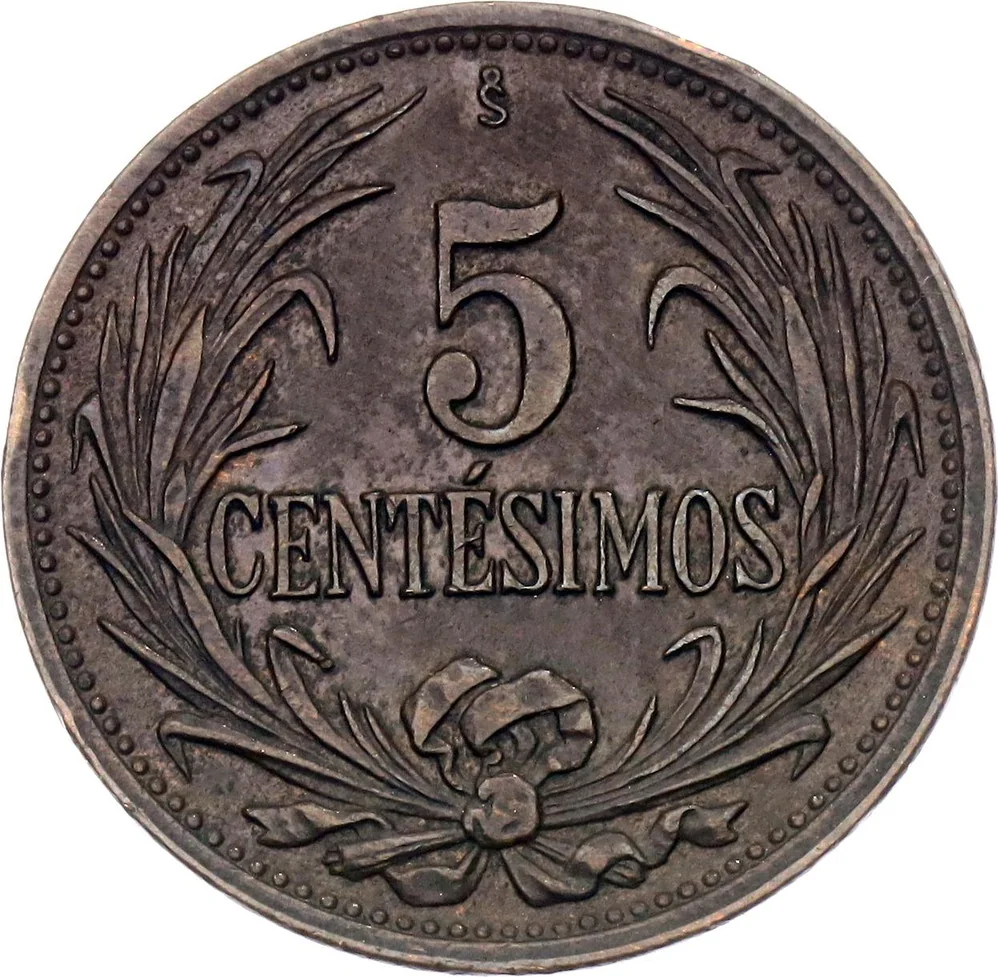
5 Centésimos – Uruguay
Uruguay
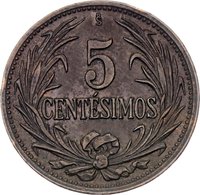
Obverse
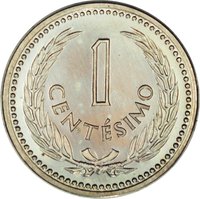
Reverse
Edge
Plain
Mints
| Name | Mark |
|---|---|
| Casa de Moneda de Chile | (So) |
Mintings
| Year | Mint Mark | Mintage | Quality | Collection |
|---|---|---|---|---|
| 1944 | So | 4,000,000 | ||
| 1946 | So | 2,000,000 | ||
| 1947 | So | 2,000,000 | ||
| 1948 | So | 3,000,000 | ||
| 1949 | So | 2,800,000 | ||
| 1951 | So | 15,000,000 |
Historical background
In 1944, Uruguay's currency situation was characterized by stability and relative strength, largely insulated from the direct upheavals of World War II. This was a result of deliberate, conservative fiscal and monetary policies established in the preceding decades. The country's financial bedrock was the "peso oro" (gold peso), a stable unit of account used for international contracts and official valuations, though not a physical circulating coin. The actual circulating currency was the paper peso, whose value was managed prudently by the Banco de la República Oriental del Uruguay (the state bank, precursor to the central bank). Uruguay's substantial accumulated gold and foreign currency reserves, built from robust meat and wool exports to Allied nations, provided a formidable buffer, allowing it to maintain convertibility and avoid the rampant inflation plaguing other regional economies.
This external strength, however, masked growing internal economic pressures and distortions. While the official exchange rate was pegged and stable, a complex system of exchange controls and multiple preferential rates had been implemented to manage wartime trade. These controls, administered by the Exchange Control Commission, created a divergence between the official financial rate and higher black-market rates for currencies like the US dollar and British pound. This system aimed to conserve hard currency, prioritize essential imports, and capture export earnings for the state, but it also led to inefficiencies and incentives for evasion.
Overall, 1944 represents the tail end of a period of remarkable monetary stability for Uruguay, a direct legacy of the Batllist welfare state and its strong export-led economy. The country entered the post-war era with significant reserves and a credible currency. However, the administrative controls and rigidities of the wartime economy also planted seeds for future challenges. In the coming decades, as export revenues fluctuated and domestic spending increased, the managed stability of 1944 would gradually give way to persistent inflationary pressures and more pronounced currency devaluations.
This external strength, however, masked growing internal economic pressures and distortions. While the official exchange rate was pegged and stable, a complex system of exchange controls and multiple preferential rates had been implemented to manage wartime trade. These controls, administered by the Exchange Control Commission, created a divergence between the official financial rate and higher black-market rates for currencies like the US dollar and British pound. This system aimed to conserve hard currency, prioritize essential imports, and capture export earnings for the state, but it also led to inefficiencies and incentives for evasion.
Overall, 1944 represents the tail end of a period of remarkable monetary stability for Uruguay, a direct legacy of the Batllist welfare state and its strong export-led economy. The country entered the post-war era with significant reserves and a credible currency. However, the administrative controls and rigidities of the wartime economy also planted seeds for future challenges. In the coming decades, as export revenues fluctuated and domestic spending increased, the managed stability of 1944 would gradually give way to persistent inflationary pressures and more pronounced currency devaluations.
🌱 Very Common