

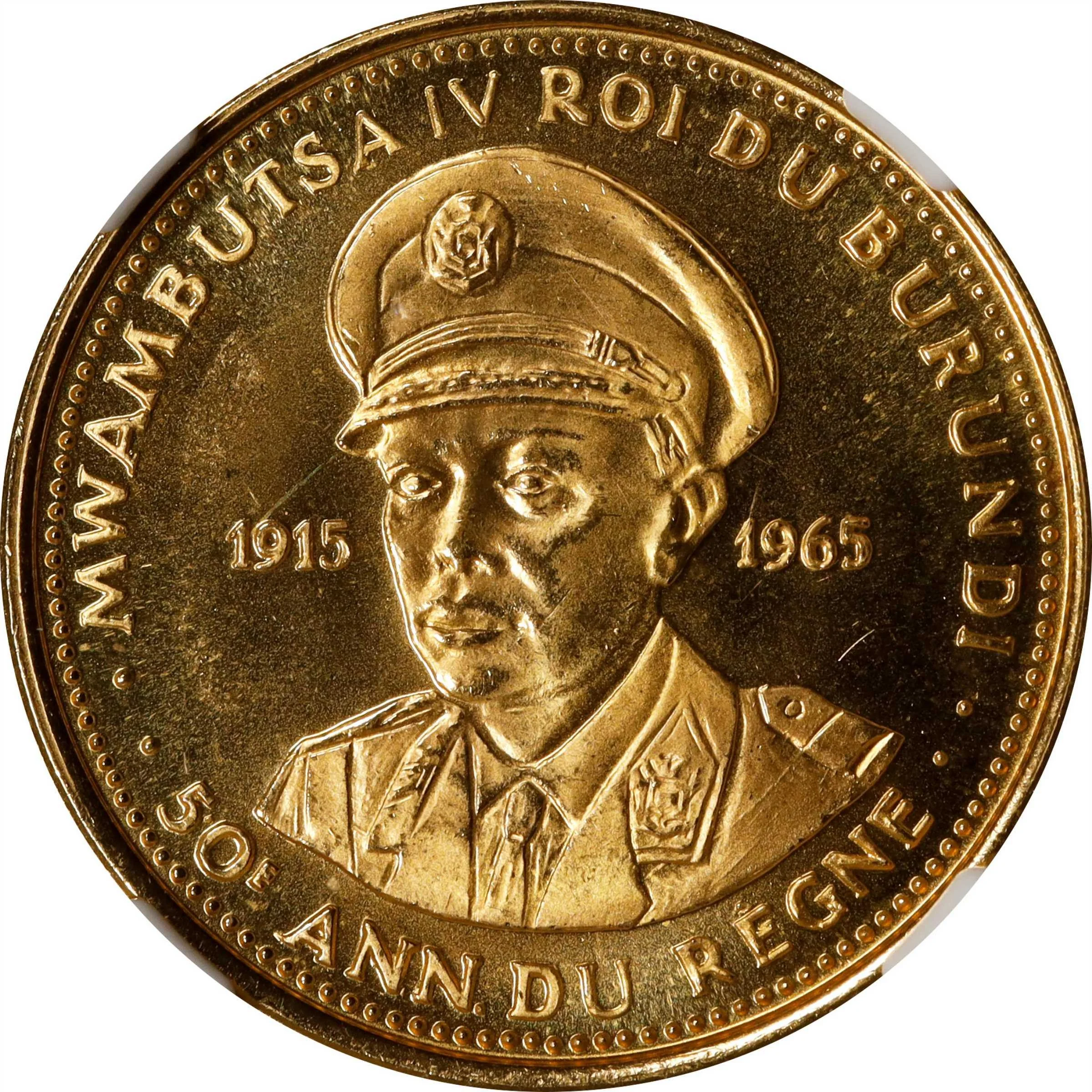
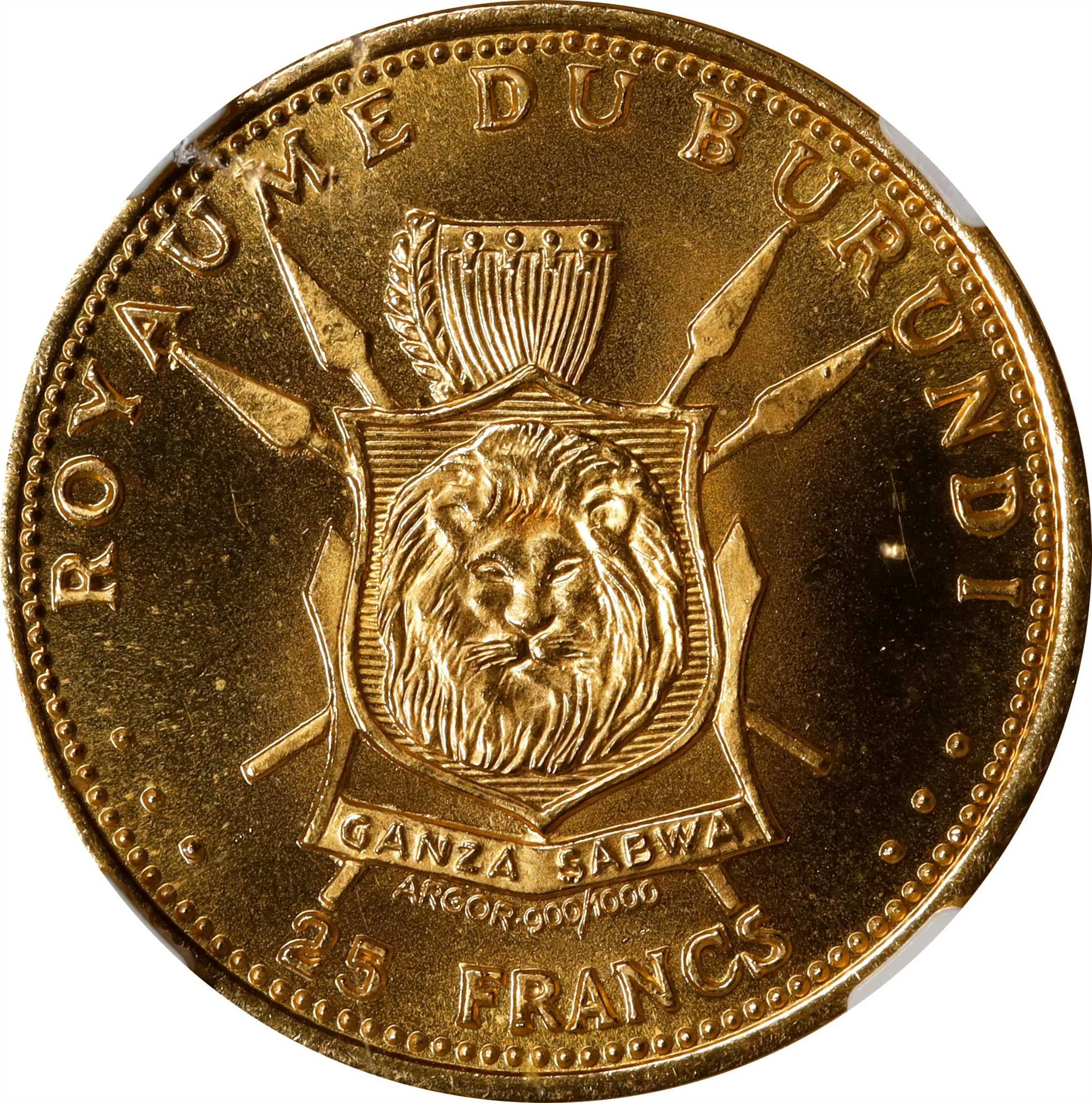
25 francs (Reign of Mwambutsa IV) – Burundi
Non-circulating coins
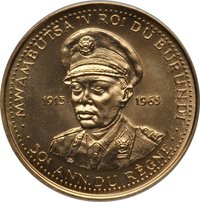
Commemoration: 50th Anniversary of the Reign of Mwambutsa IV
Burundi
Context

Material
References
KM: #Click to copy to clipboard8
Numista: #52735
Value
Exchange value: 25 BIF
Bullion value: $1142.16
Obverse
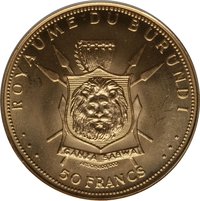
Reverse
Edge
Categories
| Symbols> Coat of Arms |
Mintings
| Year | Mint Mark | Mintage | Quality | Collection |
|---|---|---|---|---|
| 1965 | — | — | ||
| 1965 | — | 5,000 | Proof |
Historical background
In 1965, Burundi's currency situation was intrinsically linked to its colonial past and fragile post-independence political landscape. The nation continued to use the Burundian franc (BIF), which was pegged at par to the Rwandan franc, a structure established in 1960 under the auspices of the Banque d'Emission du Rwanda et du Burundi. This shared central bank, a legacy of the Belgian-administered Ruanda-Urundi trust territory, meant Burundi did not have independent monetary control. The currency's stability was therefore externally managed and tied to the Belgian franc via the Bretton Woods system, providing a degree of predictability but limiting sovereign economic policy.
Economically, the currency system operated within a severely underdeveloped and agrarian economy, heavily dependent on coffee exports. The fixed exchange rate provided stability for the limited foreign trade, but the monetary infrastructure was rudimentary, with a largely unbanked population and economic activity concentrated in subsistence farming. However, the primary stress on the currency framework was profoundly political. 1965 was a year of intense crisis, marked by an attempted Hutu-led coup in October and a subsequent brutal Tutsi-led repression, fundamentally destabilizing the state.
The political turmoil of 1965 directly threatened the existing monetary arrangement. The violence and instability undermined economic activity and exposed the impracticality of a shared central bank with Rwanda, given the two nations' diverging paths. While the currency itself remained formally unchanged that year, the events set an irreversible course toward monetary independence. This culminated in 1966, when Burundi withdrew from the common bank and established its own Banque de la République du Burundi, seeking to wield its currency as a direct instrument of national sovereignty.
Economically, the currency system operated within a severely underdeveloped and agrarian economy, heavily dependent on coffee exports. The fixed exchange rate provided stability for the limited foreign trade, but the monetary infrastructure was rudimentary, with a largely unbanked population and economic activity concentrated in subsistence farming. However, the primary stress on the currency framework was profoundly political. 1965 was a year of intense crisis, marked by an attempted Hutu-led coup in October and a subsequent brutal Tutsi-led repression, fundamentally destabilizing the state.
The political turmoil of 1965 directly threatened the existing monetary arrangement. The violence and instability undermined economic activity and exposed the impracticality of a shared central bank with Rwanda, given the two nations' diverging paths. While the currency itself remained formally unchanged that year, the events set an irreversible course toward monetary independence. This culminated in 1966, when Burundi withdrew from the common bank and established its own Banque de la République du Burundi, seeking to wield its currency as a direct instrument of national sovereignty.
✨ Legendary