

1000 lire (Eugenio Montale) – Italy
Add to wishlist
Non-circulating coins
Commemoration: 100th Anniversary of the Birth of Eugenio Montale
Italy
Context
Material
References
KM: #
Numista: #52638
Value
Exchange value: 1000 ITL
Bullion value: $30.39
Inflation-adjusted value: 1812.94 ITL
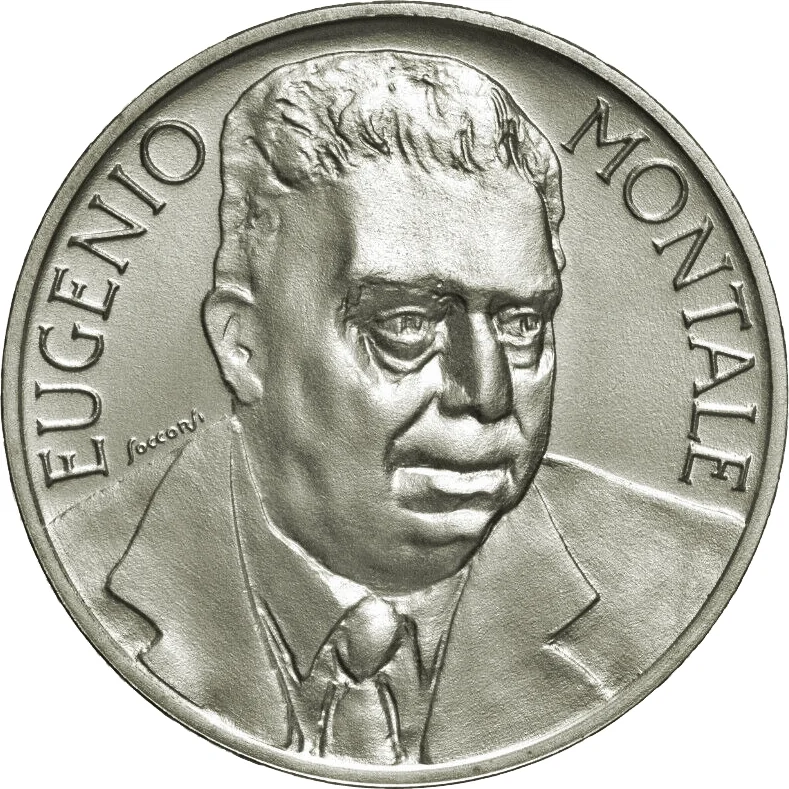
Obverse
Description:
Old portrait of poet Montale, author's name above right shoulder.
Inscription:
EUGENIO MONTALE
SOCCORSI
SOCCORSI
Translation:
EUGENIO MONTALE
RESCUES
RESCUES
Script: Latin
Language: Italian
Engraver: Maurizio Soccorsi
Reverse
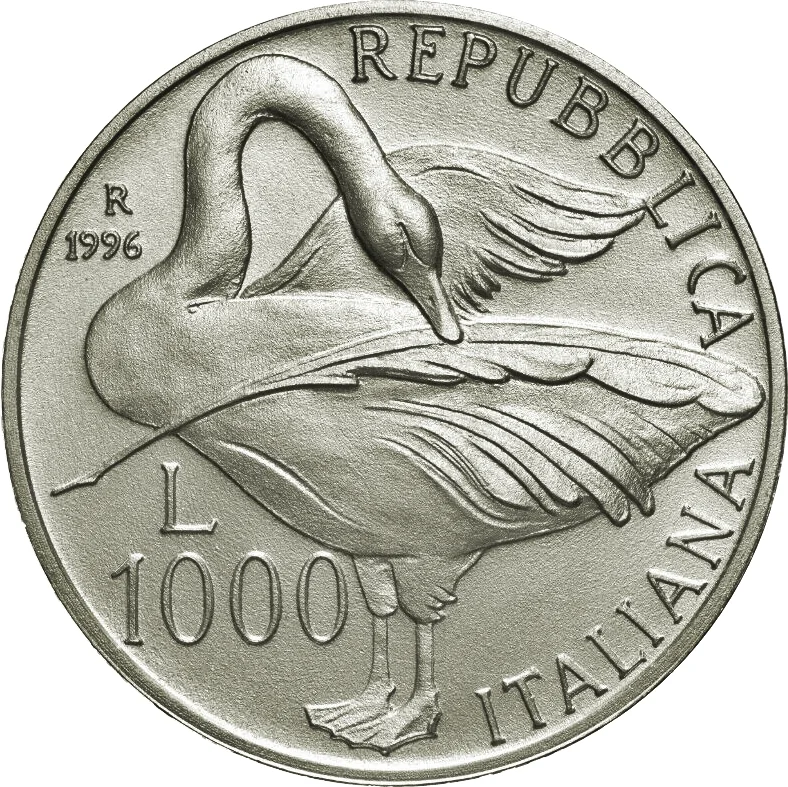
Description:
A swan preening, with a horizontal feather before it. To its left, the value is below its belly and the date and mint mark are near its neck.
Inscription:
REPUBBLICA ITALIANA
L 1000
1996 R
L 1000
1996 R
Translation:
Italian Republic
1000 Lire
1996 R
1000 Lire
1996 R
Script: Latin
Language: Italian
Engraver: Mauro Soccorsi
Edge
"R.I." repeated 3 times between stars and laurel
Legend:
R.I. | R.I. | R.I. |
Categories
| Animal> Bird |
| Event> Birth anniversary |
| Art> Literature |
Mints
| Name | Mark |
|---|---|
| Rome | R |
Historical background
In 1996, Italy's currency situation was defined by its pivotal and tense final year within the European Exchange Rate Mechanism (ERM), the system designed to stabilize currencies ahead of the planned single European currency. The Italian lira had rejoined the ERM in November 1996 after a traumatic exit in September 1992, when it was forced to devalue dramatically under speculative attack. Its return was at a significantly devalued central rate, a hard-won concession that boosted export competitiveness but also symbolized the economic fragility and political instability that had plagued Italy in the early 1990s.
Domestically, the period was marked by a determined austerity drive led by Prime Minister Romano Prodi's center-left government, which took office in May 1996. The urgent goal was to meet the strict Maastricht Treaty convergence criteria—particularly reducing the budget deficit to below 3% of GDP and curbing public debt—to qualify for the first wave of Economic and Monetary Union (EMU). This required severe fiscal measures, including a one-off "Eurotax," which was politically unpopular but crucial for demonstrating Italy's commitment to European integration and financial discipline to skeptical European partners, especially Germany.
Thus, the 1996 currency backdrop was one of a precarious balancing act. Italy was striving to maintain lira stability within the ERM's narrow bands while implementing harsh domestic reforms, all under the intense scrutiny of financial markets and European institutions. The year culminated in success on both fronts: the lira remained stable, and in 1997, Italy's deficit was confirmed to have met the 3% target. This paved the way for the historic 1998 decision to include Italy in the eurozone, effectively ending the lira's independent existence after 1999.
Domestically, the period was marked by a determined austerity drive led by Prime Minister Romano Prodi's center-left government, which took office in May 1996. The urgent goal was to meet the strict Maastricht Treaty convergence criteria—particularly reducing the budget deficit to below 3% of GDP and curbing public debt—to qualify for the first wave of Economic and Monetary Union (EMU). This required severe fiscal measures, including a one-off "Eurotax," which was politically unpopular but crucial for demonstrating Italy's commitment to European integration and financial discipline to skeptical European partners, especially Germany.
Thus, the 1996 currency backdrop was one of a precarious balancing act. Italy was striving to maintain lira stability within the ERM's narrow bands while implementing harsh domestic reforms, all under the intense scrutiny of financial markets and European institutions. The year culminated in success on both fronts: the lira remained stable, and in 1997, Italy's deficit was confirmed to have met the 3% target. This paved the way for the historic 1998 decision to include Italy in the eurozone, effectively ending the lira's independent existence after 1999.

⭐ Rare