

10000 Lire (Conference of Messina) – Italy
Non-circulating coins
Commemoration: 40th Anniversary of the Conference of Messina
Italy
Context

Material
References
KM: #Click to copy to clipboard174
Numista: #52605
Value
Exchange value: 10000 ITL
Bullion value: $52.22
Inflation-adjusted value: 19079.40 ITL
Obverse
Description:
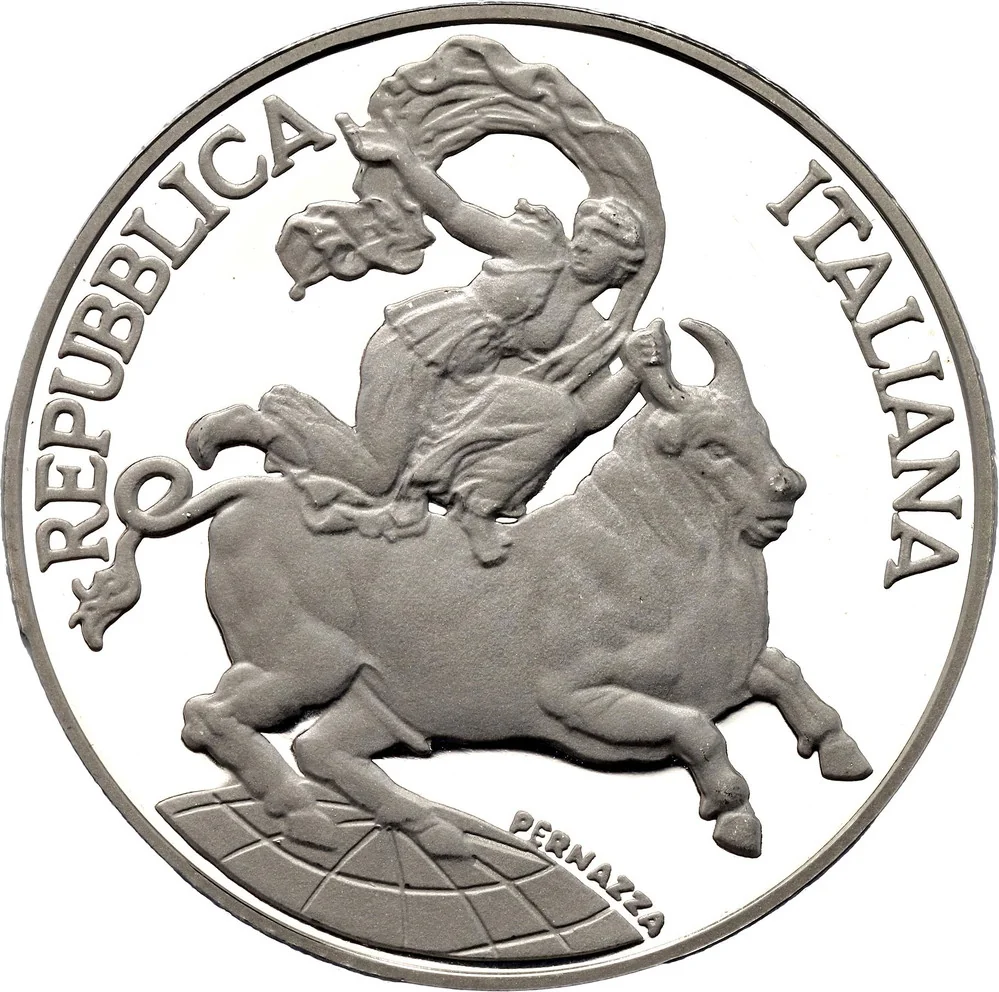
A depiction of Europa's abduction by Zeus as a bull, above a globe bearing the engraver's name.
Inscription:
REPUBBLICA ITALIANA
PERNAZZA
PERNAZZA
Translation:
Italian Republic
Pernazza
Pernazza
Script: Latin
Language: Italian
Engraver: Uliana Pernazza
Reverse
Description:
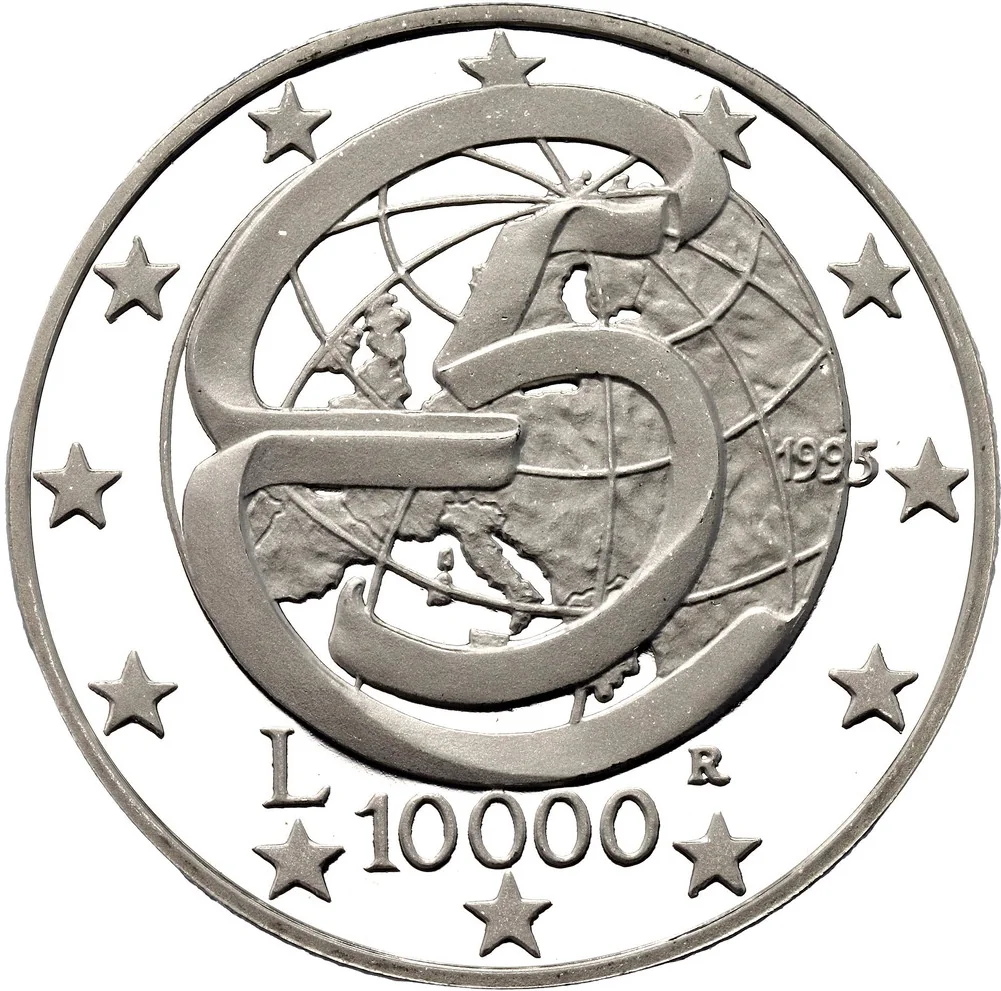
A globe centered on Europe shows a ribbon forming 'E' and '5'. Twelve stars encircle the rim. Below are the value and mintmark.
Inscription:
E 5
L 10000
1995 R
L 10000
1995 R
Script: Latin
Engraver: Uliana Pernazza
Edge
Alternating milled and smooth sections
Mints
| Name | Mark |
|---|---|
| Rome | R |
Historical background
In 1995, Italy's currency situation was defined by intense pressure on the lira within the European Exchange Rate Mechanism (ERM), the system designed to stabilize European currencies ahead of the planned single currency. The lira had been devalued and temporarily suspended from the ERM during the 1992 crisis, but its return in 1996 was a key political goal for Prime Minister Lamberto Dini's technocratic government. The primary objective was to prove Italy's monetary stability and fiscal discipline to meet the Maastricht Treaty convergence criteria for joining the European Monetary Union (EMU), a project of immense national and political importance.
Domestically, the situation was fraught with difficulty. The Italian government was grappling with a massive public debt exceeding 120% of GDP and persistent budget deficits. To strengthen the lira and curb inflation, the Bank of Italy maintained high interest rates, which stifled economic growth and increased the cost of servicing the national debt. This created a painful squeeze, as the policies needed to qualify for the EMU came at the cost of short-term economic hardship and public discontent.
Ultimately, 1995 was a year of painful but determined groundwork. The severe austerity measures, including significant pension reforms and budget cuts, began to show results by year's end, with the lira stabilizing and inflation falling. This arduous progress set the stage for the lira's formal re-entry into the ERM in November 1996, a critical step that paved Italy's way to ultimately adopting the euro in 1999. Thus, the currency story of 1995 was one of sacrifice and strategic maneuvering to secure a place in Europe's monetary future.
Domestically, the situation was fraught with difficulty. The Italian government was grappling with a massive public debt exceeding 120% of GDP and persistent budget deficits. To strengthen the lira and curb inflation, the Bank of Italy maintained high interest rates, which stifled economic growth and increased the cost of servicing the national debt. This created a painful squeeze, as the policies needed to qualify for the EMU came at the cost of short-term economic hardship and public discontent.
Ultimately, 1995 was a year of painful but determined groundwork. The severe austerity measures, including significant pension reforms and budget cuts, began to show results by year's end, with the lira stabilizing and inflation falling. This arduous progress set the stage for the lira's formal re-entry into the ERM in November 1996, a critical step that paved Italy's way to ultimately adopting the euro in 1999. Thus, the currency story of 1995 was one of sacrifice and strategic maneuvering to secure a place in Europe's monetary future.
⭐ Somewhat Rare