

5 Dollars – Solomon Islands
Non-circulating coins
Commemoration: UN Decade for Women
Solomon Islands
Context

Material

References
KM: #Click to copy to clipboard22
Numista: #52586
Value
Exchange value: 5 SBD
Bullion value: $75.88
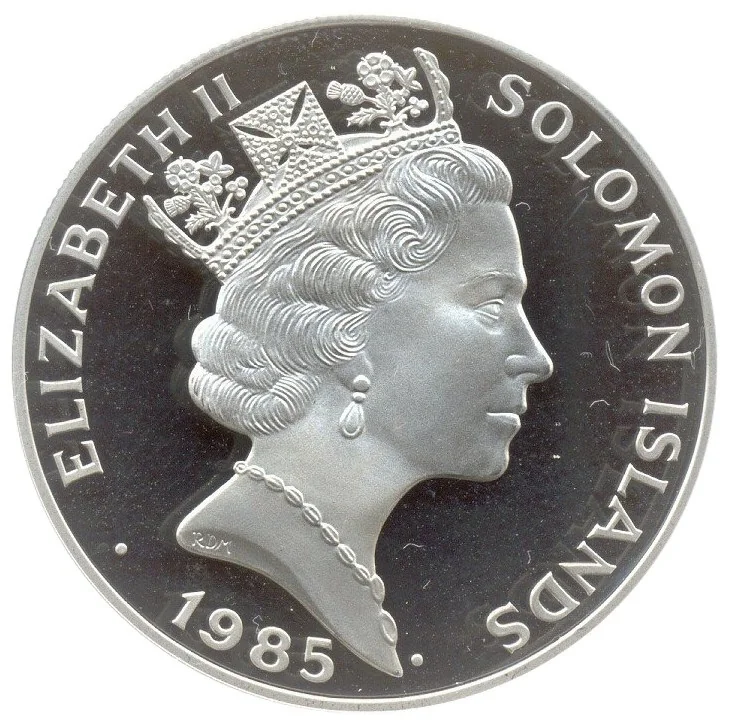
Obverse
Description:
Queen Elizabeth II's effigy
Inscription:
ELIZABETH II SOLOMON ISLANDS
· 1985 ·
· 1985 ·
Translation:
ELIZABETH II SOLOMON ISLANDS
· 1985 ·
· 1985 ·
Script: Latin
Language: English
Engraver: Raphael David Maklouf
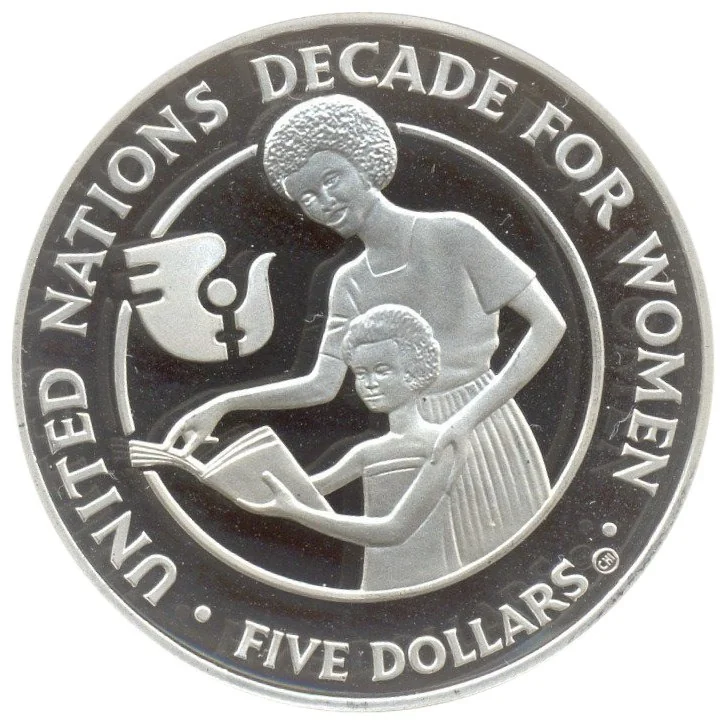
Reverse
Description:
Teacher and student reading in a circle.
Inscription:
UNITED NATIONS DECADE FOR WOMEN
· FIVE DOLLARS ·
CHI
· FIVE DOLLARS ·
CHI
Script: Latin
Edge
Reeded
Categories
| Organization> United Nations |
| History> Feminism |
Mints
| Name | Mark |
|---|---|
| Valcambi | CHI |
Mintings
| Year | Mint Mark | Mintage | Quality | Collection |
|---|---|---|---|---|
| 1985 | CHI | 1,050 | Proof |
Historical background
In 1985, the currency situation in Solomon Islands was defined by its reliance on the Solomon Islands dollar (SBD), which had been established as the national currency just four years earlier in 1977, following independence from Britain in 1978. Prior to this, the country used the Australian dollar. The new currency was initially pegged to a basket of currencies, but by the early 1980s, it was pegged to the Special Drawing Rights (SDR) of the International Monetary Fund, a move aimed at providing stability. However, the economy was highly vulnerable, being heavily dependent on exports of key commodities like timber, fish, and particularly copra, whose prices on the global market were volatile.
The mid-1980s presented significant economic challenges that pressured the currency. A global recession earlier in the decade, coupled with a severe cyclone in 1986, highlighted the fragility of the resource-based economy. While 1985 itself did not see a major devaluation, the period was marked by underlying strains: declining terms of trade, a growing government budget deficit, and an increasing dependence on foreign aid. These factors placed persistent downward pressure on the value of the Solomon Islands dollar, testing the managed exchange rate regime and foreshadowing the economic difficulties that would intensify later in the decade.
Consequently, the monetary policy of the Central Bank of Solomon Islands in 1985 was primarily focused on maintaining the SDR peg to ensure import stability and control inflation. This required careful management of foreign reserves, which were susceptible to swings in export earnings. The currency situation, therefore, reflected a young nation navigating the complexities of economic sovereignty, striving for monetary stability amidst a narrow export base and exposure to external shocks, setting the stage for the more pronounced structural adjustments and devaluations that would follow in the late 1980s and early 1990s.
The mid-1980s presented significant economic challenges that pressured the currency. A global recession earlier in the decade, coupled with a severe cyclone in 1986, highlighted the fragility of the resource-based economy. While 1985 itself did not see a major devaluation, the period was marked by underlying strains: declining terms of trade, a growing government budget deficit, and an increasing dependence on foreign aid. These factors placed persistent downward pressure on the value of the Solomon Islands dollar, testing the managed exchange rate regime and foreshadowing the economic difficulties that would intensify later in the decade.
Consequently, the monetary policy of the Central Bank of Solomon Islands in 1985 was primarily focused on maintaining the SDR peg to ensure import stability and control inflation. This required careful management of foreign reserves, which were susceptible to swings in export earnings. The currency situation, therefore, reflected a young nation navigating the complexities of economic sovereignty, striving for monetary stability amidst a narrow export base and exposure to external shocks, setting the stage for the more pronounced structural adjustments and devaluations that would follow in the late 1980s and early 1990s.
💎 Extremely Rare