

500 Lire (discovery of America) – Italy
Non-circulating coins
Commemoration: 500th Anniversary of discovery of America (4th issue)
Italy
Context

Material
References
KM: #Click to copy to clipboard150
Numista: #52579
Value
Exchange value: 500 ITL
Bullion value: $26.68
Inflation-adjusted value: 1093.30 ITL
Obverse
Description:
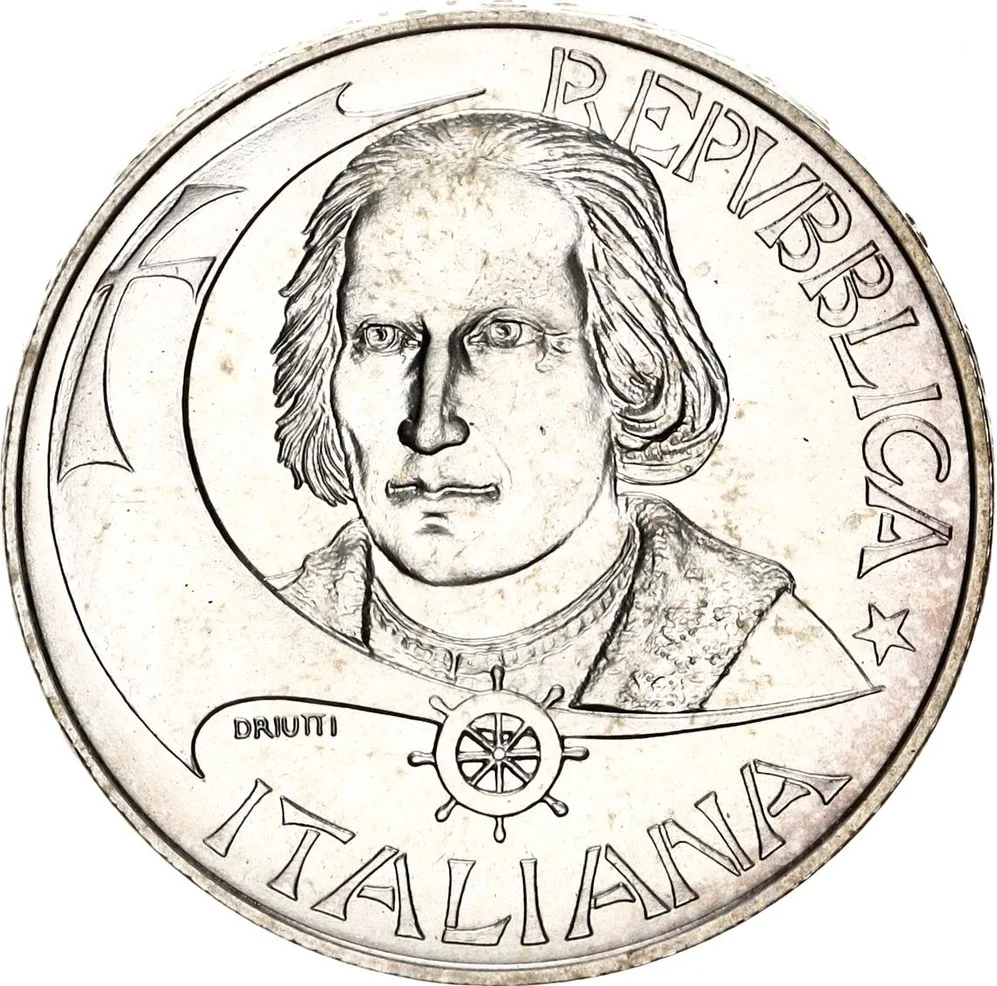
Columbus faces left, his portrait forming the C of a wind-filled caravel sail. A small rudder hangs like a pendant at his neck. The author's name is below the sail.
Inscription:
REPVBBLICA * ITALIANA
DRIUTTI
DRIUTTI
Translation:
Italian Republic
Rights
Rights
Script: Latin
Engraver: Eugenio Driutti
Reverse
Description:
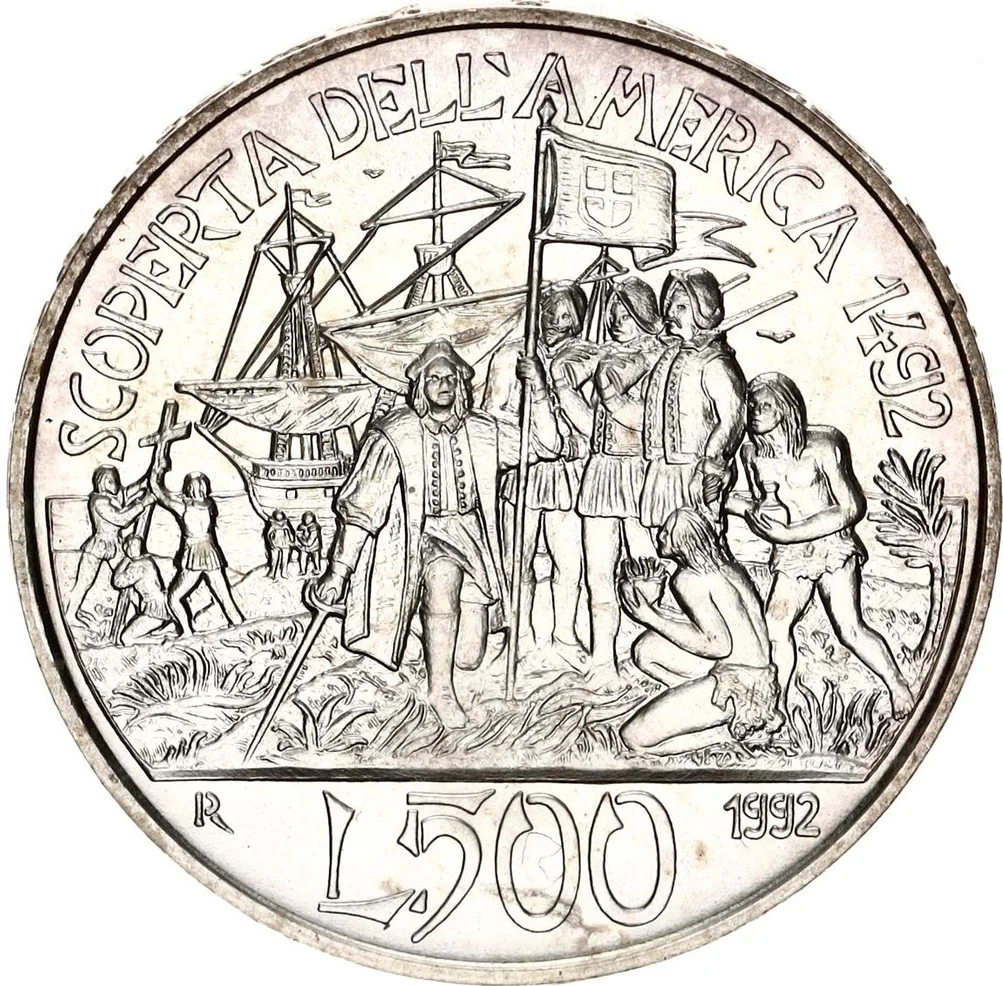
Columbus lands on a shore, holding a sword and a Genoese flag. Soldiers stand beside him as kneeling Indigenous figures offer goods. In the background, men erect a cross and three caravels sit offshore. Exergue contains value, date, and mintmark.
Inscription:
SCOPERTA DELL'AMERICA 1492
R L.500 1992
R L.500 1992
Translation:
Discovery of America 1492
R L.500 1992
R L.500 1992
Script: Latin
Language: Italian
Engraver: Eugenio Driutti
Edge
"R.I." repeated 3 times between stars and laurel
Legend:
R.I. | R.I. | R.I. |
Categories
| Symbol> Flag |
| Transportation> Watercraft |
Mints
| Name | Mark |
|---|---|
| Rome | R |
Historical background
In 1992, Italy found itself in a profound currency crisis, a central episode of the broader European Exchange Rate Mechanism (ERM) turmoil. The lira was under severe speculative attack, as international investors doubted Italy's ability to maintain its fixed parity within the ERM, the system designed to limit currency fluctuations ahead of the planned single European currency. This pressure was driven by a stark divergence between Italy's high inflation and large public debt—exceeding 100% of GDP—and the more disciplined fiscal and monetary policies of its key trading partner, Germany. The high interest rates Germany used to manage its own post-reunification inflation made the lira's position untenable, as Italy could not match these rates without crippling its already weak economy.
The situation came to a head in September 1992, known as "Black Wednesday" across Europe. Despite desperate measures, including a last-minute emergency hike in the discount rate and massive, costly interventions by the Bank of Italy to buy lire on the foreign exchange markets, the speculative pressure proved overwhelming. On September 17, 1992, the Italian government and monetary authorities were forced to announce the lira's withdrawal from the ERM and its subsequent devaluation. This humiliating exit was paralleled by the UK's departure on the same day, marking a catastrophic failure of the existing European monetary order.
The aftermath of the 1992 crisis was transformative. The devaluation, while a shock, ultimately boosted Italian export competitiveness. More importantly, the trauma of being expelled from the ERM provided a powerful political impetus for fiscal reform and convergence with the Maastricht Treaty criteria. This collective national effort, though painful and incomplete in many areas, allowed Italy to later re-enter the ERM in 1996 and ultimately qualify as a founding member of the European Economic and Monetary Union (EMU) and the euro in 1999, with the currency changeover occurring in 2002.
The situation came to a head in September 1992, known as "Black Wednesday" across Europe. Despite desperate measures, including a last-minute emergency hike in the discount rate and massive, costly interventions by the Bank of Italy to buy lire on the foreign exchange markets, the speculative pressure proved overwhelming. On September 17, 1992, the Italian government and monetary authorities were forced to announce the lira's withdrawal from the ERM and its subsequent devaluation. This humiliating exit was paralleled by the UK's departure on the same day, marking a catastrophic failure of the existing European monetary order.
The aftermath of the 1992 crisis was transformative. The devaluation, while a shock, ultimately boosted Italian export competitiveness. More importantly, the trauma of being expelled from the ERM provided a powerful political impetus for fiscal reform and convergence with the Maastricht Treaty criteria. This collective national effort, though painful and incomplete in many areas, allowed Italy to later re-enter the ERM in 1996 and ultimately qualify as a founding member of the European Economic and Monetary Union (EMU) and the euro in 1999, with the currency changeover occurring in 2002.
🌟 Limited