

60 Pence – Isle of Man
Non-circulating coins
Commemoration: The euro
Context
Years: 2002–2003
Country: British Crown dependencies
Issuer: Isle of Man 
Ruler: Elizabeth II
Currency:
(since 1971)
Material
References
KM: #Click to copy to clipboard1128
Numista: #52573
Value
Exchange value: 0.6 IMP
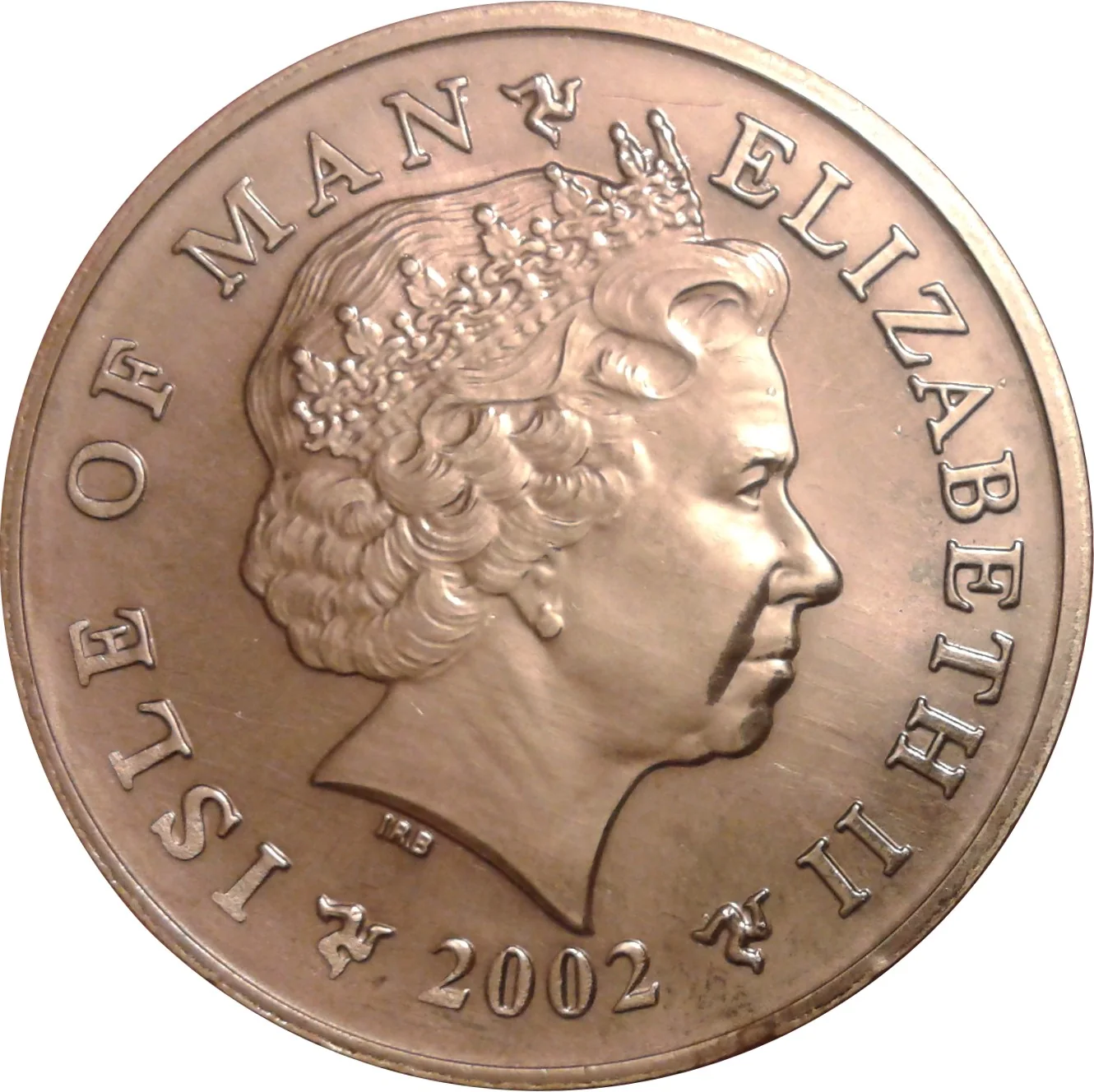
Obverse
Inscription:
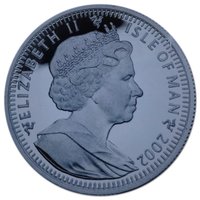
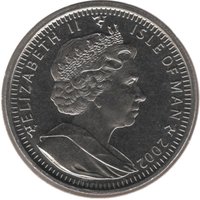
ISLE OF MAN ELIZABETH II
2002
2002
Translation:
ISLE OF MAN ELIZABETH II
2002
2002
Script: Latin
Language: English
Engraver: Ian Rank-Broadley
Reverse
Description:
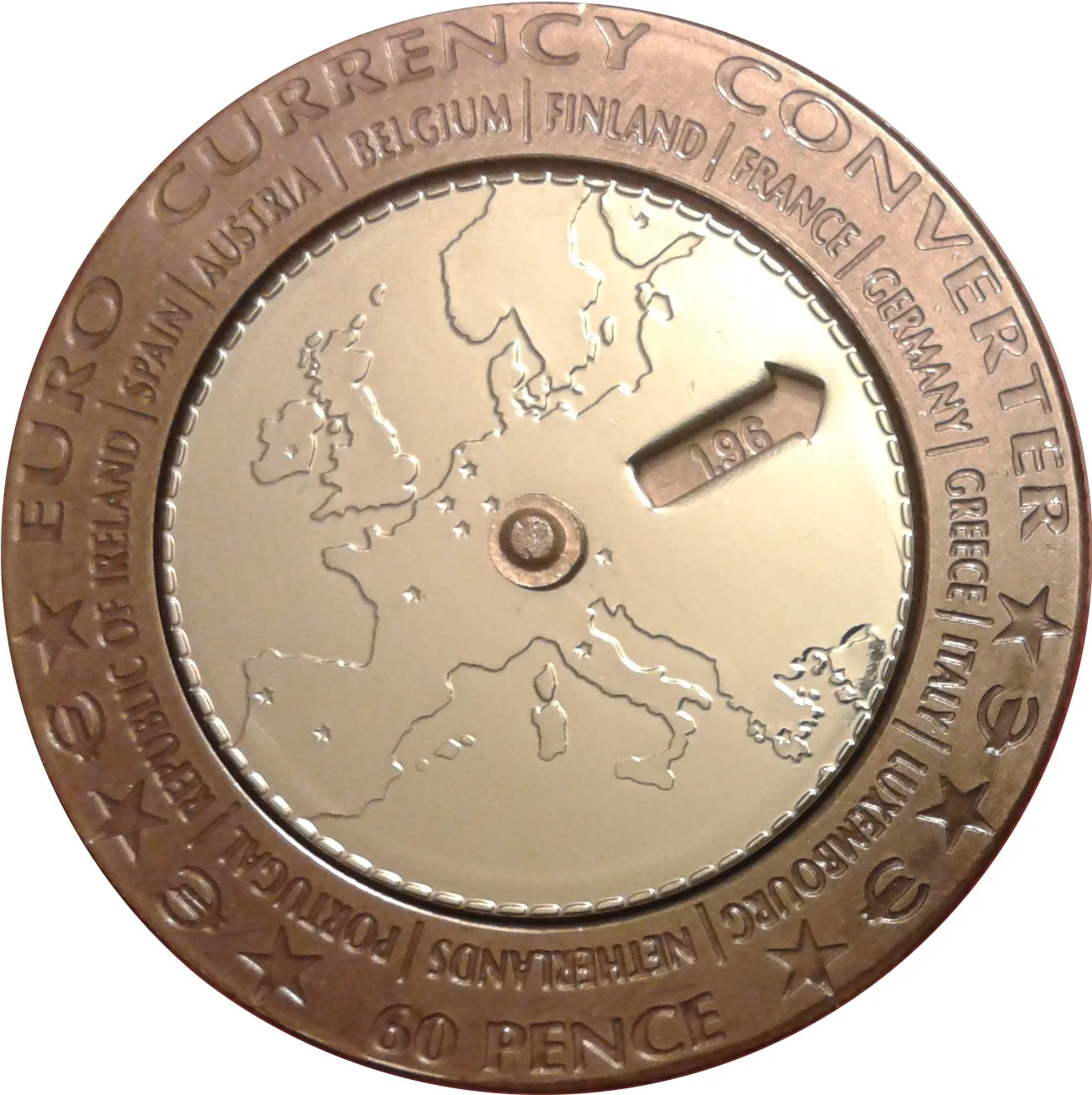
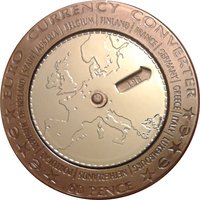
The central map rotates to display exchange rates for the first 12 Eurozone countries.
Inscription:
★ € ★ € ★ EURO CURRENCY CONVERTER ★ ★ ★
AUSTRIA|BELGIUM|FINLAND|FRANCE|GERMANY|GREECE|ITALY|LUXEMBOURG|NETHERLANDS|PORTUGAL|REPUBLIC OF IRELAND|
40.34
5.95
1.96
340.75
40.34
60 PENCE € €
AUSTRIA|BELGIUM|FINLAND|FRANCE|GERMANY|GREECE|ITALY|LUXEMBOURG|NETHERLANDS|PORTUGAL|REPUBLIC OF IRELAND|
40.34
5.95
1.96
340.75
40.34
60 PENCE € €
Script: Latin
Edge
Milled
Mintings
| Year | Mint Mark | Mintage | Quality | Collection |
|---|---|---|---|---|
| 2002 | — | — | ||
| 2003 | — | — |
Historical background
In 2002, the Isle of Man's currency situation was defined by its unique constitutional position as a British Crown Dependency, which granted it a high degree of autonomy in domestic affairs, including monetary policy. While not part of the United Kingdom or the European Union, the Island's economy was deeply integrated with that of the UK. Consequently, the Manx government maintained a long-standing currency union with Britain, with sterling being the official currency. However, exercising its privilege of issuing its own legal tender, the Isle of Man circulated distinctive notes and coins, denominated in pounds sterling, which were technically local issues but traded at par with UK sterling throughout the Island and, often, in the UK itself, albeit without legal tender status there.
The year 2002 was particularly significant as it marked the culmination of the UK's transition to decimal coinage in its own currency three decades prior, with the withdrawal of the old penny and halfpenny. While the Isle of Man had decimalised in parallel with the UK in 1971, 2002 saw the Island fully align its coinage series with the UK's modern, smaller-sized denominations. More notably, this period was framed by the UK's major economic event of the time: the launch of euro banknotes and coins in the Eurozone on 1 January 2002. This created a direct contrast, highlighting the Isle of Man's deliberate and continued choice to remain firmly within the sterling zone, reflecting its economic and political ties to London rather than Brussels.
Therefore, the 2002 currency landscape was one of stability and deliberate alignment. The Manx authorities focused on maintaining public confidence in their local issues, ensuring their notes and coins were secure and readily exchangeable. There was no serious debate about adopting the euro, as the Island's constitutional relationship with the EU (under Protocol 3 of the UK's Treaty of Accession) only provided for trade in goods, excluding monetary union. The priority was to manage a stable, familiar monetary environment that supported the Island's key sectors of offshore finance, tourism, and light manufacturing, all of which relied heavily on the predictability of the sterling link.
The year 2002 was particularly significant as it marked the culmination of the UK's transition to decimal coinage in its own currency three decades prior, with the withdrawal of the old penny and halfpenny. While the Isle of Man had decimalised in parallel with the UK in 1971, 2002 saw the Island fully align its coinage series with the UK's modern, smaller-sized denominations. More notably, this period was framed by the UK's major economic event of the time: the launch of euro banknotes and coins in the Eurozone on 1 January 2002. This created a direct contrast, highlighting the Isle of Man's deliberate and continued choice to remain firmly within the sterling zone, reflecting its economic and political ties to London rather than Brussels.
Therefore, the 2002 currency landscape was one of stability and deliberate alignment. The Manx authorities focused on maintaining public confidence in their local issues, ensuring their notes and coins were secure and readily exchangeable. There was no serious debate about adopting the euro, as the Island's constitutional relationship with the EU (under Protocol 3 of the UK's Treaty of Accession) only provided for trade in goods, excluding monetary union. The priority was to manage a stable, familiar monetary environment that supported the Island's key sectors of offshore finance, tourism, and light manufacturing, all of which relied heavily on the predictability of the sterling link.
💎 Extremely Rare