

500 Lire – Italy
Non-circulating coins
Commemoration: Fight against Cancer
Italy
Context

Material
References
KM: #Click to copy to clipboard131
Numista: #52545
Value
Exchange value: 500 ITL
Bullion value: $26.11
Inflation-adjusted value: 1314.08 ITL
Obverse
Description:
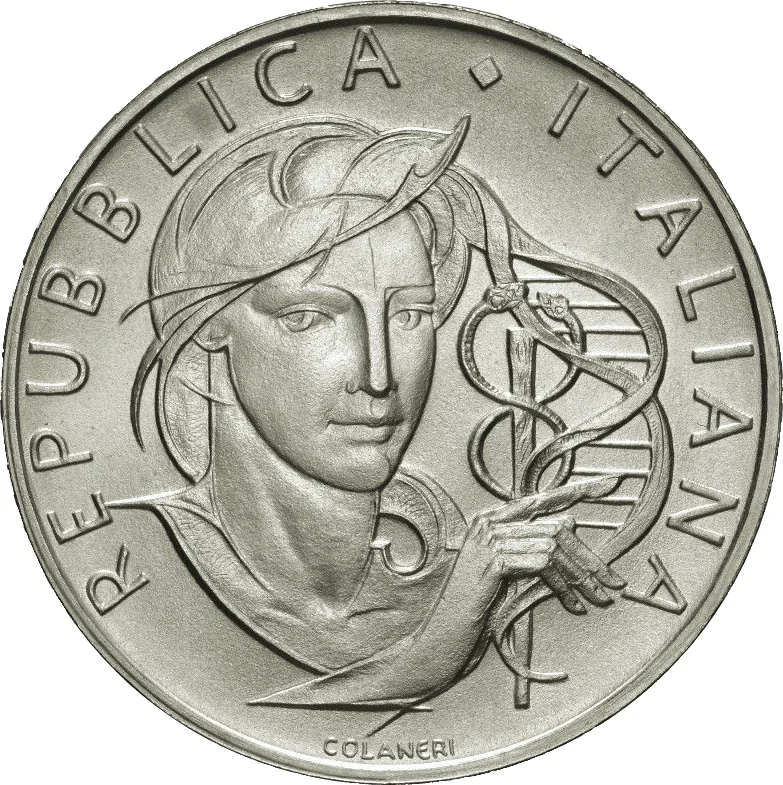
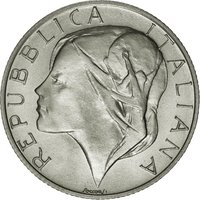
A woman holds the Caduceus; her hair twists into a DNA helix. The engraver's name is below.
Inscription:
REPUBBLICA ITALIANA
COLANERI
COLANERI
Translation:
Italian Republic
Cola Neri
Cola Neri
Script: Latin
Language: Italian
Engraver: Maria Carmela Colaneri
Reverse
Description:
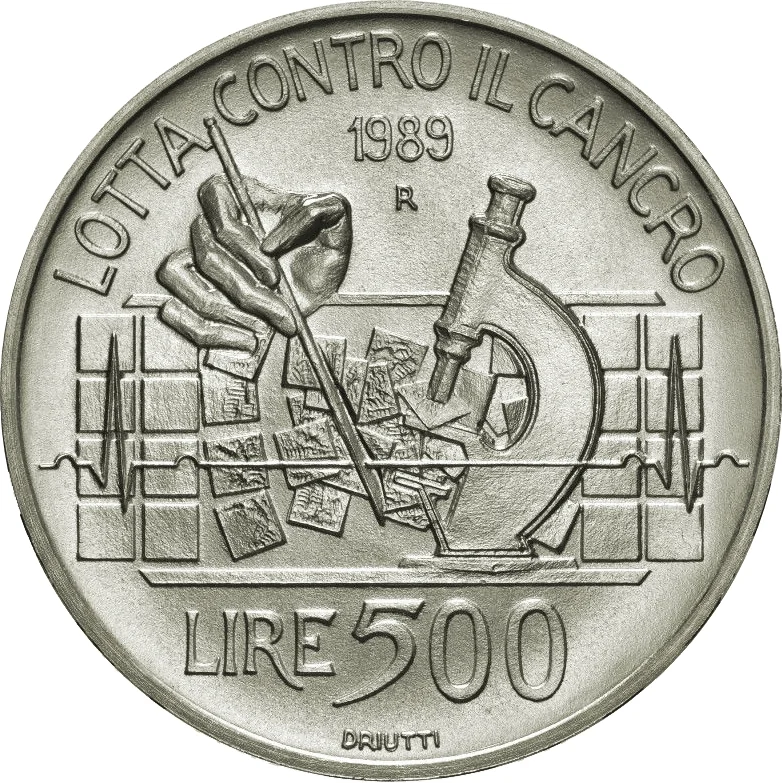
Scientific research symbols in medicine: microscope, scalpel, etc. Date and mintmark above; value and engraver below.
Inscription:
LOTTA CONTRO IL CANCRO
1989 R
LIRE 500
DRIUTTI
1989 R
LIRE 500
DRIUTTI
Translation:
Fight Against Cancer
1989 R
LIRE 500
DRIUTTI
1989 R
LIRE 500
DRIUTTI
Script: Latin
Language: Italian
Engraver: Eugenio Driutti
Edge
Mints
| Name | Mark |
|---|---|
| Rome | R |
Historical background
In 1989, Italy was navigating a complex and often turbulent currency situation, deeply intertwined with its participation in the European Monetary System (EMS). The lira was part of the EMS Exchange Rate Mechanism (ERM), a system designed to reduce exchange rate variability and achieve monetary stability in Europe by pegging currencies within agreed bands. However, Italy's position was persistently weak. The country struggled with high public debt, chronic budget deficits, and inflation rates that, while falling, remained higher than those of its key EMS partner, Germany. This created a recurring strain, as the strong Deutsche Mark acted as an anchor, forcing the Banca d'Italia to maintain high interest rates and frequently intervene in foreign exchange markets to defend the lira's central parity.
The underlying economic fundamentals were the core of the problem. Italy's "divergenza economica" (economic divergence) from Germany was stark. Its public debt was soaring toward 100% of GDP, fueled by a large primary deficit and high costs of debt servicing. While inflation had been reduced from the double-digit peaks of the early 1980s to around 6-7%, it still eroded Italy's competitiveness within the ERM. This period was characterized by a "hard currency" policy, where Italian authorities prioritized maintaining the ERM peg over domestic economic stimulation, accepting high real interest rates to attract capital and support the lira, despite the drag on growth.
This tense stability in 1989 proved to be a prelude to the crises of the early 1990s. The pressures were building, and the rigidities of the ERM would soon be tested. Within three years, the cumulative strain of German reunification (which pushed Bundesbank interest rates higher), combined with Italy's unresolved fiscal weaknesses and speculative attacks, would force the lira to devalue and ultimately withdraw from the ERM in September 1992. Thus, the 1989 landscape was one of fragile and costly equilibrium, where Italy's commitment to European monetary integration was actively constraining domestic policy, setting the stage for a dramatic rupture.
The underlying economic fundamentals were the core of the problem. Italy's "divergenza economica" (economic divergence) from Germany was stark. Its public debt was soaring toward 100% of GDP, fueled by a large primary deficit and high costs of debt servicing. While inflation had been reduced from the double-digit peaks of the early 1980s to around 6-7%, it still eroded Italy's competitiveness within the ERM. This period was characterized by a "hard currency" policy, where Italian authorities prioritized maintaining the ERM peg over domestic economic stimulation, accepting high real interest rates to attract capital and support the lira, despite the drag on growth.
This tense stability in 1989 proved to be a prelude to the crises of the early 1990s. The pressures were building, and the rigidities of the ERM would soon be tested. Within three years, the cumulative strain of German reunification (which pushed Bundesbank interest rates higher), combined with Italy's unresolved fiscal weaknesses and speculative attacks, would force the lira to devalue and ultimately withdraw from the ERM in September 1992. Thus, the 1989 landscape was one of fragile and costly equilibrium, where Italy's commitment to European monetary integration was actively constraining domestic policy, setting the stage for a dramatic rupture.
🌟 Limited