

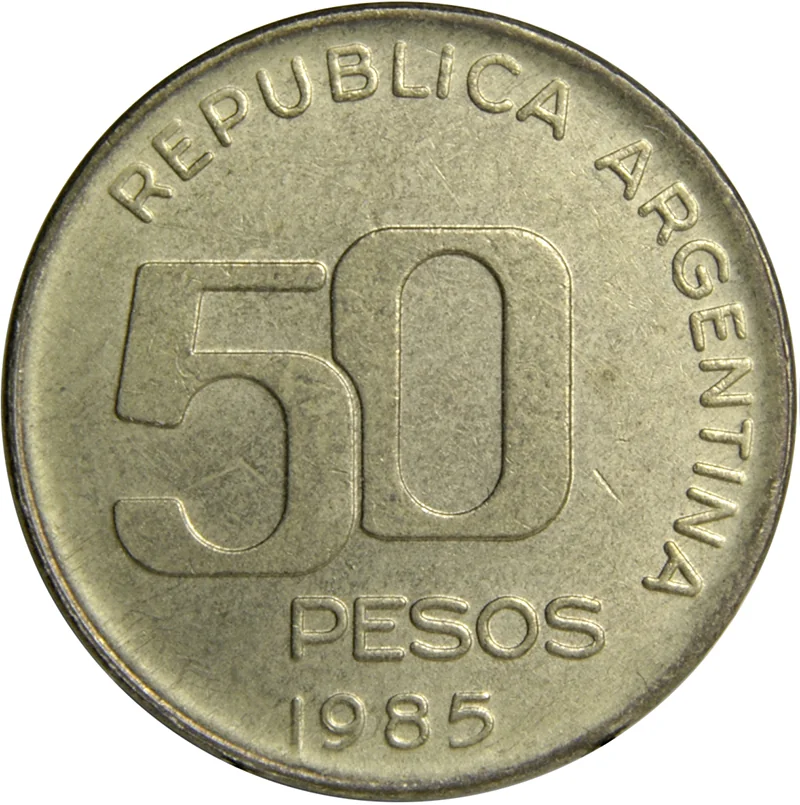
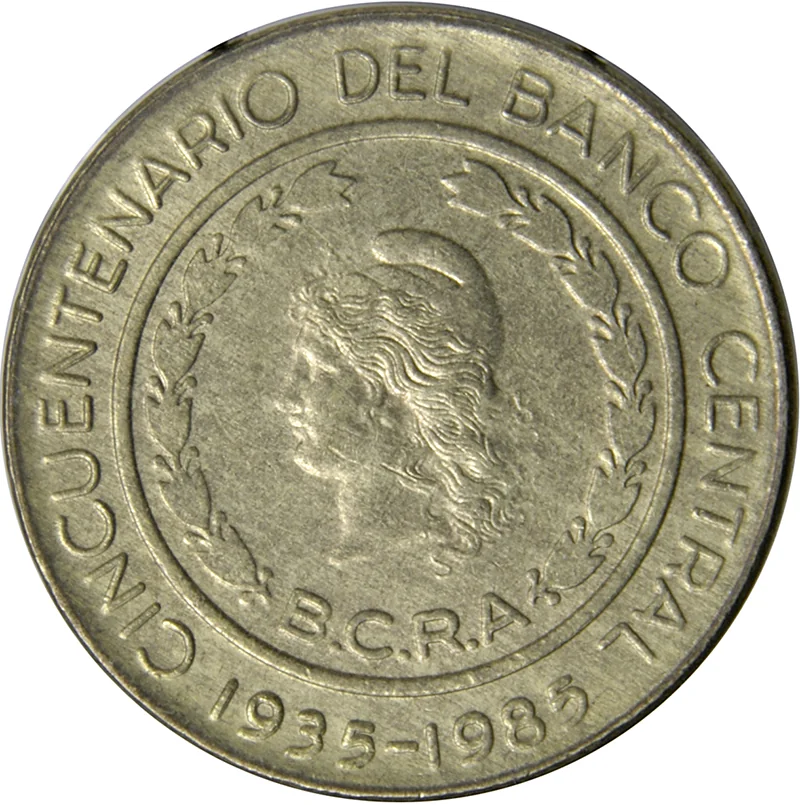
50 pesos (Central Bank) – Argentina
Add to wishlist
Circulating commemorative coins
Commemoration: 50th Anniversary of Central Bank
Argentina
Context
Year: 1985
Issuer: Argentina
Period:
(since 1861)
Currency:
(1983—1985)
Demonetization: 30 September 1991
Total mintage: 3,300,000
Material
Diameter: 23 mm
Weight: 5 g
Thickness: 1.7 mm
Shape: Round
Composition: Aluminium bronze
Magnetic: No
Technique: Milled
Alignment: Coin alignment
flip
References
KM: #
Numista: #5242
Value
Exchange value: 50 ARP
Obverse
Reverse
Edge
Plain
Categories
| Symbol> Allegory |
| Symbol> Phrygian cap |
Mints
| Name | Mark |
|---|---|
| Buenos Aires | — |
Mintings
| Year | Mint Mark | Mintage | Quality | Collection |
|---|---|---|---|---|
| 1985 | — | 3,300,000 |
Historical background
By 1985, Argentina was in the throes of a profound economic and currency crisis, the culmination of decades of instability. The period was defined by hyperinflation, which had begun to accelerate dramatically under the military dictatorship (1976-1983) and continued unabated after the return to democracy with President Raúl Alfonsín. The national currency, the peso argentino (established in 1983), was losing value at a terrifying pace, with inflation reaching 672% for the year. This erosion of purchasing power created a widespread loss of confidence; the public desperately sought to convert pesos into durable goods or stable foreign currencies like the US dollar the moment they were paid, a behavior known as "flight from money."
The root causes were deeply structural. The state was plagued by massive fiscal deficits, primarily financed by printing money from the central bank. A bloated public sector, a vast network of inefficient state-owned enterprises, and a crushing foreign debt burden left the government with no credible means to balance its books. Successive failed stabilization plans, like the "Austral Plan" launched in June 1985, attempted shock therapy by freezing prices and wages and introducing a new temporary currency (the austral), but they failed to address the fundamental lack of fiscal discipline. Consequently, the currency was not merely an economic tool but a symbol of failed policy and national anxiety.
This monetary chaos had devastating social consequences. Hyperinflation acted as a violent tax on the poor and the middle class, wiping out savings and salaries overnight and pushing poverty rates sharply higher. The constant price adjustments and uncertainty paralyzed long-term investment and fostered a speculative economy. The currency situation of 1985 thus represented more than financial data; it was a central battleground for the survival of Argentina's young democracy, testing its ability to provide basic economic stability for its citizens and threatening to unravel the social fabric entirely.
The root causes were deeply structural. The state was plagued by massive fiscal deficits, primarily financed by printing money from the central bank. A bloated public sector, a vast network of inefficient state-owned enterprises, and a crushing foreign debt burden left the government with no credible means to balance its books. Successive failed stabilization plans, like the "Austral Plan" launched in June 1985, attempted shock therapy by freezing prices and wages and introducing a new temporary currency (the austral), but they failed to address the fundamental lack of fiscal discipline. Consequently, the currency was not merely an economic tool but a symbol of failed policy and national anxiety.
This monetary chaos had devastating social consequences. Hyperinflation acted as a violent tax on the poor and the middle class, wiping out savings and salaries overnight and pushing poverty rates sharply higher. The constant price adjustments and uncertainty paralyzed long-term investment and fostered a speculative economy. The currency situation of 1985 thus represented more than financial data; it was a central battleground for the survival of Argentina's young democracy, testing its ability to provide basic economic stability for its citizens and threatening to unravel the social fabric entirely.

🌱 Very Common