

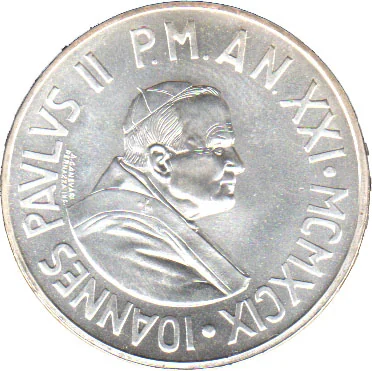
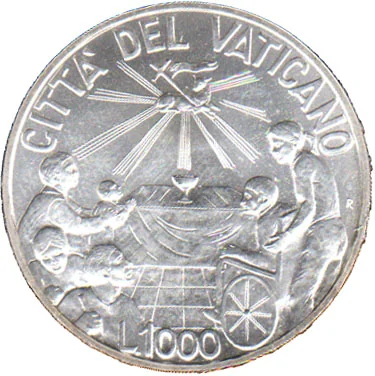
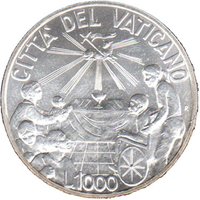
1000 Lire – Vatican City
Non-circulating coins
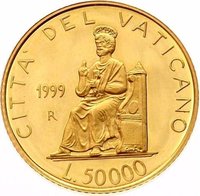
Commemoration: Rispetto dei diritti
Vatican City
Context
Year: 1999
Issuer: Vatican City 
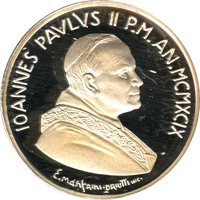
Ruler: John Paul II
Currency:
(1929—2001)
Demonetization: 1 March 2002
Material
References
KM: #Click to copy to clipboard312
Numista: #52302
Value
Exchange value: 1000 VAL
Bullion value: $34.48
Obverse
Reverse
Edge
Lettering:TOTVS TVVS +++ MCMXCIX +++
Legend:
TOTVS TVVS +++ MCMXCIX +++
Mints
| Name | Mark |
|---|---|
| Rome | — |
Mintings
| Year | Mint Mark | Mintage | Quality | Collection |
|---|---|---|---|---|
| 1999 | R | — |
Historical background
In 1999, the currency situation in Vatican City was defined by its imminent transition alongside Italy into the European Economic and Monetary Union (EMU). As a sovereign city-state with a customs and monetary union with Italy established by the 1929 Lateran Treaty, Vatican City did not have an independent central bank or mint its own circulating currency. Instead, its monetary system was pegged to the Italian lira, and it issued its own series of Vatican-lire coins and banknotes, which were legal tender within its borders and, by agreement, in Italy. The year 1999 was therefore a pivotal final year for the lira as the national currency before the introduction of euro banknotes and coins in 2002.
In preparation for the euro changeover, the Vatican entered into a new monetary agreement with the Italian Republic, acting on behalf of the European Community, in December 1998. This agreement, which came into force in 1999, granted the Vatican the right to use the euro as its official currency and, crucially, to mint a limited quantity of its own euro coins featuring distinctive Vatican designs. However, a significant constraint was imposed: the total annual face value of these coins was capped to a figure deemed appropriate for the tiny state's numismatic needs, a measure designed to prevent profiteering from speculative coin collecting, which could disrupt the money supply.
Thus, the background of 1999 is one of legal and logistical preparation under a framework of dependency. The Vatican could not autonomously join the eurozone but did so through its special relationship with Italy. While euro banknotes used in Vatican City would be standard European issues, the right to issue distinctive Vatican euro coins was secured, ensuring a continued symbol of sovereignty and a key source of revenue through sales to collectors. The year marked the quiet end of the Vatican lira era and the bureaucratic foundation for its participation in the single European currency.
In preparation for the euro changeover, the Vatican entered into a new monetary agreement with the Italian Republic, acting on behalf of the European Community, in December 1998. This agreement, which came into force in 1999, granted the Vatican the right to use the euro as its official currency and, crucially, to mint a limited quantity of its own euro coins featuring distinctive Vatican designs. However, a significant constraint was imposed: the total annual face value of these coins was capped to a figure deemed appropriate for the tiny state's numismatic needs, a measure designed to prevent profiteering from speculative coin collecting, which could disrupt the money supply.
Thus, the background of 1999 is one of legal and logistical preparation under a framework of dependency. The Vatican could not autonomously join the eurozone but did so through its special relationship with Italy. While euro banknotes used in Vatican City would be standard European issues, the right to issue distinctive Vatican euro coins was secured, ensuring a continued symbol of sovereignty and a key source of revenue through sales to collectors. The year marked the quiet end of the Vatican lira era and the bureaucratic foundation for its participation in the single European currency.
⭐ Rare