

250 dirhams (King Hassan II) – Morocco
Add to wishlist
Non-circulating coins
Commemoration: Birthday of King Hassan II (9th July)
Morocco
Context
Material
References
Y: #
Numista: #52289
Value
Exchange value: 250 MAD
Bullion value: $891.20
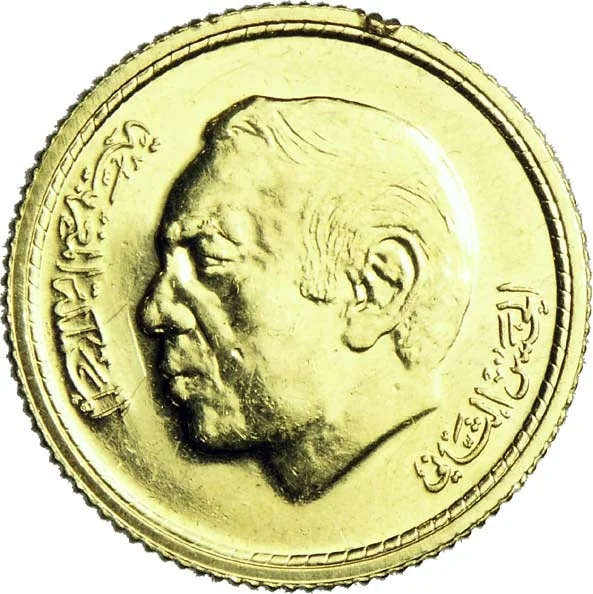
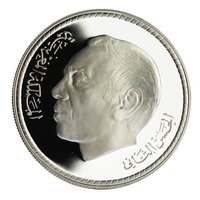
Obverse
Description:
King Hassan II, left-facing portrait.
Inscription:
الحسن الثاني
المملكة المغربية
المملكة المغربية
Translation:
Hassan II
Kingdom of Morocco
Kingdom of Morocco
Script: Arabic
Language: Arabic
Engraver: David Wynne
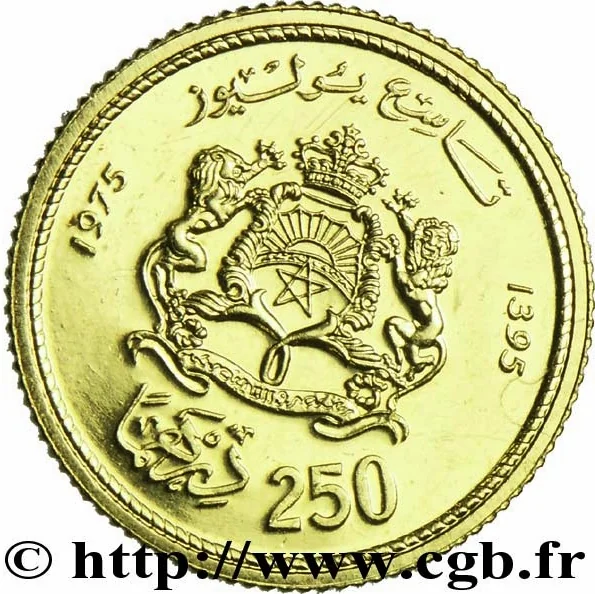
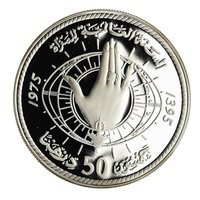
Reverse
Edge
Reeded
Mints
| Name | Mark |
|---|---|
| Royal Mint | — |
Mintings
| Year | Mint Mark | Mintage | Quality | Collection |
|---|---|---|---|---|
| 1975 | — | 5,000 | ||
| 1975 | — | 1,270 | Proof | |
| 1976 | — | 3,200 | ||
| 1976 | — | 450 | Proof | |
| 1977 | — | 3,000 | ||
| 1977 | — | 800 | Proof | |
| 1978 | — | 2,000 | ||
| 1978 | — | 150 | Proof |
Historical background
In 1975, Morocco's currency situation was intrinsically linked to the nation's geopolitical ambitions and economic structure. The Moroccan dirham, issued by Bank Al-Maghrib, operated under a fixed exchange rate regime, pegged to a basket of currencies heavily weighted by the French franc. This peg, a legacy of the French protectorate era, provided stability for trade and investment but limited monetary policy autonomy. The economy was primarily agrarian, with key exports like phosphates providing crucial foreign exchange reserves, though it remained vulnerable to commodity price swings and reliant on imports for manufactured goods and food.
This financial backdrop was critically strained by the events surrounding the Western Sahara. Following the Green March in November 1975 and the Madrid Accords, Morocco embarked on a costly annexation and ensuing conflict with the Polisario Front. The sudden expansion of territory and the immediate need to administer and secure the vast, sparsely populated region placed enormous new demands on the state treasury. Military expenditures skyrocketed, and significant public funds were redirected to subsidize settlements and infrastructure in the newly claimed southern provinces.
Consequently, while the official peg maintained a stable nominal exchange rate, underlying pressures mounted. The dual burden of military engagement and development costs began to stretch public finances, contributing to budget deficits and increasing national debt. These strains, though not causing an immediate currency crisis in 1975, sowed the seeds for future economic challenges. The dirham's rigidity would eventually be tested in the coming decades as the protracted conflict continued to divert resources from broader economic development, highlighting how political and military objectives directly shaped Morocco's monetary stability and fiscal health.
This financial backdrop was critically strained by the events surrounding the Western Sahara. Following the Green March in November 1975 and the Madrid Accords, Morocco embarked on a costly annexation and ensuing conflict with the Polisario Front. The sudden expansion of territory and the immediate need to administer and secure the vast, sparsely populated region placed enormous new demands on the state treasury. Military expenditures skyrocketed, and significant public funds were redirected to subsidize settlements and infrastructure in the newly claimed southern provinces.
Consequently, while the official peg maintained a stable nominal exchange rate, underlying pressures mounted. The dual burden of military engagement and development costs began to stretch public finances, contributing to budget deficits and increasing national debt. These strains, though not causing an immediate currency crisis in 1975, sowed the seeds for future economic challenges. The dirham's rigidity would eventually be tested in the coming decades as the protracted conflict continued to divert resources from broader economic development, highlighting how political and military objectives directly shaped Morocco's monetary stability and fiscal health.

💎 Extremely Rare