

Denmark
Context
Years: 1856–1863
Issuer: Denmark 
Ruler: Frederick VII
Currency:
(1854—1873)
Subdivision: 1 Skilling rigsmont = 1⁄16 Rigsdaler courant = 1⁄96 Rigsdaler
Demonetized: Yes
Material
References
KM: #Click to copy to clipboard763
Numista: #5210
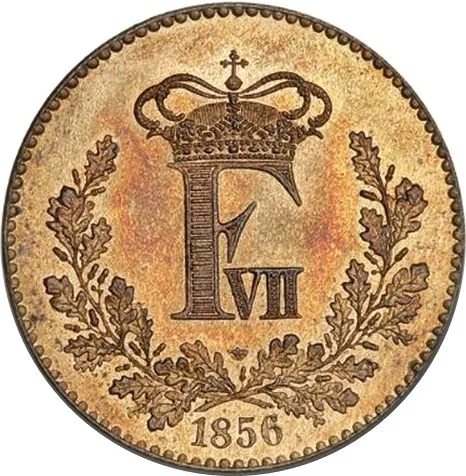
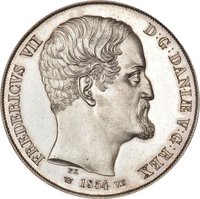
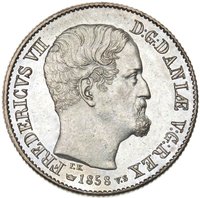
Obverse
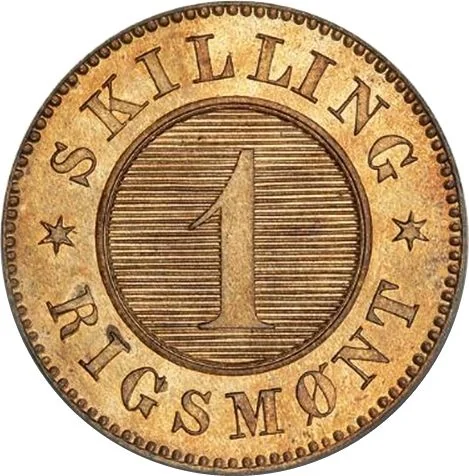
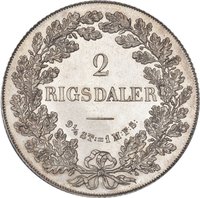
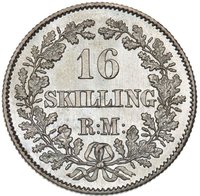
Reverse
Edge
Plain
Mints
| Name | Mark |
|---|---|
| Altona, Schleswig-Holstein | ♁ |
| Royal Danish Mint | ♔ |
Historical background
In 1856, Denmark operated under a silver standard, having formally adopted the rigsdaler as its sole currency in 1813 following state bankruptcy. This system, established by the Rigsbank and later managed by the National Bank (Nationalbanken, founded in 1818), tied the value of the Danish currency directly to a fixed quantity of silver. The monetary landscape was therefore one of relative stability in terms of intrinsic value, but it was also complex and somewhat archaic. The rigsdaler was divided into 96 skilling, a cumbersome system that reflected pre-decimal traditions and complicated everyday commerce and accounting.
However, this stability was under growing economic and international pressure. The mid-19th century was a period of rapid industrialization and expanding global trade, where the practical dominance of the British gold standard was becoming increasingly evident. Neighbouring powers, notably Germany and the Scandinavian Union (Sweden and Norway), were actively debating or moving towards gold-based currencies to facilitate smoother international exchange and investment. Denmark, as a trading nation, felt the strain of operating on a different standard than its most important economic partners, creating exchange rate uncertainties and potential competitive disadvantages.
Consequently, 1856 fell within a pivotal decade of monetary debate and transition for Denmark. While the formal shift to the gold standard would not occur until 1873 with the formation of the Scandinavian Monetary Union, the groundwork was being laid throughout the 1850s and 1860s. The discussions involved serious deliberations about decimalization to simplify the currency and the broader strategic move from silver to gold. Thus, the currency situation in 1856 was one of a settled but increasingly anachronistic system, on the cusp of major reform driven by the imperatives of regional integration and modern commerce.
However, this stability was under growing economic and international pressure. The mid-19th century was a period of rapid industrialization and expanding global trade, where the practical dominance of the British gold standard was becoming increasingly evident. Neighbouring powers, notably Germany and the Scandinavian Union (Sweden and Norway), were actively debating or moving towards gold-based currencies to facilitate smoother international exchange and investment. Denmark, as a trading nation, felt the strain of operating on a different standard than its most important economic partners, creating exchange rate uncertainties and potential competitive disadvantages.
Consequently, 1856 fell within a pivotal decade of monetary debate and transition for Denmark. While the formal shift to the gold standard would not occur until 1873 with the formation of the Scandinavian Monetary Union, the groundwork was being laid throughout the 1850s and 1860s. The discussions involved serious deliberations about decimalization to simplify the currency and the broader strategic move from silver to gold. Thus, the currency situation in 1856 was one of a settled but increasingly anachronistic system, on the cusp of major reform driven by the imperatives of regional integration and modern commerce.
🌱 Very Common