

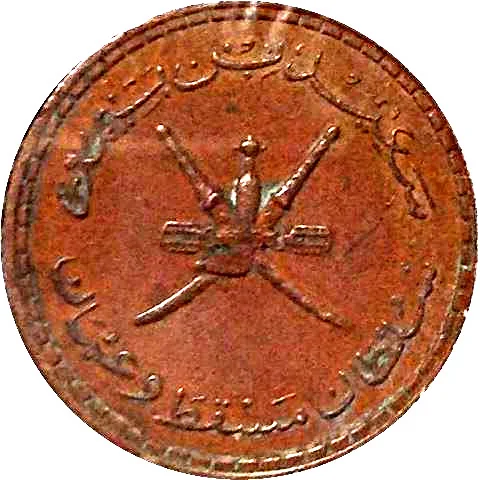
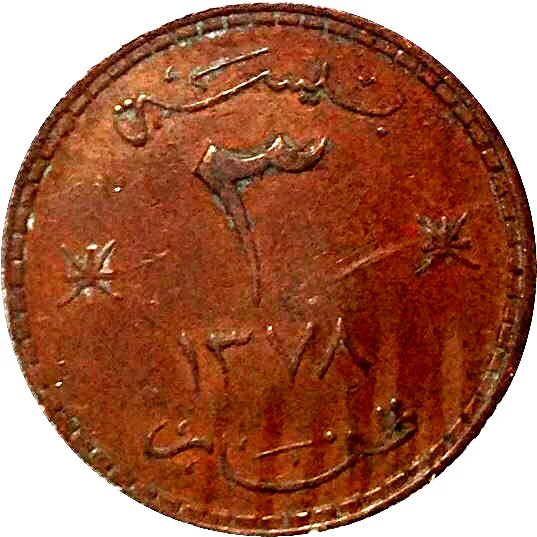
3 Baisa – Dhofar Governorate
Oman
Context
Year: 1959
Islamic (Hijri) Year: 1378
Country: Oman 
Issuer: Dhofar Governorate
Ruler: Said bin Taimur
Currency:
(1940—1970)
Demonetized: Yes
Total mintage: 8,000,000
Material
References
KM: #Click to copy to clipboard30
Numista: #51919
Obverse
Reverse
Edge
Plain
Categories
| Symbols> Coat of Arms |
| Object> Cold weapons |
Mints
| Name | Mark |
|---|---|
| Royal Mint (Tower Hill) | — |
Mintings
| Year | Mint Mark | Mintage | Quality | Collection |
|---|---|---|---|---|
| 1959 | — | 8,000,000 | ||
| 1959 | — | — | Proof |
Historical background
In 1959, the currency situation in Dhofar Governorate was complex and fragmented, reflecting the region's political and economic isolation from the Sultanate of Muscat and Oman. While the Indian Rupee, backed by the British government, served as the official currency in Muscat's coastal areas, its reach and authority in Dhofar was limited. The interior of Dhofar, particularly under the influence of the Jebel Qara tribes and the autonomous leadership of Sheikh Musallam bin Nufl, operated largely outside the Sultan's direct control, relying on a traditional, non-monetized barter economy and informal trade networks.
The primary medium of exchange for most Dhofaris was the Maria Theresa Thaler (MTT), a silver coin minted in Austria but widely circulated throughout Arabia and the Horn of Africa. Valued for its consistent silver content and durability, the Thaler was the dominant currency for any significant transactions, including the region's important trade in livestock and dried fish. Alongside the Thaler, the British sovereign and various Indian and Gulf rupees circulated in coastal towns like Salalah, but their use was sporadic and tied to external trade via the Arabian Sea.
This monetary fragmentation underscored Dhofar's distinct identity and its economic linkages to the wider Indian Ocean world rather than to Muscat. The Sultan, Said bin Taimur, exercised minimal administrative presence in the region, and there was no unified banking or currency system. The situation would begin to change only after the 1958 discovery of oil in the neighboring Fahud region, which prompted the Sultan to consolidate control. The subsequent military defeat of the Dhofar forces in the Jebel Akhdar War (1957-1959) paved the way for greater integration, setting the stage for the eventual introduction of the Gulf Rupee and, later, the Saidi Rial as instruments of central authority in the following decade.
The primary medium of exchange for most Dhofaris was the Maria Theresa Thaler (MTT), a silver coin minted in Austria but widely circulated throughout Arabia and the Horn of Africa. Valued for its consistent silver content and durability, the Thaler was the dominant currency for any significant transactions, including the region's important trade in livestock and dried fish. Alongside the Thaler, the British sovereign and various Indian and Gulf rupees circulated in coastal towns like Salalah, but their use was sporadic and tied to external trade via the Arabian Sea.
This monetary fragmentation underscored Dhofar's distinct identity and its economic linkages to the wider Indian Ocean world rather than to Muscat. The Sultan, Said bin Taimur, exercised minimal administrative presence in the region, and there was no unified banking or currency system. The situation would begin to change only after the 1958 discovery of oil in the neighboring Fahud region, which prompted the Sultan to consolidate control. The subsequent military defeat of the Dhofar forces in the Jebel Akhdar War (1957-1959) paved the way for greater integration, setting the stage for the eventual introduction of the Gulf Rupee and, later, the Saidi Rial as instruments of central authority in the following decade.
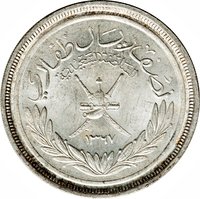
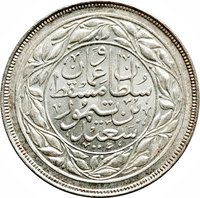
⭐ Somewhat Rare