



1 lats – Latvia
Add to wishlist
Non-circulating coins
Commemoration: The Times of the Land-Surveyors
Latvia
Context
Material
Diameter: 38.61 mm
Weight: 31.47 g
Silver Weight:: 29.11 g
Shape: Round
Composition: 92.5% Silver
Standard: Silver ounce
Magnetic: No
Technique: Milled
Alignment: Medal alignment

flip
References
KM: #
Numista: #51706
Value
Exchange value: 1 LVL
Bullion value: $73.07
Inflation-adjusted value: 1.61 LVL
Obverse
Description:
Kencis, holding a whip and a 5 lats banknote, is centered on the coin. The edge bears the inscriptions: 1 LATS, 2009, MERNIEKU LAIKI, 1879, and BRALI KAUDZITES.
Inscription:
BRĀĻI KAUDZĪTES 1 LATS
1879 MĒRNIEKU LAIKI 2009
1879 MĒRNIEKU LAIKI 2009
Translation:
BROTHERS KAUDZĪTES 1 LATS
1879 TIMES OF THE SURVEYORS 2009
1879 TIMES OF THE SURVEYORS 2009
Script: Latin
Language: Latvian
Engraver: Ligita Franckeviča
Designer: Laimonis Šēnbergs
Reverse
Description:
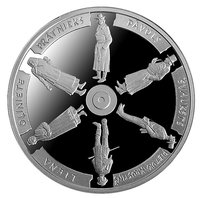
A central wheel hub is surrounded by characters from "Mernieku laiki" ("The Times of the Land-Surveyors"), with their names—PAVULS, SVAUKSTS, PIETUKA KRUSTINS, LIENA, OLINIETE, and PRATNIEKS—inscribed along the coin's edge.
Inscription:
PĀVULS ŠVAUKSTS PIETUKA KRUSTIŅŠ LIENA OĻINIETE PRĀTNIEKS
Translation:
Paul, Švauksts, Pietuka cross, Liena, Oļiniete, Prātnieks.
Script: Latin
Language: Latvian
Engraver: Ligita Franckeviča
Designer: Laimonis Šēnbergs
Edge
Legend:
LATVIJAS REPUBLIKA ◊ LATVIJAS BANKA ◊
Mints
| Name | Mark |
|---|---|
| Royal Dutch Mint | — |
Mintings
| Year | Mint Mark | Mintage | Quality | Collection |
|---|---|---|---|---|
| 2009 | — | 7,000 | Proof |
Historical background
In 2009, Latvia faced a severe currency crisis as a direct consequence of the global financial meltdown, which exposed the profound vulnerabilities of its overheated economy. During the preceding boom years, fueled by easy credit primarily from Scandinavian banks, Latvia had accumulated massive external imbalances and one of the highest current account deficits in Europe. When capital flows abruptly reversed in late 2008, the economy contracted violently, the banking system teetered on the brink, and the government was forced to seek an international bailout to avoid bankruptcy.
The core of the crisis centered on maintaining the Latvian lat’s fixed peg to the euro, a policy cornerstone since the currency's reintroduction in 1993. Devaluation was fiercely debated, as it could have provided immediate relief for exporters but would have crippled households and businesses with euro-denominated debts and risked triggering a regional banking crisis in Sweden and the Baltics. Ultimately, the Latvian government, under pressure from the European Commission and the International Monetary Fund (IMF), chose an "internal devaluation" strategy. This involved accepting a €7.5 billion rescue package in exchange for implementing brutal austerity measures—deep cuts to public sector wages and pensions, and radical reductions in government spending—to restore competitiveness and defend the peg.
The social and economic cost was staggering. Latvia experienced the deepest recession in the European Union in 2009, with GDP plummeting by over 17%. Unemployment soared, and significant emigration ensued. However, the strategy succeeded in its primary goal: the lat's peg to the euro held firm. This painful period of internal devaluation paved the way for Latvia's eventual adoption of the euro in 2014, which was seen as the final consolidation of the currency stability that had been preserved at such a high cost during the crisis.
The core of the crisis centered on maintaining the Latvian lat’s fixed peg to the euro, a policy cornerstone since the currency's reintroduction in 1993. Devaluation was fiercely debated, as it could have provided immediate relief for exporters but would have crippled households and businesses with euro-denominated debts and risked triggering a regional banking crisis in Sweden and the Baltics. Ultimately, the Latvian government, under pressure from the European Commission and the International Monetary Fund (IMF), chose an "internal devaluation" strategy. This involved accepting a €7.5 billion rescue package in exchange for implementing brutal austerity measures—deep cuts to public sector wages and pensions, and radical reductions in government spending—to restore competitiveness and defend the peg.
The social and economic cost was staggering. Latvia experienced the deepest recession in the European Union in 2009, with GDP plummeting by over 17%. Unemployment soared, and significant emigration ensued. However, the strategy succeeded in its primary goal: the lat's peg to the euro held firm. This painful period of internal devaluation paved the way for Latvia's eventual adoption of the euro in 2014, which was seen as the final consolidation of the currency stability that had been preserved at such a high cost during the crisis.
💎 Extremely Rare